
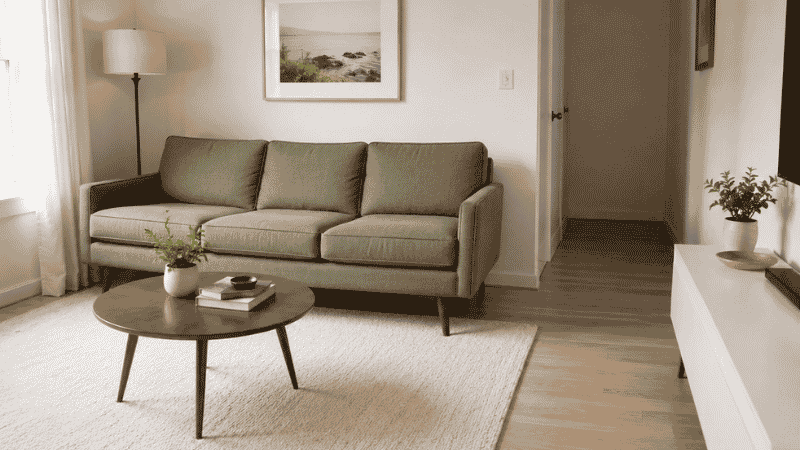
It happened to someone you know — maybe it happened to you. They found the perfect sofa. Right color, right style, right price. They ordered it without measuring. Three weeks later, delivery day arrived and the sofa made it exactly as far as the front door before it became clear that it was never going in. The sofa went back. The living room stayed empty. And now they’re sitting on the floor eating cereal, having learned an expensive lesson about apartment living.
Choosing a sofa for a small living room is not primarily a style decision. It’s a math problem with aesthetic constraints. The right sofa is the one that fits — through your doorway, into your elevator, into your room — while still leaving you enough clearance to actually use the space around it. The style comes after the dimensions pass.
This guide solves the math first. We’re going to walk you through exactly how to size a sofa for a small living room, which configurations work in which room shapes, what to look for in the specific features that matter for small spaces, and how to avoid the three most common expensive mistakes. By the end, you’ll know the maximum dimensions for your room before you look at a single product page.
Key Takeaways
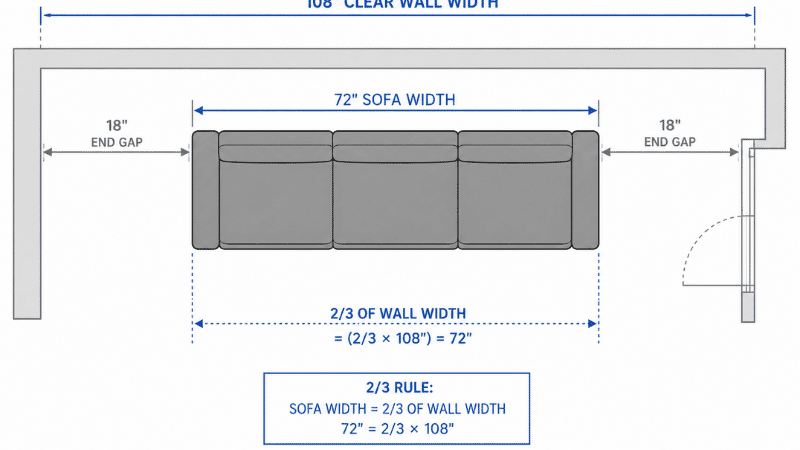
- The 2/3 rule: Your sofa should span no more than two-thirds of the wall it sits against — in most small living rooms, that caps sofa length at 72–84 inches
- Seat depth matters as much as length: A sofa 36+ inches deep in a room under 12 feet wide consumes disproportionate floor space; 32–34 inches deep is the sweet spot for small living rooms
- Legs change everything: A sofa on 4–6-inch exposed legs reads as visually lighter and makes the room feel 15–20% more open than an identical skirted-base sofa
- Measure your doorway first, your room second: Standard interior apartment doors are 32–36 inches wide; many sofas ship at 38+ inches in their largest dimension — check before ordering
- A narrow sofa (under 30 inches deep) is not a compromise: In rooms under 10 feet wide, a 28–30-inch-deep narrow sofa functions better than a standard-depth sofa and leaves a genuine walkway
Step One: Measure Before You Browse
This is the step most people skip, and it’s why most sofa returns happen. Measure these four numbers before opening a single product page. Write them down.
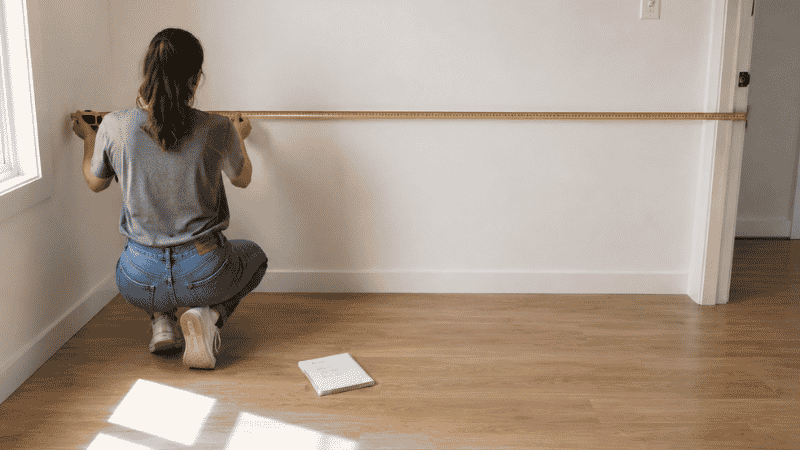
Your room’s longest clear wall: Measure from corner to the first interruption — door frame, window edge, radiator, outlet panel. Multiply by 0.67. That’s your sofa’s maximum length. If your longest clear wall is 108 inches (9 feet), your sofa caps at 72 inches.
Your room’s narrowest walkable width: The path from your entry to the kitchen, bathroom, or bedroom. You need at least 30 inches of clear path in front of the sofa — 36 inches is comfortable. Subtract 30 from your room width and you have your maximum sofa depth. A 10-foot-wide room (120 inches) minus 30 inches of walkway minus the sofa against the opposite wall gives you roughly 90 inches to work with — but the sofa itself needs 32–36 inches of that.
Your front door width: Measure at the narrowest point including the door frame — this is usually 30–32 inches in older apartment buildings, 32–36 inches in newer construction. Your sofa’s tallest dimension (usually the back height) must pass through this opening. Most delivery teams can tilt a sofa to get it through a tight door, but there are limits — anything over 36 inches in its narrowest dimension may not make it without disassembly.
Elevator or stairwell dimensions: If you’re above the ground floor, measure your elevator interior (width, depth, height) or your stairwell landing clearance. A sofa that fits through your door may not navigate the elevator or a tight stairwell turn.
Keep these four numbers open while you shop. They’re the filter every sofa passes through before you consider style.
What Size Sofa for a Small Living Room?
Once you have your room measurements, here’s how to translate them into sofa specifications.
Standard 3-Seat Sofa (72–90 inches)
The most common configuration. In a small living room, stay at the lower end: 72–82 inches is the range that works in rooms under 14 feet wide. Beyond 84 inches, a sofa starts to consume the visual width of most small living rooms even when it technically fits.
When this works: Your longest clear wall is at least 96 inches (8 feet), your room is at least 10 feet wide, and you regularly have three or more people using the seating.
When it doesn’t: Your room is under 10 feet wide, or your clear wall is under 96 inches, or you mostly watch TV alone and guests are infrequent. In these cases, a loveseat or narrow sofa may genuinely serve you better.
Loveseat (52–66 inches)
A loveseat is not a compromise in a small living room — it’s often the correct furniture decision. Two people fit comfortably; three fit tightly but workably. The shorter length frees significant wall space for other use, and the visual proportions feel more appropriate in a small room.
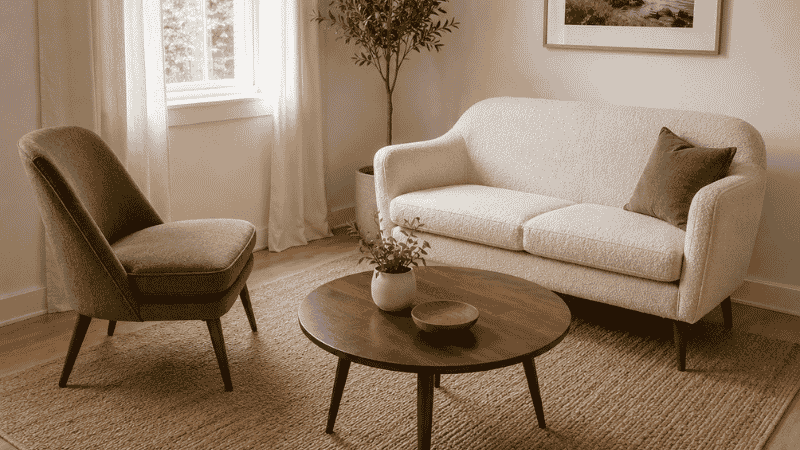
When a loveseat makes more sense than a 3-seat sofa: Your clear wall is under 90 inches, your room is under 10 feet wide, you live alone or with one other person and rarely host, or you want to pair the loveseat with one accent chair to create a more social seating configuration.
The loveseat pairing formula: Loveseat (60 inches) + accent chair (30 inches wide) + 18-inch gap between them = approximately 108 inches of wall use, creating a seating configuration that’s more conversational and flexible than a single 90-inch sofa.
Apartment Size Sofa (72–82 inches, shallow depth)
This is the specific subcategory most relevant to small living rooms — a sofa explicitly designed for apartment proportions. Typically 72–82 inches long and 30–34 inches deep (versus 35–40 inches for standard-depth sofas), with legs rather than a skirted base.
The depth reduction is what matters most. Moving from a 38-inch-deep sofa to a 32-inch-deep sofa reclaims 6 inches of floor depth — which in a 10-foot room (120 inches) represents 5% of the room’s total depth. That’s meaningful.
What to look for: Seat depth (the distance from the front edge of the cushion to the backrest) should be at least 20 inches for comfortable seating even on a shallow-depth sofa. A sofa that’s 30 inches deep total needs to have at least 20 inches of actual seat depth — check the spec sheet, not just the overall dimensions.
When a Narrow Sofa Is the Right Answer
The narrow sofa category — sofas with an overall depth of 28–32 inches — is underappreciated and frequently the best solution for rooms under 10 feet wide. The depth reduction compared to a standard sofa (38–42 inches) is significant: you recover 6–14 inches of floor space in the most critical dimension of the room.
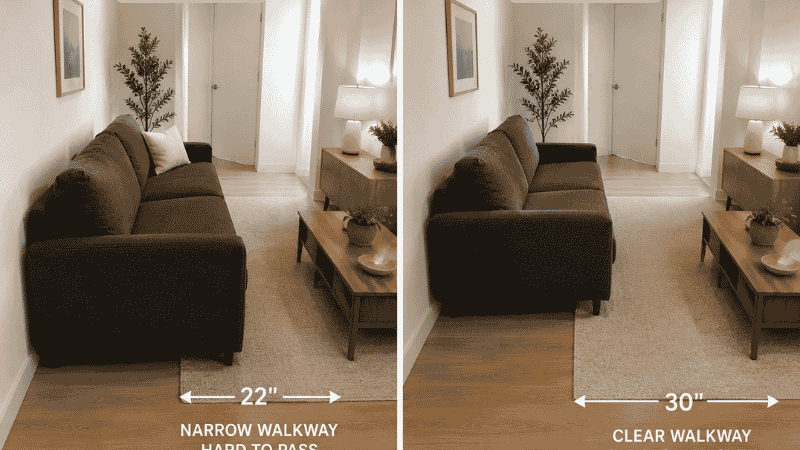
The reservation most people have: “Won’t it feel cramped to sit in?” The answer depends on the seat depth. A narrow sofa with a 28-inch total depth might have a 19-inch seat depth — tight but workable. A narrow sofa with a 32-inch total depth can have a 22-inch seat depth — comfortable for most adults.
Narrow sofa specs to look for:
- Total depth: 28–32 inches
- Seat depth (front edge to backrest): minimum 19 inches; 21 inches preferred
- Back height: 30–34 inches from the floor keeps sightlines open across the room
- Legs: required — skirted bases make narrow sofas look squat and heavy
Where narrow sofas work especially well: Against the wall in a room where both sides of the sofa need to be accessible (the narrow depth allows comfortable passage on either side); in studio apartments where the sofa defines the living zone without consuming half the floor space; in home office setups where the sofa faces the desk rather than the TV.
Sofa Configurations for Different Small Room Shapes
Room shape is the variable most sofa guides ignore. The right sofa for a square room is different from the right sofa for a long narrow room, even at the same square footage.
Square Rooms (10 × 10 to 12 × 12 feet)
The challenge in a square room is that there’s no obvious “long wall” to anchor the sofa. A standard 3-seat sofa against any wall leaves awkward equal space on all sides.
What works: A loveseat + accent chair configuration, angled toward each other at 15 degrees. This creates a conversation pocket that uses the square proportions to advantage rather than fighting them. A round or square coffee table (30–36 inch diameter) centered in the L between the loveseat and chair anchors the zone.
What doesn’t work: A large sectional or a long 3-seat sofa — these fill one wall completely and leave the rest of the square room feeling unused.
Long Narrow Rooms (9–10 feet wide, 14–18 feet long)
The challenge here is the “bowling alley” effect — furniture placed end-to-end along the length creates a runway rather than a room.
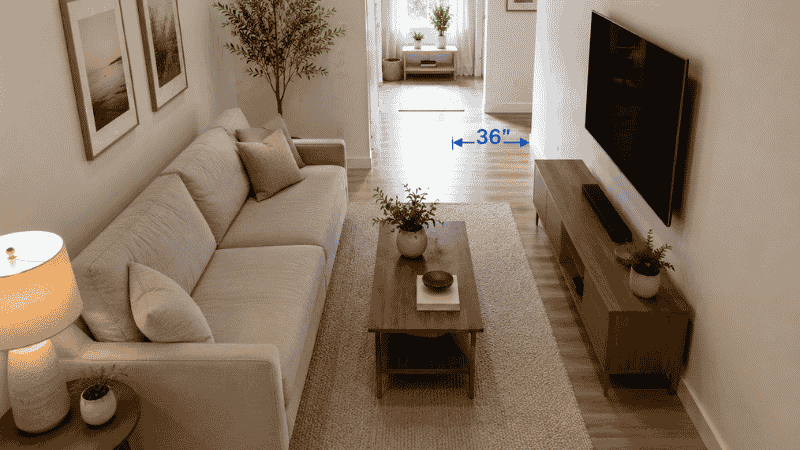
What works: Mount the TV on the long wall (not the short end wall) and place the sofa facing it, perpendicular to the room’s length. This shortens the visual axis. A sofa 72–82 inches long sits along the long wall, the coffee table sits 18 inches in front, and the remaining length becomes a separate zone (dining, desk, or open floor).
What doesn’t work: A sectional in any configuration — the L-shape that would work in a wider room just blocks the only walkway in a narrow room.
Open-Plan Rooms (Studio or combined living/dining)
The sofa in an open-plan small apartment is doing two jobs: providing seating and defining the living zone. Its back, not its front, is the zone boundary.
What works: A sofa positioned with its back facing the dining or sleeping zone, 4–6 inches away from the wall. The sofa back at 30–34 inches height creates a visual division between zones without blocking sightlines from standing height. The back of the sofa can be used as a shelf ledge (with a slim console table behind it, 10–12 inches deep) to create a surface zone between the living and dining areas.
For full zone-definition strategies and rug sizing for open-plan apartments, see our studio apartment layout guide.
The Features That Actually Matter for a Small Living Room Sofa
Once you’ve determined the correct size and configuration, these features separate a sofa that works in a small space from one that merely fits.
Leg Height and Style
A sofa on exposed legs (4–6 inches of clearance between the floor and the frame) shows floor beneath it. This visible floor space makes the room read as larger. The difference between a skirted-base sofa and the same sofa on 5-inch legs is significant — not just aesthetically, but functionally: you can clean under it, see through it from across the room, and the space feels less blocked.
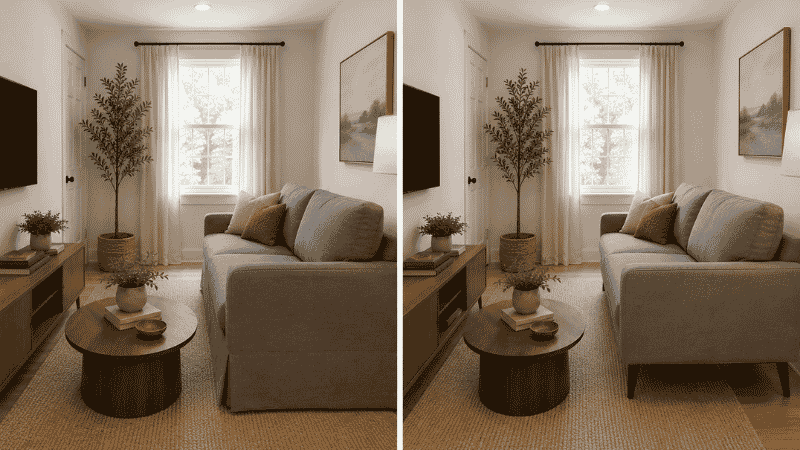
What to look for: Metal or wood tapered legs (mid-century aesthetic), square wood block legs (contemporary), or tubular metal legs (Scandinavian). All of these keep the visual profile light. Avoid solid panel bases that sit flush to the floor — they make even a small sofa look monolithic.
Tight vs. Loose Back Cushions
A tight-back sofa (cushions sewn into or attached to the back frame) has a cleaner profile and smaller visual footprint than a loose-cushion-back sofa. When you’re trying to minimize the visual mass of the sofa in a small room, the tighter the back, the better. Loose cushions that pile up against the back add 3–6 inches of perceived depth without adding any actual comfort.
Arm Profile
High-scroll arms or wide padded arms consume horizontal space at the sofa’s ends without adding seating capacity. Track arms (perpendicular to the seat, flat-faced, minimum padding) and tapered arms (angled inward slightly) are the most space-efficient arm styles for small living rooms. The difference between a high-scroll arm and a track arm can be 4–8 inches of total sofa length at the same seating capacity.
Fabric and Color for Small Living Rooms
Lighter, mid-tone fabrics consistently make small rooms feel more open. This isn’t about matching walls — it’s about visual weight. A charcoal or dark navy sofa in a small room reads as a large visual mass; the same sofa in sage green, warm beige, or dusty blue recedes visually.
Performance fabric: In a small apartment where the sofa gets daily use, performance fabric (Crypton, Sunbrella, or proprietary blends) resists stains and maintains appearance longer than standard woven fabric. The investment is worth it for a sofa you’ll use as your primary seating for 6+ years.
Sofa Delivery: The Step Everyone Forgets Until It’s Too Late
This is where small apartment sofa purchases go wrong at the last mile. The sofa you ordered fits your room. It doesn’t fit through the building.
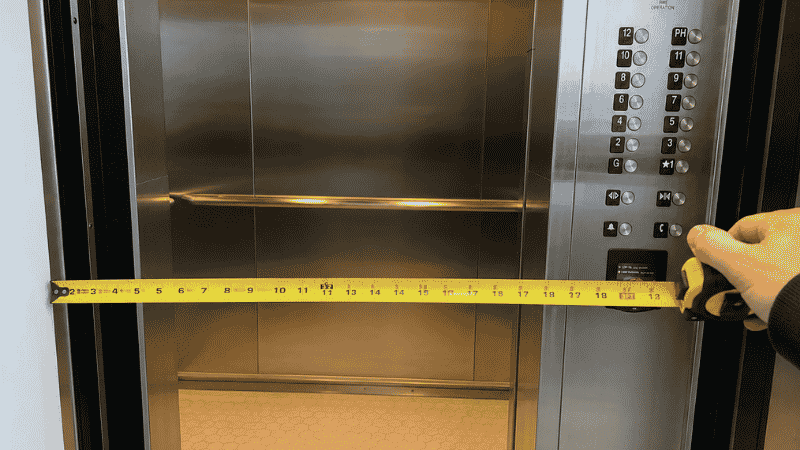
Before you order, measure and record:
- Front door width (at the narrowest point including frame): most apartment doors are 32–34 inches
- Elevator interior dimensions (width × depth × height): standard residential elevators are 36 × 48 × 84 inches — many sofas won’t enter vertically and can’t be tilted in a small elevator
- Any hallway corners or tight turns between the building entrance and your front door
- Stairwell landing dimensions if you’re taking the stairs
The sofa dimension to check: Most brands list dimensions as Width × Depth × Height. The dimension that limits entry is usually the sofa’s width (for doorways) or height (for elevators and stairwells). A sofa that’s 84 inches wide and 34 inches tall fits through a 36-inch door when tilted — but a sofa that’s 84 inches wide and 38 inches tall may not.
Modular sofas as the small-apartment solution: A modular sofa ships in sections, each of which fits through a standard doorway independently. Once inside, sections connect to form the complete sofa. This eliminates the delivery problem entirely. The trade-off is slightly higher price and more assembly time, but for apartments with tight access, it’s often the only option that works.
The Three Most Common Sofa Mistakes in Small Living Rooms
Mistake 1: Buying too much sofa because it was on sale
A sectional or oversized sofa at 40% off is still the wrong sofa if it consumes your walkway. Price shouldn’t override the dimension filter. The most expensive mistake isn’t overpaying for a sofa — it’s buying a sofa that makes your room unlivable and then paying to return it or living with the consequence for five years.
Mistake 2: Pushing the sofa against the wall
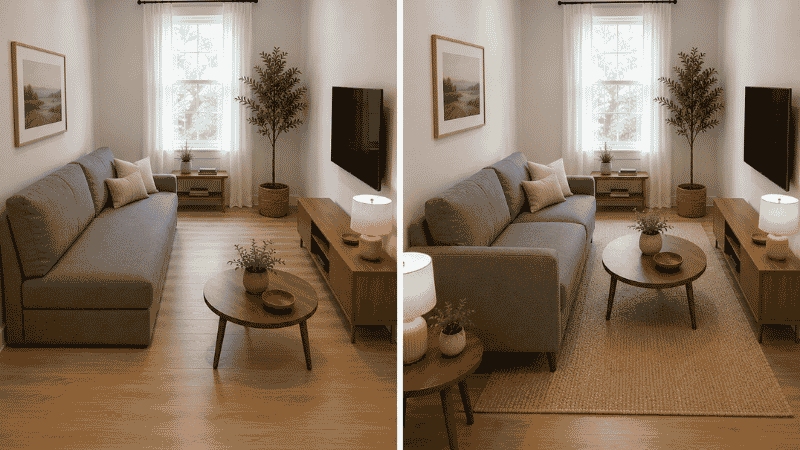
The instinct is to maximize center floor space by pushing all furniture to the perimeter. In a small room this creates a “waiting room” effect — a ring of furniture around an empty center that nobody naturally occupies. Pulling the sofa 4–6 inches from the wall and placing the coffee table in the actual center of the seating zone makes the room feel intentional rather than defensive.
Mistake 3: Choosing style over seat depth
A sofa that photographs beautifully but has a 17-inch seat depth will be uncomfortable for anyone over 5’4″. You’ll stop sitting on it within a month, it becomes a staging area for laundry, and the sofa has failed its primary function. Minimum comfortable seat depth for most adults: 19 inches. Preferred: 21–23 inches.
If You Only Have 10 Minutes: The Quick Sofa Filter
Before browsing, run every sofa through this checklist:
- Length ≤ 2/3 of your clear wall: If your longest clear wall is 108 inches, max sofa length is 72 inches. Non-negotiable.
- Depth ≤ your room width minus 46 inches: In a 10-foot (120-inch) room: 120 − 46 = 74 inches maximum depth (but this is generous — 32–34 inches is ideal).
- Smallest dimension fits through your door: The sofa’s back height or arm height must pass through your narrowest doorway.
- Seat depth ≥ 19 inches: Check the spec sheet, not just the overall depth.
- Legs visible: If the sofa sits flush to the floor, it’s visually heavier than it needs to be in a small room.
If a sofa passes all five filters, it’s worth considering for style. If it fails any one of them, move on.
FAQ: Sofa for Small Living Room
What size sofa is best for a small living room? For rooms under 12 feet wide: a sofa 72–82 inches long and 32–34 inches deep. For rooms under 10 feet wide: a loveseat (52–66 inches) or narrow sofa (28–32 inches deep) at any comfortable length. The 2/3 rule applies in any room size — the sofa should span no more than two-thirds of the wall it sits against.
Can you put a sectional in a small living room? Yes, in the right room shape. A square room (11 × 11 or larger) can accommodate an apartment-size sectional with a short arm under 58 inches. A narrow room (under 10 feet wide) almost never works with a sectional — the L-shape blocks the only functional walkway. Measure both the room and the sofa’s deployed footprint before buying.
Should a sofa touch the wall in a small living room? Ideally no. Pulling the sofa 4–6 inches from the wall creates visual depth and makes the room feel more intentional. Wall-to-wall placement creates a “waiting room” effect. The exception: in rooms under 9 feet wide, every inch matters and wall placement may be necessary to preserve walkway clearance.
What color sofa makes a small living room look bigger? Light to mid-tone neutrals: warm beige, off-white, sage green, dusty blue, light gray. These read as lower visual weight than dark or saturated colors. The effect is real but modest — color choice can make a room feel 10–15% more open, but it doesn’t substitute for correct furniture sizing.
Is a loveseat better than a sofa for a small apartment? Often yes. A loveseat in a small apartment with the right pairing (one accent chair at 15 degrees) creates a more functional and social seating configuration than a cramped 3-seat sofa. The shorter length also frees wall space for shelving, a media console, or simply breathing room.
What is a narrow sofa and when do I need one? A narrow sofa has a total depth of 28–32 inches versus 35–42 inches for a standard sofa. They’re designed for rooms under 10 feet wide where a standard sofa’s depth would leave an inadequate walkway. The seat depth on a quality narrow sofa (19–22 inches) is still comfortable; the depth reduction comes from thinner arm profiles and a tighter back cushion.
How do I know if a sofa will fit through my apartment door? Measure your door’s clear opening width (not the door width — the clear space between the door frame faces). Standard apartment interior doors: 32–34 inches clear. Most sofas can be tilted vertically to pass through if the sofa’s back height (usually 34–38 inches) fits through the clear opening. Call the manufacturer or delivery team before ordering if your clear opening is under 32 inches.
The Bottom Line
The right sofa for a small living room isn’t the one that looks best on the product page — it’s the one that passes the four pre-shopping measurements, fits your specific room shape, and still leaves you with a functional walkway and a seating area that gets used every day.
Get the numbers first. Then browse. The style choices inside those numbers are still significant, and you’ll make better decisions when you’re not also trying to figure out whether something physically fits.
Once you’ve chosen the sofa, the placement makes as much difference as the piece itself. Our small living room layout guide covers six arrangement formulas with exact walkway measurements. And for the full picture of how a sofa fits with every other piece in the room, our furniture ideas for small living rooms guide has sizing formulas for coffee tables, consoles, and rugs.
References
- American Society of Interior Designers (ASID): Residential space planning guidelines — minimum 30-inch walkway clearance standards for residential living room layouts
- Furniture Industry Research Association (FIRA): Ergonomic seating guidelines for residential sofas — recommended seat depth (19–23 inches) for comfortable long-term seating for adults of average height
- National Association of Home Builders (NAHB): Standard residential door opening dimensions for accessibility and furniture delivery planning
Published on Grainv.com | Category: Living Room | Related: Small Living Room Layout, Furniture Ideas for Small Living Rooms, Living Room Storage Ideas, Studio Apartment Layout Ideas