
Let’s be honest: your kitchen table was never meant to be your headquarters. If you’ve spent the last week nursing a stiff neck or a sore lower back, the culprit isn’t your workload—it’s your desk home office desks. In 2026, the modern professional understands that a workspace is more than just a place to put a laptop; it’s a high-performance environment designed for “Deep Work.”
Whether you’re carving out a “Clozset” (the genius closet-to-office hack) or setting up a dedicated executive suite, finding the perfect home office desk is the foundation of your professional sanctuary. Let’s dive into the layouts and specs that will transform your “work-from-home” into “thrive-from-home.”
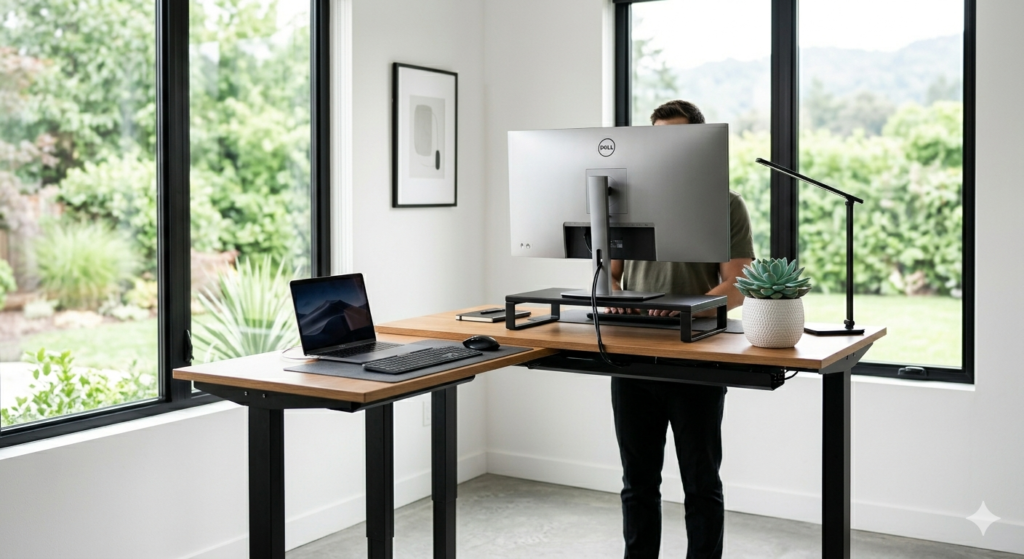
1. Strategic Layouts: Home Office Desks for Every Space
At GrainV, we’ve analyzed hundreds of small-home floor plans. The data is clear: the best desk home office desks aren’t always the biggest ones—they are the ones that optimize your “Reach Zones.”
The L-Shape Command Center
If you’re working with a tight bedroom corner, an L-shaped home office desk is your best friend. By utilizing the 90-degree angle, you increase your usable surface area by nearly 40% without eating up the middle of the room.
- The Benefit: This keeps your “Primary Reach Zone” (keyboard/mouse) and “Secondary Zone” (coffee/notebooks) within a 10-inch radius of your neutral arm position.
The “Clozset” Revolution: A Real-World Case Study
- The Subject: Mark, a software developer in a 550-sq-ft apartment.
- The Solution: He removed his 4-foot wide hallway closet doors and installed a 48″ x 24″ precision steel desk.
- The Result: Total cost was under $600, and he reclaimed 15 sq-ft of living room floor space. By physically “closing the curtain” on his home office desk at 6:00 PM, Mark reported a 28% decrease in work-related anxiety after just two weeks.
2. Ergonomic Standards: Why Stability is Everything
A desk that wobbles during a Zoom call isn’t just annoying—it’s a sign of poor structural integrity that can lead to repetitive strain.
The “Stability Test”
When shopping for desk home office desks, try the “Typing Resonance Test.” Raise the desk to your standing height (usually around 42 inches). If a glass of water on the surface ripples significantly while you type, the frame lacks the necessary cold-rolled steel thickness.
- The Spec: Look for 3mm thick steel legs. Most budget desks use 1.5mm, which results in a “jelly-like” sway that forces your wrists to constantly micro-adjust, leading to carpal tunnel symptoms over time.
3. Precision Height Alignment: Matching You to Your Desk
One size definitely does not fit all. According to 2025 ergonomic research, even a 0.5-inch mismatch between your height and your desk can increase upper trapezius tension by 15%.
2026 Ergonomic Height Cheat Sheet
| Your Height | Ideal Sitting Height | Ideal Standing Height |
| 5’4″ (162cm) | 24.5 inches | 38.5 inches |
| 5’10” (178cm) | 27.0 inches | 42.0 inches |
| 6’2″ (188cm) | 28.5 inches | 44.5 inches |
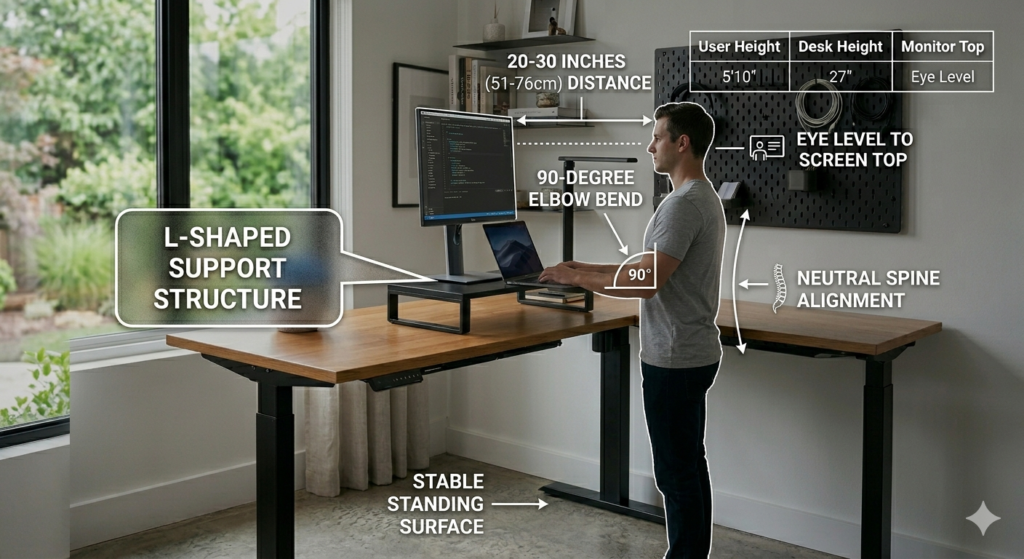
4. Pro Tips for Optimizing Your Workspace
- Verticality is Free Real Estate: In a small office, the desk surface is precious. Use pegboards above your home office desk to move your hard drives and stationery off the table. A clear desk leads to a 30% improvement in task focus.
- The Window Perpendicular Rule: Position your desk perpendicular to the window. This provides natural light (boosting serotonin) without the back-glare that causes eye strain.
- Smart Cable Management: Visual clutter is a cognitive drain. Choose a home office desk with built-in cable trays. If your floor is clear of “wire nests,” the room feels twice as big.
5. FAQ: Finding Your Perfect Match
What’s the best standing desk for a home office? In 2026, the gold standard is a dual-motor system with a “Precision-Roll” steel frame. Look for models that operate at under 45 decibels (whisper quiet) and include a collision-avoidance sensor. This ensures you can transition heights during a meeting without disturbing your flow or damaging your chair.
Is a wood or laminate top better? Laminate is more durable for high-intensity use, but solid wood (like bamboo or oak) offers “Acoustic Warmth”—it absorbs the sound of your keyboard better, making for a quieter work environment.
How deep should a home office desk be? Aim for 24 to 30 inches. Anything deeper than 30 inches often becomes a “junk zone” for clutter you can’t reach, while anything shallower than 22 inches puts your monitor too close to your eyes, increasing blue light fatigue.
6. Conclusion: A Gentle Suggestion for Your Sanctuary
Choosing among the various desk home office desks on the market isn’t just about furniture—it’s about designing the life you want to lead. By prioritizing ergonomics, stability, and the “Clozset” mentality, you are building a workspace that respects your body and fuels your ambition.
My warm advice? Start with a desk that feels solid. A “Precision Steel” frame is an investment that pays for itself in focus and back health. Once your foundation is set, everything else—the lighting, the plants, the high-output vibes—will fall into place.
Stay productive, stay healthy!
Ready to find your flow? [Check out our 7 Tested Small Office Layouts] or [Browse the 2026 Standing Desk Collection].