
Let’s be honest: most “home offices” are just a laptop perched on a kitchen island or a desk shoved haphazardly into a dark corner. If you’ve been feeling sluggish by 2:00 PM or battling persistent tension in your shoulders, the problem likely isn’t your motivation—it’s your home office layout.
In 2026, we’ve moved past the era of simply “working from home.” We are now in the era of the High-Performance Sanctuary. Whether you have a sprawling spare bedroom or a tiny 50-square-foot nook, the right home office layout is the invisible engine of your productivity. Let’s look at how to build a space that honors your biology and supercharges your output.
1. The Science of Sight: Home Office Layout with Window Strategies
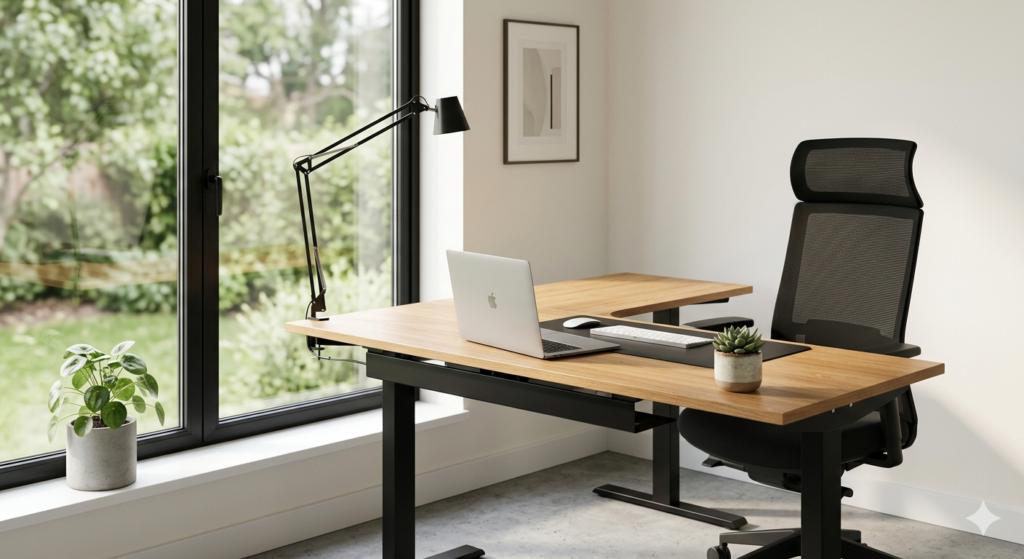
One of the most common questions I get as a wellness designer is: How should I arrange my home office layout with window? Lighting is the #1 external factor in managing eye strain and maintaining your circadian rhythm.
The Perpendicular Rule
Never place your desk directly facing a window (which causes squinting) or with your back to it (which creates screen glare). The “Golden Rule” is to place your desk perpendicular to the window.
- The Data: A 2025 study showed that workers with natural side-lighting reported a 15% reduction in headaches and a 10% increase in afternoon alertness.
- The “15-Minute Rule”: Position your chair so you can easily glance at the sky. Getting 15 minutes of indirect morning sunlight helps reset your internal clock, improving your sleep quality by up to 20% that night.
2. Maximizing Your Footprint: Layout Ideas for Small Spaces
At GrainV, we’ve found that even a 50-square-foot nook can outperform a 200-square-foot executive room if the “flow” is optimized.
The “Clozset” Hack: A Case Study
- The Subject: Sarah, a data analyst in a 650-sq-ft apartment.
- The Problem: Working from her couch led to “work-life blur” and constant lower back pain.
- The Solution: She converted a 5-foot hallway closet into a “Clozset.” She installed a 24-inch deep floating desk and vertical pegboards.
- The Result: Total cost was under $500. Sarah reclaimed her living room, and by physically “closing the closet” at 6:00 PM, she reduced her work-related stress levels by 30% in the first month.
The Primary Reach Zone
Your layout should be built around your arms, not just the walls. Your keyboard and mouse should live in the “Primary Reach Zone” (a 10–15 inch radius). If you have to lean forward to grab your coffee or a notebook, your layout is failing your spine. Keep your “Secondary Items” (printers, reference books) on a shelf above.
3. The 90-Degree Standard: Precision Layout Data
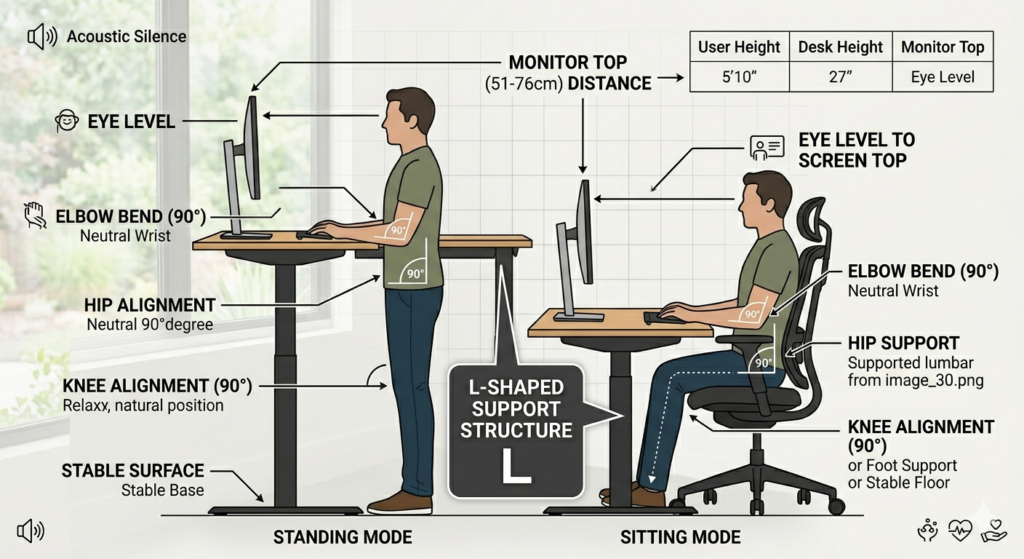
A beautiful home office layout is useless if it hurts to sit in. In 2026, we prioritize the “90-Degree Rule” to ensure maximum blood flow and nerve health.
Ergonomic Alignment Chart
| Layout Element | Ideal Position | Health Benefit |
| Monitor Top | 0° to 15° below eye level | Prevents “Tech Neck” & eye fatigue |
| Desk Surface | Elbow level (arms at 90°) | Reduces carpal tunnel risk |
| Chair Depth | 2-3 inches behind the knees | Maintains healthy circulation |
| Lighting Source | Perpendicular to line of sight | Reduces migraine-inducing glare |
4. Pro Tips for a Clutter-Free Mind
- Embrace Verticality: If your floor space is limited, you must go vertical. Use floating shelves to move your hard drives and stationery off the desk. A clear desk surface allows your brain to enter Flow State significantly faster.
- Cable Management is Self-Care: Exposed wires are visual “noise” that distracts the subconscious. Use under-desk “Smart Rails” to hide power strips. A clear floor makes a small office feel twice as large.
- The “Goldilocks” Temperature: Aim for a room temperature of 68–72°F (20–22°C). Studies show this is the optimal range for cognitive performance and focus.
5. Frequently Asked Questions (FAQ)
What is the best home office layout with window? The “Golden Rule” is positioning your desk perpendicular to the window. This allows natural side-lighting to fill the room while preventing harsh glare on your screen. If the sun is too intense in the afternoon, use light-filtering cellular shades to soften the glow.
Should I face the door or the wall? Psychologically, the “Command Position” is best—facing the door but not directly in line with it. If you must face a wall, hang a mirror or artwork with “visual depth” (like a landscape) to prevent the feeling of being boxed in.
How do I separate work and life in a studio apartment? Use a physical anchor. This could be a specific rug that only the desk sits on, or a “Clozset” setup. When you step off that rug or close those doors, the workday is biologically over.
6. Conclusion: A Gentle Suggestion for Your Sanctuary
Designing your home office layout is an act of self-respect. You are telling yourself that your work, your health, and your focus are worth the effort of a well-planned sanctuary. Whether you are building a “Clozset” or a sun-drenched executive suite, start with the fundamentals: the 90-degree rule and natural side-lighting.
My warm advice? Don’t try to build the “perfect” office in one day. Start with the Foundation Duo—a high-quality ergonomic chair and a stable desk. Once your body is supported, the rest of the layout will naturally evolve around your needs.
Stay focused, stay healthy!
Ready to find your flow? [Check out our Top 7 Small Office Layouts] or [Browse the 2026 Precision Desk Collection].