
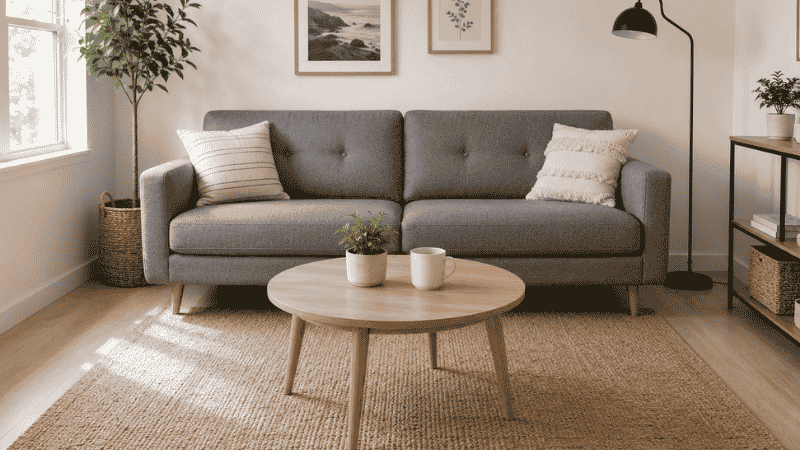
The coffee table is the piece most people size by feel. The sofa looks good, the rug looks right, so they pick a coffee table that looks proportional in the store — and bring it home to discover it takes up most of the walkway, sits too close to the sofa, and makes the room feel like a furniture showroom rather than a living space.
In a small living room, a coffee table that’s 4 inches too long or 2 inches too high doesn’t just look wrong. It actively makes the room harder to use. You’re stepping around it every time you cross the room. You’re leaning forward uncomfortably to reach your drink. You’re constantly moving it out of the way when guests sit down.
The right coffee table for a small living room is a math decision before it’s an aesthetic decision. There are three numbers that determine whether a coffee table works in your specific room — the length relative to your sofa, the height relative to your sofa cushion, and the clearance between the table and everything around it. Once those numbers are right, the style and material choices within those constraints are genuinely flexible.
This guide covers those three numbers, the five coffee table types that consistently work in small living rooms, and what to skip entirely.
Key Takeaways
- The length rule: A coffee table should be 1/2 to 2/3 the length of your sofa — for an 80-inch sofa, a 40–53-inch coffee table is the correct range
- The height rule: Coffee table height should be within 1–2 inches of your sofa’s seat cushion height (typically 16–18 inches) — higher feels like a barrier; lower requires uncomfortable reaching
- The clearance rule: 18 inches between the sofa front and the coffee table edge is the minimum comfortable distance — 14 inches is workable, under 12 inches means you’ll be stepping over it
- Round coffee tables outperform rectangular in most small living rooms: No sharp corners means safer circulation, and the circular form seats the same number of people per square foot with a smaller visual footprint
- Glass and acrylic coffee tables read as visually absent: In rooms under 150 square feet, a transparent coffee table effectively “disappears” — the eye sees the floor beneath rather than the table itself, making the room feel significantly more open
The Three Numbers That Determine Whether a Coffee Table Works
Before looking at any product, establish these three measurements for your specific room. They’re non-negotiable — a table outside these ranges will create functional problems that no amount of styling can fix.
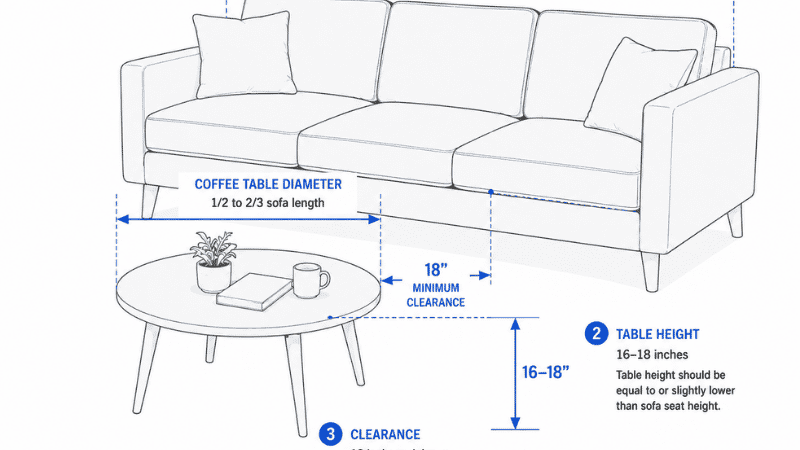
Number 1: Length (The Sofa Proportion Rule)
The formula: Coffee table length = 1/2 to 2/3 of sofa length
For common sofa sizes:
- 72-inch sofa → 36–48-inch coffee table
- 80-inch sofa → 40–53-inch coffee table
- 84-inch sofa → 42–56-inch coffee table
- 60-inch loveseat → 30–40-inch coffee table (or a round 28–32-inch diameter)
Why this works: A coffee table shorter than 1/2 the sofa looks like an afterthought — visually disconnected from the seating zone. A coffee table longer than 2/3 the sofa starts to visually compete with the sofa rather than anchoring it. At 1/2 to 2/3, the table reads as belonging to the sofa without dominating it.
For round tables: Use diameter as the equivalent of length. A 34-inch diameter round table anchors an 80-inch sofa well; a 28-inch diameter round table works with a 60-inch loveseat.
Number 2: Height (The Reach Comfort Rule)
The formula: Coffee table height = sofa seat cushion height, minus 0–2 inches
Standard sofa seat cushion height: 17–19 inches from the floor. Coffee table ideal height: 15–18 inches.
Why this matters: A coffee table at the same height as your sofa seat cushion is the most comfortable for setting drinks and reaching objects without leaning. A table 1–2 inches lower is also comfortable and reads as slightly more relaxed. A table 3+ inches lower requires leaning significantly and is uncomfortable during extended use. A table higher than the seat cushion creates a visual barrier and feels like a desk rather than a coffee table.
Check your sofa: Sit on your sofa and note where your knees naturally fall. The coffee table should be at or slightly below that knee height — this is the reach point that feels natural without leaning.
Number 3: Clearance (The Walkability Rule)
The formula: 18 inches of clear space between sofa front edge and coffee table edge
- 14–18 inches: Workable for a room where you rarely walk between sofa and table
- 18–24 inches: Comfortable for daily circulation, reaching objects, occasional sitting on the floor
- Under 14 inches: Problematic — you’ll step over or around the table consistently
The secondary clearance: The space between the coffee table and the opposite wall or furniture should be at least 24 inches — 30 inches is comfortable for circulation. Add your clearances: sofa depth + 18 inches + coffee table depth + 24 inches minimum clearance = total room depth needed for this configuration.
In a 10-foot-wide room (120 inches): 34-inch sofa + 18-inch gap + 20-inch table + 24-inch clearance = 96 inches. You have 24 inches left for the media console on the opposite wall, which works. A 30-inch-deep table in the same calculation = 106 inches used, leaving only 14 inches — not enough for a media console.
5 Types of Coffee Table That Work in Small Living Rooms
Type 1: Round Coffee Table (Best Overall for Small Rooms)
A round coffee table has no corners. This sounds minor until you’ve lived with the shin-corner interaction in a tight living room for a week. More practically, a round table allows circulation from any angle — you can walk around it from the left, right, or in front without corner-avoidance geometry.
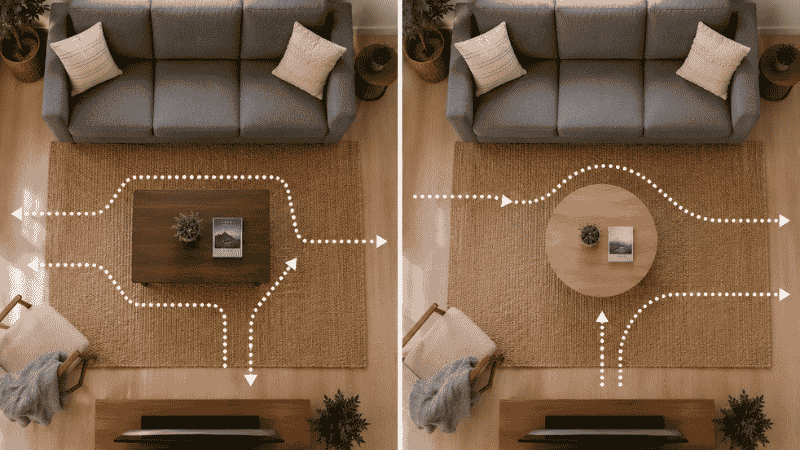
The visual lightness advantage: A round table reads as smaller than a rectangular table of equivalent surface area. A 36-inch round has approximately 1,018 square inches of surface; a 24 × 42-inch rectangle has 1,008 square inches — essentially the same area. But the round table reads as lighter and less dominant because the circular form doesn’t align with the rectangular geometry of the walls, sofa, and rug.
Pairing with sofas: Round tables work particularly well with sofas that have rounded arms or softer profiles. They can feel slightly disconnected from sofas with very sharp, linear track arms — a minor aesthetic issue that doesn’t affect function.
Sizing for round tables:
- Loveseat (52–60 inches): 24–28-inch round
- Compact sofa (72–78 inches): 28–34-inch round
- Standard sofa (80–84 inches): 34–40-inch round
Type 2: Lift-Top Coffee Table (Best for Dual-Function Use)
A lift-top coffee table has a hinged surface that raises to desk or dining height — typically 26–28 inches from the floor. When lowered, it functions as a standard coffee table at 16–18 inches. When raised, it provides a comfortable work surface for a laptop, a surface for eating dinner at the sofa, or a surface for any activity that requires a higher working height.
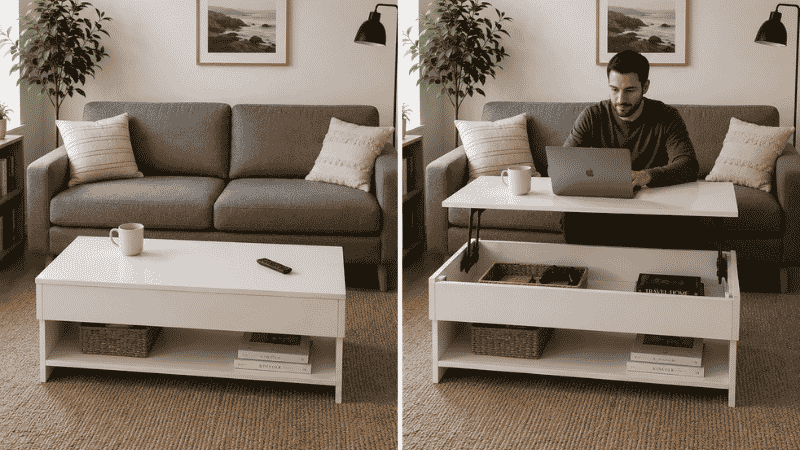
Who needs this: Anyone who regularly works from the sofa, eats at the coffee table, or plays board games — basically anyone using their small living room as an all-purpose living space rather than a dedicated entertainment area.
Sizing considerations: Lift-top tables are typically rectangular, ranging from 40–48 inches long. The mechanism adds 2–4 inches to the table’s overall height when closed, making them slightly taller than standard coffee tables (18–20 inches closed rather than 16–18). Check the closed height before purchasing — if your sofa seat is at 17 inches and the lift-top closes at 20 inches, it will feel slightly high in its resting position.
Storage bonus: Most lift-top coffee tables have storage inside the raised section — a compartment that becomes accessible when the top is raised. This stores items that would otherwise be on the table surface or in a side table drawer.
Type 3: Nesting Tables (Best for Maximum Flexibility)
Nesting tables — two or three tables that stack together as one unit — solve the small living room coffee table problem differently than any other type. At rest, they stack to the footprint of the largest table. When you need more surface (guests arrive, you’re eating, you’re working with multiple items), you pull the smaller tables out and position them wherever they’re needed.
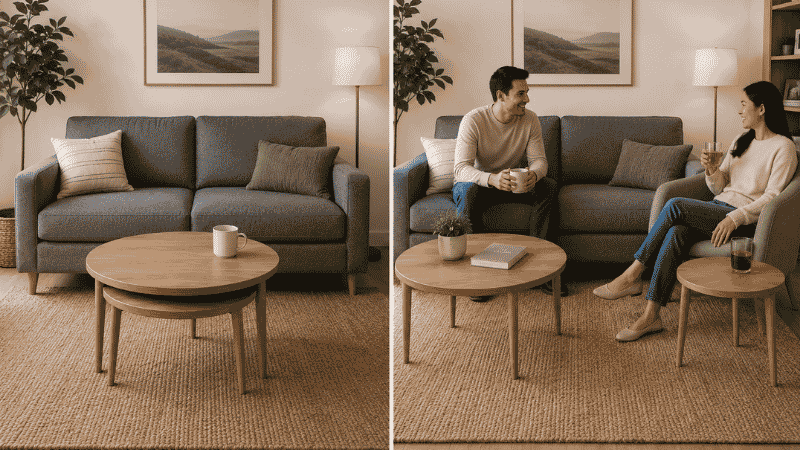
The flexibility advantage: A single coffee table is a fixed surface in a fixed location. Nesting tables are adaptable — the primary table holds drinks normally; the secondary table becomes a side table when a guest sits in an accent chair; the tertiary (if present) holds snacks during movie night. This configurability is worth more in a small room than the same square footage of fixed surface.
What to look for: The primary table should be the right size for your sofa per the formula above. The secondary table should nest fully beneath the primary with minimal visible gap. The height difference between nested tables should be at least 4 inches (so the smaller one can slide out without lifting).
Style considerations: Nesting tables read as more casual than a single solid coffee table. They work well in eclectic, mid-century, or casual contemporary rooms. They can feel mismatched in more formal or minimalist interiors where visual consistency is the priority.
Type 4: Glass or Acrylic Coffee Table (Best for Visually Small Rooms)
A transparent coffee table — glass top on metal legs, or solid acrylic/lucite construction — is the coffee table that most effectively “disappears” in a small living room. The eye reads the floor beneath rather than the table surface, making the room feel significantly more open than it is.
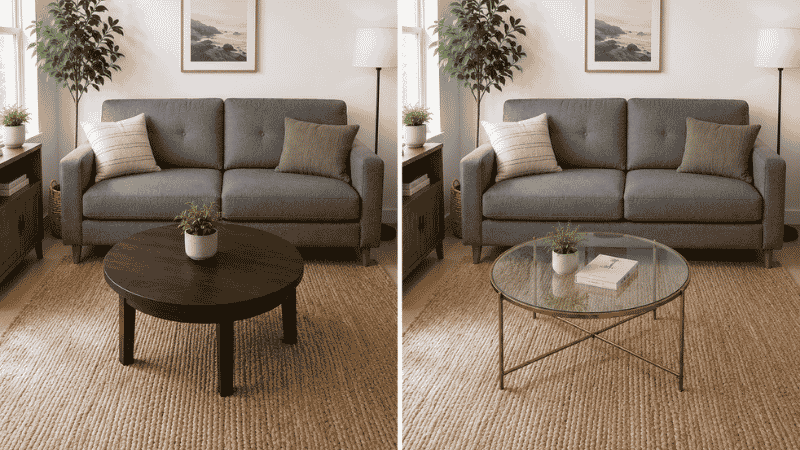
The visual science: Research on spatial perception shows that transparent objects within a field of vision are processed as lower visual mass than opaque objects of equivalent physical size. In practical terms, a 40-inch glass coffee table reads as taking up less visual space than a 32-inch solid wood coffee table, even though the glass table is physically larger.
Material options:
- Glass top with metal legs: Most common, most affordable. Look for tempered glass (not regular glass — tempered breaks into granules rather than shards if broken). Legs in black, gold, or chrome — each reads differently in the room.
- Solid acrylic/lucite: The most visually minimal option. The entire table is transparent. More expensive than glass-top options; can scratch over time but scratches are often buffable with plastic polish.
When not to choose glass: If you have young children or large pets, glass tops at coffee table height create safety considerations. Solid acrylic is slightly more forgiving. Households with heavy daily use (drinks, laptops, feet on the table) may find glass requires more cleaning maintenance than other materials.
Type 5: Ottoman Coffee Table (Best When Storage Is the Priority)
An upholstered ottoman as a coffee table has been covered fully in our ottoman coffee table guide. The short version: when storage and extra seating matter more than a rigid surface, an ottoman beats a conventional coffee table at the same footprint.
When a traditional coffee table beats an ottoman: When you need a genuinely flat, rigid surface for a laptop, for eating meals at the sofa, or for a drink glass that won’t tip on an upholstered surface without a tray. If you use the coffee table as a work surface regularly, a lift-top or conventional table serves better than an ottoman.
The hybrid solution: An ottoman as the primary piece, plus one small nesting table beside the sofa for a dedicated drink surface. This gives you the storage and seating of the ottoman while solving the stable-surface limitation.
Coffee Table Materials for Small Living Rooms: What Reads Light vs. Heavy
Beyond the five types, material choice affects how large a coffee table feels in a small room — independent of its actual dimensions.
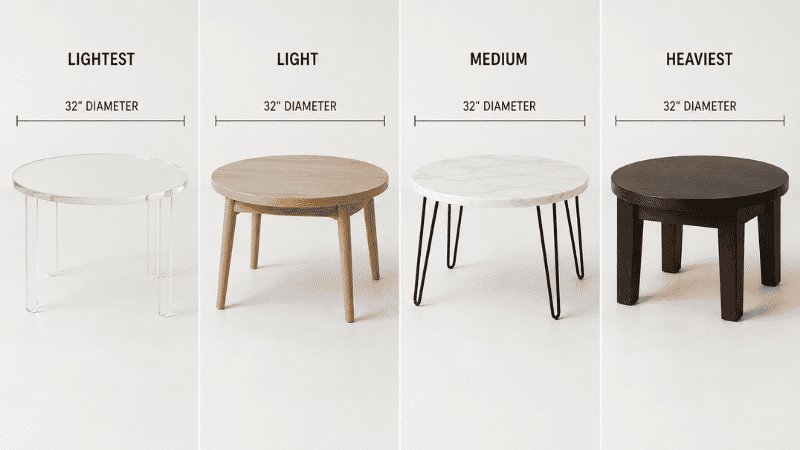
Visual weight from lightest to heaviest:
Glass / Acrylic: Lowest visual weight. The table effectively recedes into the background. Best for rooms where you want the floor or rug to be the visual focus.
Light wood (white oak, pine, ash): Low-to-moderate visual weight. Warm, approachable, versatile with most interior styles. A 34-inch round in white oak reads significantly lighter than the same table in dark walnut.
Metal (gold, brass, chrome): Depends on leg design. Thin hairpin legs or thin tubular metal legs read as very light. Thick cast-metal legs read as heavy. The leg profile matters more than the metal type.
Dark wood (walnut, ebony, dark stain): Higher visual weight. Appropriate for rooms with high ceilings or where you want the coffee table to be a visual anchor rather than a receding element.
Upholstered (ottoman): Moderate visual weight. The fabric texture adds warmth but also visual mass. Lighter fabric colors (cream, beige, sage) read lighter than darker ones.
Coffee Table Placement: The Rug Relationship
The coffee table and rug work together as a system — and the relationship between them determines whether both pieces look intentional.
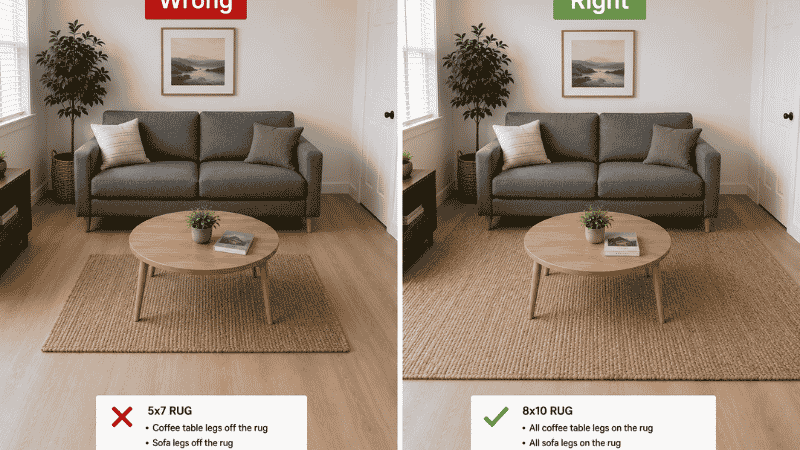
The rule: All four legs of the coffee table should sit on the rug, with a minimum of 6 inches of rug visible between the coffee table legs and the sofa front legs. If the rug is too small for this, the coffee table will look like it’s floating between the sofa and rug rather than integrated with the seating zone.
Rug sizing for coffee table integration:
- Sofa length + 12 inches on each side = rug width minimum
- For a 80-inch sofa: 80 + 24 = 104-inch (8.7-foot) rug minimum width
- Common rug sizes that work: 8×10-foot or 9×12-foot rugs in most standard living rooms
When the rug is too small: Two options. First, replace the rug with a correctly sized one — the most effective fix. Second, use a round coffee table on a round rug (a 5-foot round rug under a 30-inch round coffee table creates a defined zone that reads as intentional rather than undersized).
What to Avoid in a Small Living Room
Oversized rectangular table: A 48 × 26-inch coffee table in front of a 72-inch sofa violates the 2/3 rule, creates excessive visual mass, and typically leaves insufficient clearance on the sides. The most common coffee table mistake in small rooms.
Matching coffee table sets (coffee table + two matching end tables): In a small living room, three separate surface pieces look like a furniture showroom. If you need side surfaces, floating wall shelves or one small C-table (a table that slides under the sofa arm) provides surface without three separate footprints.
Solid wood tables in dark finishes in rooms under 120 sq ft: A 36-inch dark walnut coffee table in a 100 sq ft living room reads as a heavy anchor rather than a functional surface. Save dark wood finishes for rooms where the ceiling height and room volume can absorb the visual weight.
Coffee tables with extensive under-shelf storage: A coffee table with a lower shelf holds books, remotes, and baskets — which sounds useful until the shelf becomes a collection zone for items that shouldn’t be there. In a small living room, everything on or near the coffee table is visible all the time. Closed storage (ottoman with lid, lift-top with interior compartment) hides the accumulation; open shelving amplifies it.
If Your Current Coffee Table Isn’t Working
If the table feels too large: measure the clearance between the sofa and table edge. If it’s under 14 inches, the table is objectively too large for the room. Consider replacing with the correctly sized option per the formula.
If the table feels too low: this may be a sofa issue as much as a table issue. If your sofa has unusually low cushions (under 16 inches), a standard 16–18-inch coffee table will feel high. In this case, a lower coffee table (14–15 inches) or a pouf/ottoman at the same height as the sofa cushion may serve better.
If the table is constantly cluttered: the table is functioning as a catchall surface because objects don’t have better homes. A coffee table tray with a designated maximum capacity (one remote, one drink, one decorative object) contains the accumulation. Anything beyond the tray’s capacity gets returned to its actual home rather than staying on the table.
FAQ: Coffee Table for Small Living Room
What size coffee table for a small living room? The formula: coffee table length = 1/2 to 2/3 of sofa length. For an 80-inch sofa, a 40–53-inch coffee table is correct. Height should be 15–18 inches (within 1–2 inches of the sofa seat cushion). Leave 18 inches of clearance between the sofa front and the table edge. For round tables, use diameter as equivalent to length.
Is a round or rectangular coffee table better for a small living room? Round is almost always better for small living rooms. No sharp corners means safer circulation from any direction, and the circular form reads as visually lighter than a rectangular table of equivalent surface area. Round tables pair with any sofa style and any rug shape. The only exception is if your room has a strong linear architectural geometry where the rectangular form integrates more cohesively.
Can you use an ottoman as a coffee table in a small living room? Yes — and in many small living rooms, an ottoman is preferable to a conventional coffee table because it adds storage, extra seating, and footrest function from the same footprint. The requirement: a tray (14–16 inches round for a 30–36-inch ottoman) is necessary to create a stable surface for drinks and objects. See our complete ottoman coffee table guide for sizing formulas.
How high should a coffee table be? Within 1–2 inches of your sofa’s seat cushion height. Measure from the floor to the top of the sofa seat cushion (not the top of the sofa back). Standard range: 16–18 inches. A table 2+ inches higher than the seat cushion feels like a barrier; a table 3+ inches lower requires uncomfortable leaning.
Should all four legs of the coffee table be on the rug? Yes, in most configurations. All four coffee table legs on the rug, with at least 6 inches of rug visible between the coffee table and the sofa’s front legs. This integrates the table visually with the seating zone. A coffee table floating half-on, half-off the rug looks disconnected from the seating arrangement and makes both the table and rug appear the wrong size.
What is the best coffee table for a very small living room under 100 sq ft? In rooms under 100 sq ft, visual lightness is the primary selection criterion. First choice: a 28–32-inch round glass or acrylic coffee table — small footprint, no corners, transparent. Second choice: a 28–30-inch round light wood coffee table on slim legs with no lower shelf. Avoid dark finishes, rectangular tables over 36 inches, and tables with lower shelves that add visual mass without controlled storage.
The Bottom Line
A coffee table for a small living room works when it’s sized correctly before it’s styled correctly. The three numbers — length at 1/2 to 2/3 sofa, height within 2 inches of seat cushion, clearance at 18 inches minimum — create the functional foundation. Everything within those numbers is a style choice.
For most small living rooms, a round table in a light material (glass, acrylic, light wood) at the correct proportion hits all the criteria and reads as visually lighter than almost any rectangular alternative.
Measure first. Then browse.
For living rooms where you’d rather replace the coffee table entirely with something that does more, our ottoman coffee table guide covers the storage, seating, and footrest functions from one piece. And for the complete living room furniture picture — including sofa sizing, rug proportions, and media console placement — our furniture ideas for small living rooms guide has the full formula.
References
- American Society of Interior Designers (ASID): Residential space planning guidelines — minimum 18-inch clearance between sofa and coffee table; coffee table proportional guidelines for residential seating arrangements
- Stamps, A. E. (2010). Effects of permeability on perceived enclosure and spaciousness. Environment and Behavior, 42(6), 864–886. (Research on visual transparency and perceived spatial openness — basis for the glass/acrylic visual weight effect)
- Gifford, R. (2002). Environmental psychology: Principles and practice. Optimal Books. (Foundational research on furniture arrangement and psychological experience of residential spaces)
Published on Grainv.com | Category: Living Room | Related: Ottoman Coffee Table, Furniture Ideas for Small Living Rooms, Sofa for Small Living Room