
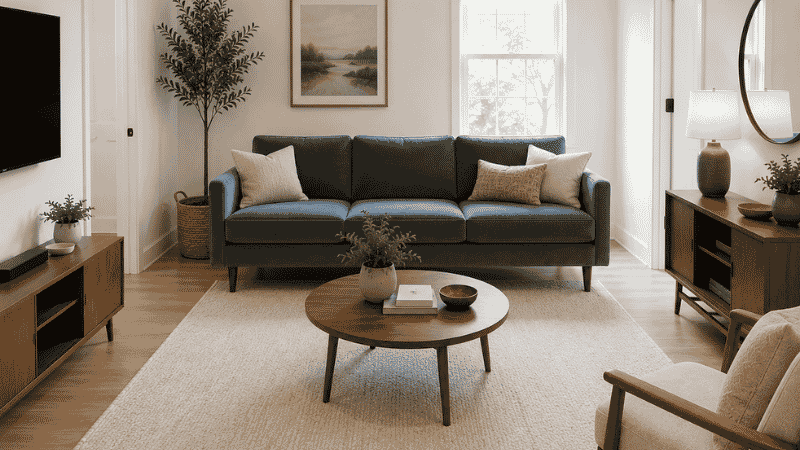
You searched “apartment sofa” and found a hundred results labeled “apartment size,” “apartment friendly,” or “perfect for small spaces.” Some of them are 72 inches. Some are 84 inches. A few are 90 inches. All of them claim to be made for apartments.
Here’s the problem: “apartment size” is not a standardized term. Every furniture brand defines it differently. Some mean “shorter than our standard sofa.” Some mean “shallow depth.” Some just mean “we’ve used the phrase enough times in the product description to show up in search results.” The label tells you almost nothing about whether the sofa will actually work in your specific apartment.
This guide cuts through that. We’re going to define what an apartment sofa should actually measure, explain which specs matter for different apartment types — studio, one-bedroom, shared — and give you a clear decision framework based on your room’s actual dimensions. By the end, you’ll know exactly what you’re looking for before you read a single product description.
Key Takeaways
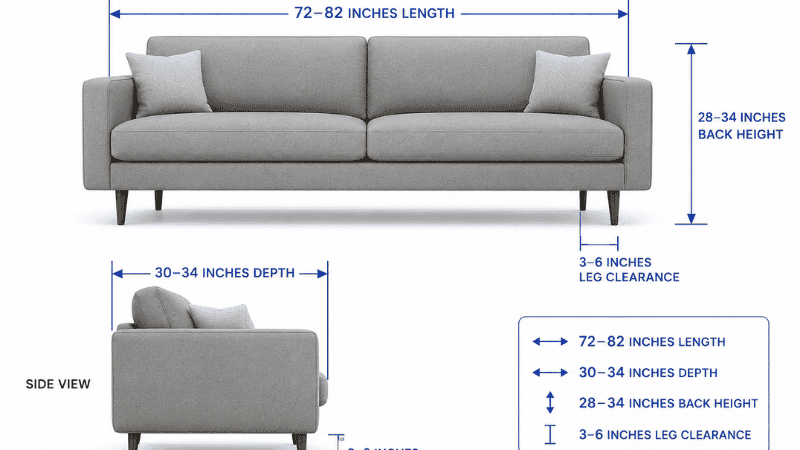
- True apartment sofas are 72–82 inches long and 30–34 inches deep: Anything longer than 84 inches or deeper than 35 inches is a standard residential sofa regardless of what the label says
- Seat depth is the comfort spec most people ignore: An apartment sofa with a total depth of 32 inches needs at least 20 inches of seat depth (front edge to backrest) — below 19 inches is uncomfortable for most adults during extended use
- Studio apartments need a different sofa than one-bedrooms: In a studio, the sofa defines a zone and its back faces another zone; in a one-bedroom, it anchors a dedicated living room with more placement flexibility
- The “one size smaller” rule: In most apartments, go one sofa size smaller than feels right at first — the room will feel more functional and proportionally correct than if you push the maximum dimensions
- Modular apartment sofas solve the delivery problem: Sectional-style modular sofas ship in boxes that fit through standard apartment doorways — critical when elevator dimensions or stairwell corners limit what can enter the building
What Does “Apartment Size” Actually Mean?
The furniture industry uses “apartment size” loosely, but there’s a practical definition worth knowing: an apartment sofa is a sofa scaled for rooms under 200 square feet, designed to leave functional walkways rather than maximize seating capacity.
In concrete specs, that means:
Length: 66–82 inches. The 66-inch end is a large loveseat; the 82-inch end is a compact 3-seater. Anything over 84 inches starts to challenge most apartment living rooms visually and spatially, even if it technically fits.
Depth: 30–34 inches total. This is the critical dimension. Standard residential sofas run 35–42 inches deep. Those extra 4–8 inches feel minor until you’re in a 10-foot-wide room trying to walk past the coffee table to get to the kitchen.
Back height: 28–34 inches from the floor. Lower backs keep sightlines open across an apartment. Taller backs (36+ inches) visually cut the room in half at eye level.
Leg clearance: 3–6 inches from the floor to the frame. Exposed legs show floor beneath the sofa, which reads as visual space. A skirted or paneled base at floor level makes even a correctly-sized apartment sofa feel heavy.
When shopping, look for these numbers in the spec sheet — not the marketing copy. If a product doesn’t list all four, ask before ordering.
Apartment Sofa by Apartment Type
The right sofa configuration isn’t just about size — it’s about how the sofa functions in your specific layout. A studio has completely different demands than a one-bedroom, and a shared apartment has different demands than both.
The Studio Apartment Sofa
In a studio, the sofa is doing two jobs simultaneously: providing seating and defining the boundary between your living zone and your sleeping zone. The sofa’s back, not its front, is what creates zone separation.
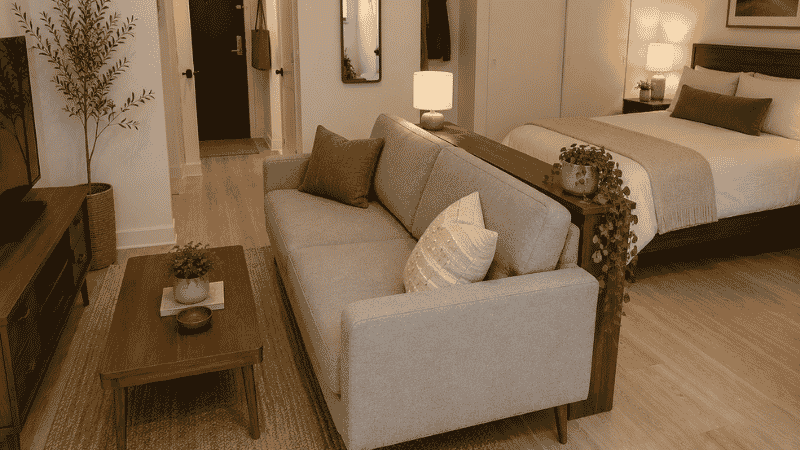
This means placement matters as much as size. The ideal studio sofa:
- Sits with its back facing the sleeping zone, 4–6 inches off the wall (not against it)
- Has a back height of at least 28 inches — enough to register as a visual boundary from the sleeping side, but low enough not to block light
- Is no longer than 78 inches — in most studios under 450 sq ft, an 80+ inch sofa starts to feel like a statement against furniture co-existence
- Has a depth of 30–32 inches — the shallower the sofa, the more open floor space remains in the living zone
The sofa-back console trick for studios: A slim console table (10–12 inches deep, matching the sofa back height) positioned flush against the sofa’s back creates a ledge for a lamp, small plant, or phone charger on the “sleeping side” of the sofa. This transforms the sofa back from a blank barrier into a functional surface and makes the studio’s zone separation feel deliberate rather than accidental.
Best studio sofa configuration: A 72–78-inch sofa with a tight back, exposed legs, and a depth of 30–32 inches. Avoid loose cushion backs (they add visual depth without adding comfort) and skirted bases (they eliminate the visible floor space beneath the sofa that makes a studio feel open).
The One-Bedroom Apartment Sofa
A one-bedroom gives the sofa a dedicated room to live in — no zone-sharing with the bed. This unlocks more configuration options, but doesn’t change the fundamental sizing logic.
The primary constraint in a one-bedroom living room is still width. Most one-bedroom apartment living rooms run 10–13 feet wide. Working within that:
- 10-foot-wide room: cap sofa at 78 inches, depth at 32 inches, leaving 22–24 inches of walkway in front
- 11-foot-wide room: comfortable with 80–84 inches, depth to 34 inches
- 12-foot-wide room: most apartment sofas work; consider whether a loveseat + chair configuration serves you better than a single long sofa
In a one-bedroom, the sofa placement also relates to the TV wall. Standard viewing distance for a 50-inch TV: 6–8 feet (72–96 inches) from the screen to the sofa seat. For a 55-inch TV: 7–9 feet. Measure this axis before committing to sofa placement — in some one-bedrooms, the correct viewing distance forces the sofa into the center of the room rather than against the far wall.
Best one-bedroom apartment sofa configuration: 78–84 inches, 32–34 inches deep, back height 30–34 inches. A tight-back sofa or a sofa with attached back cushions (not loose) keeps the profile clean and prevents the living room from feeling cluttered.
The Shared Apartment Sofa
Shared apartments present a unique challenge: the sofa needs to seat multiple people comfortably for movie nights, but it also needs to belong to a living room that three or four people pass through daily. Seating capacity and walkway space are in direct tension.
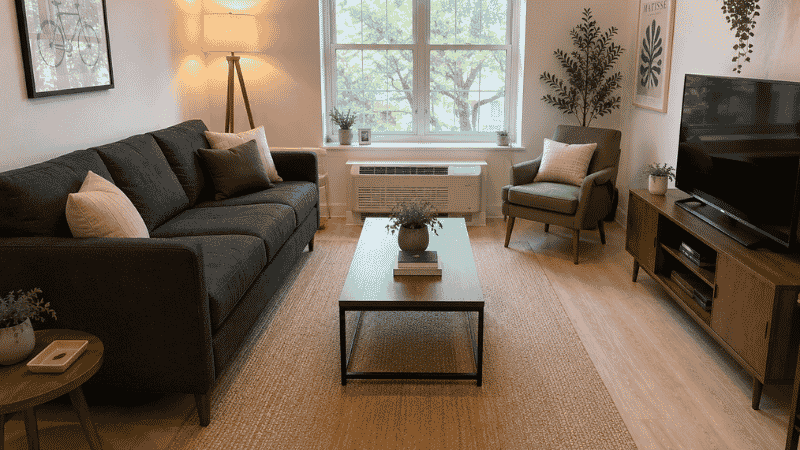
The answer is almost always a longer sofa rather than a sectional. A sectional in a shared apartment living room typically blocks at least one walking path and creates a furniture arrangement that works for TV watching but nothing else. A 78–84-inch sofa with a separate accent chair or two gives the same total seating capacity with more flexibility for the room to function as a gathering space.
The shared apartment sofa metric: Count the number of roommates. For two: a 72-inch sofa handles both comfortably. For three or four: an 82-inch sofa plus one accent chair handles four people with more comfort and less floor commitment than a sectional.
Apartment Sofa Styles That Work (And What to Avoid)
Not every sofa style scales well to apartment dimensions. These are the configurations that consistently work in apartment living rooms under 200 square feet.
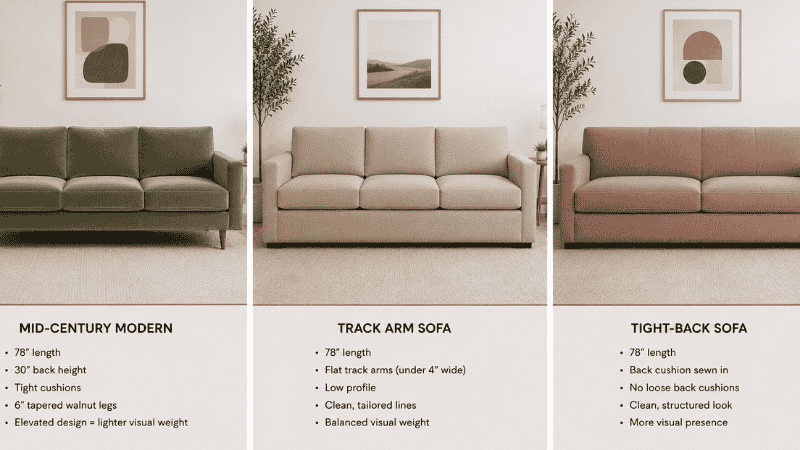
Mid-Century Modern (Best Overall for Apartments)
The mid-century profile — tapered legs, low back, tight seat cushions — was essentially designed for post-war urban apartments. Every element works at apartment scale: the exposed legs show floor, the low back keeps sightlines open, the tight upholstery reads as compact rather than bulky. Available at every price point, from budget replicas to well-made originals.
Look for: Leg height 5–7 inches, back height 28–32 inches, seat depth 20–22 inches.
Track Arm Sofa (Best for Maximizing Seating Capacity)
The track arm style — where the arm is a flat panel perpendicular to the seat — eliminates the curving scroll arm that consumes 4–8 inches of sofa length without adding seating. A 78-inch track arm sofa seats as many people as an 84-inch scroll arm sofa. For apartments where seating capacity matters, the track arm configuration is the most space-efficient arm style.
Look for: Arm width under 4 inches, arm height 22–26 inches (lower than the sofa back).
Tight-Back Sofa (Best for Visual Cleanliness)
A sofa with cushions sewn into or firmly attached to the back frame — rather than loose cushions that need constant repositioning — has a smaller visual footprint and requires zero maintenance. In an apartment where the living room doubles as a workspace or guest space, the tight back reads as more intentional and less “I haven’t gotten around to fluffing the cushions.”
Avoid: Large loose back cushions that pile against the back and add 4–6 inches of perceived depth without adding comfort.
What to Avoid in Apartment Living Rooms
Oversized sectionals: Any sectional with a chaise longer than 58 inches or a long arm exceeding 90 inches will block at least one walkway in most apartment living rooms. The extra floor consumption of the L or U shape disproportionately limits the room’s other functions.
Skirted-base sofas: The fabric skirt that reaches the floor hides the legs and makes the sofa read as significantly heavier than it is. In an apartment under 150 sq ft, this visual weight compounds — the sofa dominates the room rather than coexisting with it.
High scroll arms: Beyond style preference, high curved arms on an apartment-scale sofa look out of proportion — like a large-scale element crammed into a small room. Track arms, tapered arms, or minimally padded arms scale correctly at apartment dimensions.
Apartment Sofa Fabrics: What Holds Up in Daily Use
In an apartment where the sofa is used daily — often as the primary seating for eating, working, and entertaining — fabric durability matters more than in a house where the sofa might be one of several seating options.

Performance Fabric
Performance fabrics (Crypton, Sunbrella, and various branded equivalents) are treated to resist stains, moisture, and wear. They don’t feel different from standard upholstery in most cases, but they dramatically extend the sofa’s usable life in daily apartment use. A quality performance fabric sofa used daily for 6 years will look substantially better than a standard fabric sofa at the 3-year mark.
Worth it if: The sofa is your primary daily seating, you eat on the sofa regularly, you have pets, or you entertain frequently.
Linen and Linen-Blend
Linen reads as more elevated than polyester and has a natural texture that ages well. The trade-off is stain sensitivity — a linen sofa in an apartment requires more care than a performance fabric equivalent. Linen blends (typically 55% linen, 45% polyester or cotton) balance the aesthetic appeal with improved durability.
Best for: Low-traffic apartments, single-person households, or anyone willing to use a slipcover or treat stains promptly.
Velvet
Velvet works exceptionally well at apartment scale because of its light-catching surface — it reads as more luxurious than its price often suggests, and the texture adds visual interest to a small room without adding physical bulk. Modern velvet sofas use synthetic velvet that’s significantly more durable than vintage velvet upholstery.
Best for: Apartments where the sofa is the primary aesthetic statement and aesthetics matter more than durability.
Leather and Faux Leather
Genuine leather develops character over time and is easy to clean (wipe, don’t soak). The weight can be higher than fabric sofas, which matters if the apartment requires frequent rearranging. Quality faux leather (PU leather or top-grain bonded leather) offers similar cleanability at lower cost, but edges and corners show wear faster than genuine leather.
The Apartment Sofa Delivery Problem and How to Solve It
Buying an apartment sofa online without thinking about delivery logistics is how you end up with a sofa in your building lobby and a furniture company telling you it can’t be returned.
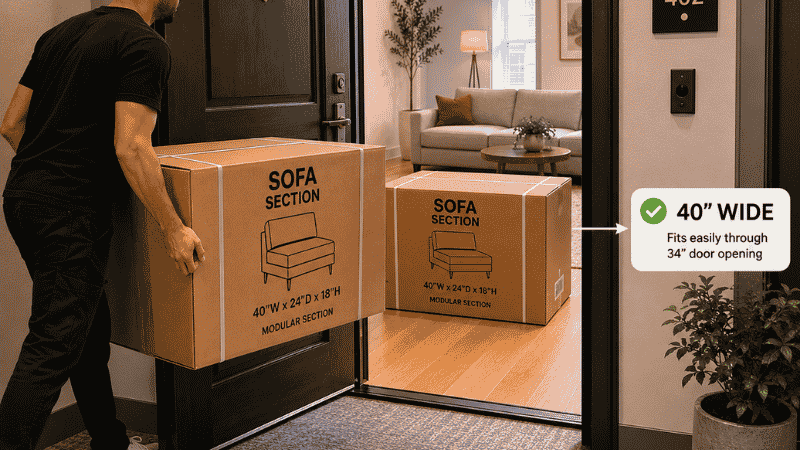
The three measurements to take before ordering any apartment sofa:
- Front door clear width: Measure the opening between door frames, not the door itself. Most apartment interior doors: 30–32 inches clear. Some modern buildings: 34–36 inches. Most sofas can be tilted to pass through a tight door, but the sofa’s back height (usually 28–34 inches) needs to fit through the narrowest opening in tilt.
- Elevator interior: Width × depth × height. A standard residential elevator runs approximately 36 × 48 × 84 inches interior. A sofa that fits through your front door may not fit in the elevator if it can’t be tilted safely in the confined space. For any sofa over 80 inches in length, verify elevator dimensions before ordering.
- Stairwell landing clearance: If you’re taking stairs, the landing turn radius is the critical constraint. Measure the turning radius at the tightest landing between your building entrance and your floor.
Modular sofas as the solution: A modular sofa ships in individual section boxes — each section typically 35–42 inches wide — that fit through any standard door and elevator independently. Once inside your apartment, sections connect to form the complete sofa. This eliminates the delivery problem entirely. The trade-off is slightly more assembly time and in some cases a slightly higher price. For apartments above the ground floor with tight access, modular is often the only practical option for sofas over 72 inches.
Apartment Sofa by Budget
The right apartment sofa exists at multiple price points. Here’s what to expect at each tier.
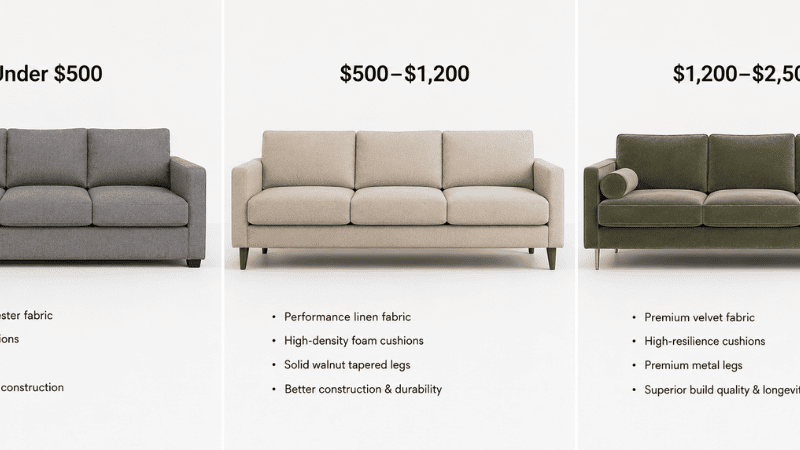
Under $500: Adequate frame and cushioning; polyester fabric; expect 3–4 years of daily use before significant wear. This range works for renters who move frequently and don’t want to invest in furniture they may not keep. Look for frames with reinforced corner blocks (check the spec or ask the retailer).
$500–$1,200: Solid wood or hardwood frame; better foam density (1.8+ lbs/cubic foot for seat cushions); wider fabric options including performance fabrics. This is the range where you start getting quality that holds up for 6–8 years of daily use. The majority of quality apartment sofas land here.
$1,200–$2,500: Premium materials throughout; eight-way hand-tied or sinuous spring suspension (more supportive and longer-lasting than webbing); choice of seat depth and fill. At this range you’re investing in a sofa you keep for a decade or longer. Worth it if you’re settled in an apartment for 3+ years and the sofa is your primary furniture investment.
Over $2,500: Custom dimensions (you specify the exact length and depth), premium upholstery, extended warranties, domestic manufacturing. The advantage is being able to spec exactly the dimensions your room requires — important if your apartment has a non-standard layout or doorway constraint that eliminates most standard options.
If You Only Have 10 Minutes: The Apartment Sofa Checklist
Before browsing, write down these six numbers and keep them open while you shop:
- Clear wall length × 0.67 = maximum sofa length
- Room width minus 46 = check (if result < 32, you need a narrow depth sofa)
- Front door clear width (in inches)
- Elevator interior width (if above ground floor)
- Your budget range
- Minimum acceptable seat depth (19 inches for shorter adults, 21 inches for taller)
Any sofa that fails any of these six numbers doesn’t make the shortlist, regardless of style.
FAQ: Apartment Sofa Questions
What is an apartment size sofa? There’s no universal industry standard, but a practical definition is: a sofa 66–82 inches long, 30–34 inches deep, with a back height of 28–34 inches and exposed legs. These dimensions are calibrated for rooms under 200 square feet, leaving functional walkways rather than maximizing seating capacity.
What size sofa fits in an apartment? Depends on room width and clear wall length. For rooms 10 feet wide or under: 72–78 inches maximum length, 30–32 inches maximum depth. For rooms 10–12 feet wide: 78–84 inches, 32–34 inches. The 2/3 rule applies in any room — the sofa should span no more than two-thirds of the wall it sits against.
Is a loveseat or sofa better for a studio apartment? A 72–78 inch sofa (compact 3-seater) typically works better than a loveseat in most studios, because the sofa back is tall enough (28+ inches) to create a meaningful visual zone boundary between the living and sleeping areas. A loveseat at 52–60 inches is shorter and lower, which weakens the zone division. Exception: in micro-studios under 300 sq ft, a loveseat paired with one accent chair may genuinely make more sense than any sofa.
How do I get a sofa into an apartment? Measure three things before ordering: front door clear width (the opening between frames, not the door itself), elevator interior dimensions if above ground floor, and stairwell landing clearance if using stairs. For sofas over 72 inches in tight-access buildings, consider a modular sofa that ships in sections and assembles inside the apartment.
What’s the difference between an apartment sofa and a regular sofa? Primarily depth: apartment sofas run 30–34 inches deep versus 35–42 inches for standard residential sofas. They’re also typically shorter (under 84 inches vs 84–96 inches standard) and lower in back height (28–34 inches vs 34–40 inches standard). The depth difference is the most significant for apartment living — it determines whether your walkway is functional or cramped.
Can you put a sectional in an apartment? In studios and rooms under 10 feet wide: almost never works — the L-shape blocks walkways. In one-bedroom apartments with rooms 11 feet wide or larger: a compact sectional (short arm under 58 inches, long section under 86 inches) can work in a square or near-square room. Measure both dimensions of the sectional’s footprint, not just one length. And verify delivery access before ordering — most sectionals ship as one piece and require significant maneuvering.
The Bottom Line
“Apartment sofa” should mean a sofa scaled for how apartments actually work — not just “smaller than our flagship.” The specs that matter are total depth (30–34 inches), length calibrated to 2/3 of your clear wall, back height that leaves sightlines open (28–34 inches), and legs that show floor beneath the frame.
Beyond the specs, the right apartment sofa matches how your specific apartment functions — whether it’s a studio where the sofa creates zone separation, a one-bedroom where it anchors a dedicated living room, or a shared space where it needs to accommodate multiple people without blocking the paths everyone uses daily.
Size first. Style second. Everything else is details.
Want to see exactly how a sofa fits into different small room layouts? Our small living room layout guide covers six arrangement formulas by room shape with exact walkway measurements. And for the full sofa selection picture — how to size against your room’s specific dimensions — our sofa for small living room guide walks through the four measurements to take before you browse.
References
- American Society of Interior Designers (ASID): Residential space planning guidelines — minimum clearance standards including 30-inch walkway requirements for residential living areas
- Furniture Industry Research Association (FIRA): Ergonomic seating guidelines for residential upholstered furniture — seat depth recommendations (19–23 inches) for comfortable extended seating for adults
- National Association of Home Builders (NAHB): Standard residential door and elevator clearance specifications for furniture delivery in multi-family residential buildings
Published on Grainv.com | Category: Living Room | Related: Sofa for Small Living Room, Small Living Room Layout, Furniture Ideas for Small Living Rooms