
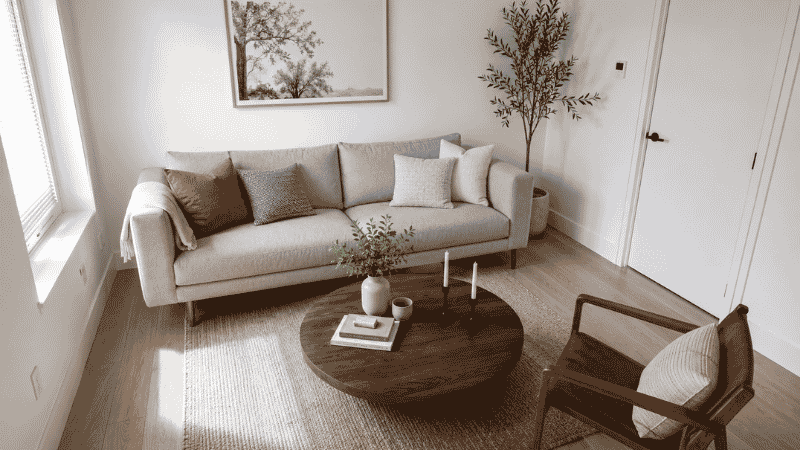
You moved the sofa for the third time this month. It looked fine in theory — sofa against the wall, coffee table in the middle, TV across from it — but something still feels off. The room feels cramped, the walkway is awkward, and it just doesn’t look like the photos you saved on Pinterest.
Here’s the thing: the wall-hugging layout most people default to is actually one of the worst small living room layouts you can use. Interior designers know this. But the advice online either shows you gorgeous 400 sq ft lofts that bear zero resemblance to your actual space, or gives you vague tips like “float your furniture” without explaining what that means for an 11 × 13 room with a weird doorway.
This guide is different. We’re going to give you specific small living room layout formulas — with exact measurements, furniture dimensions, and a clear decision system based on your actual room shape. By the end, you’ll know exactly which layout fits your space, and why.
Key Takeaways
- The 2/3 Rule: Your sofa should take up no more than 2/3 of any single wall — for most small living rooms, that means capping sofa length at 78–84 inches
- The 18-inch standard: Leave at least 18 inches between your sofa and coffee table for comfortable legroom (and clearance to walk)
- Floating works: Pulling furniture even 4–6 inches away from the wall makes a room feel larger, not smaller
- Your room shape determines your layout — not your sofa style, not your TV size
- One anchor, one conversation zone: Small rooms need a single focal point and a single seating cluster — anything more creates visual chaos
First: Measure Before You Move Anything
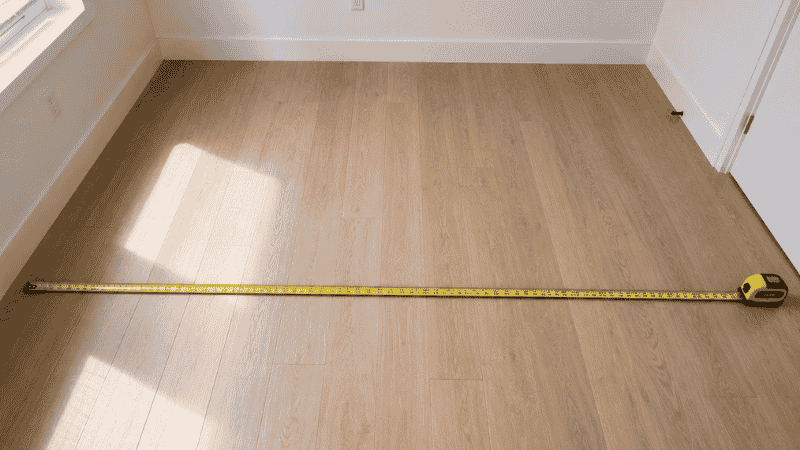
Most layout mistakes happen before a single piece of furniture is touched. People eyeball. They assume. They move the sofa and realize the coffee table no longer fits.
Before we get into layouts, grab a tape measure and write down three numbers:
- Room width (the shorter dimension)
- Room length (the longer dimension)
- The “clear zone” — the distance between your longest wall and any doorway, window, or architectural interruption
These three numbers determine which layout formula works for you. Everything else is secondary.
Quick size reference:
- Under 10 ft wide → you’re working with a micro layout; skip L-shapes and sectionals entirely
- 10–12 ft wide → you have options; 2-seat sofa + accent chair is your sweet spot
- 12–14 ft wide → most standard layouts work; you can consider a small sectional
- Over 14 ft wide → you have a medium room, not a small one; different rules apply
Layout Formula 1: The Floating Sofa (Works in Almost Any Small Room)
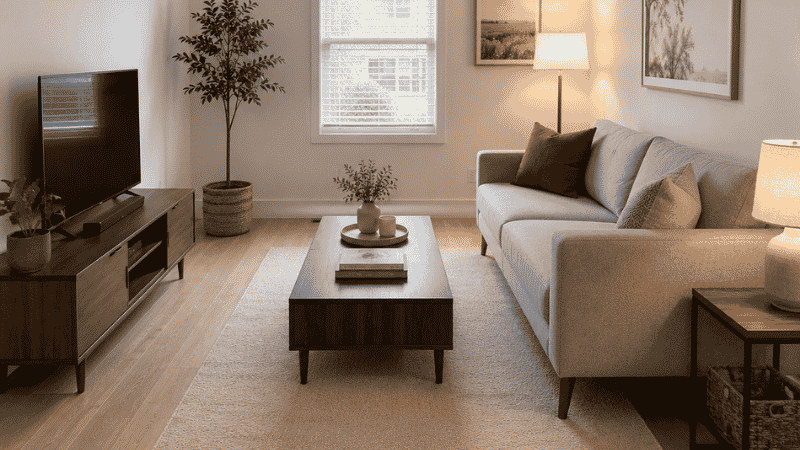
Best for: Rectangular rooms, 10–13 ft wide, single-wall TV setup
This is the layout most small space designers recommend first — and the one most people resist because it feels counterintuitive. Instead of pushing your sofa flush against the wall, pull it forward 4–8 inches.
That small gap does two things: it creates a sense of depth that makes the room read larger, and it defines the seating zone as its own space rather than an afterthought stuck to the perimeter.
The formula:
- Sofa: max 84 inches long, depth 32–35 inches preferred (shallower profiles free up walkway)
- Coffee table: 18 inches from sofa edge, length should be roughly 2/3 the sofa length
- TV console: no taller than 24 inches so sightlines stay open across the room
- Rug: anchor everything — front legs of sofa ON the rug minimum; all four legs preferred
The mistake to avoid: Floating the sofa but pushing the coffee table so far forward that you lose the walkway behind it. Always measure: you need at least 30 inches of clear path between the coffee table and any opposing wall or furniture.
Layout Formula 2: The L-Shape Anchor (For Corner-Challenged Rooms)
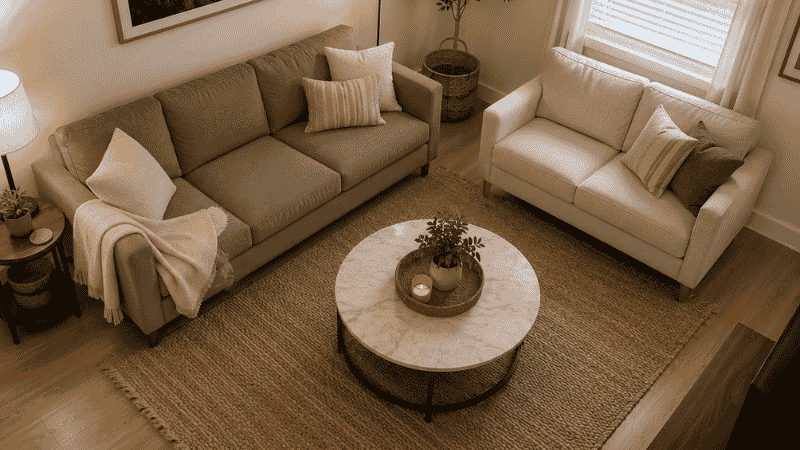
Best for: Square rooms, awkward corner entries, rooms where traffic flows through the middle
If you have a square room — say 11 × 11 or 12 × 12 — a straight sofa + coffee table layout will always feel off-center, because there’s no clear “long wall” to anchor to. The L-shape layout solves this by using the corner as your anchor instead.
This doesn’t necessarily mean buying a sectional. You can create an L-shape with a 72-inch sofa on one wall and a 48-inch loveseat or chaise on the adjacent wall. This actually gives you more flexibility than a built-in sectional because the two pieces can be repositioned independently.
The formula:
- Sofa: 72–84 inches, placed parallel to your longer wall or window wall
- Secondary seat: 48–60 inches, perpendicular to the sofa — leave a 24-inch gap in the corner for breathing room
- Coffee table: centered in the L, approximately 16–18 inches from each seating piece
- No rug under everything — an 8 × 10 rug centered under the coffee table is enough
What this layout does well: It channels traffic around the seating area rather than through it, which makes the room feel more intentional even when guests are over.
Layout Formula 3: The Single-Chair Swap (For Rooms Under 150 Sq Ft)
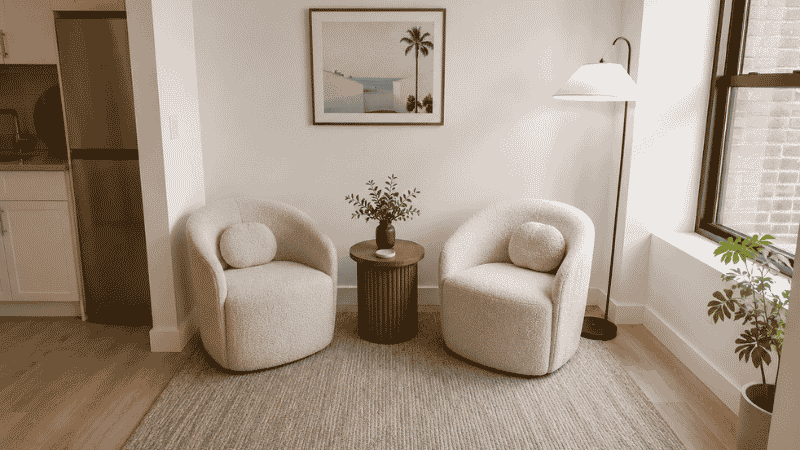
Best for: Studio apartments, rooms under 10 × 14 ft, spaces that pull double-duty as a bedroom
Sometimes the honest answer is: a sofa doesn’t belong in this room.
As one real-world example from a 400 sq ft New York apartment showed, swapping a sofa for two compact barrel chairs freed up the entire room — the living area felt larger, and there was space for a proper coffee table for the first time. This isn’t a compromise. For rooms under 150 sq ft, two accent chairs in an angled conversation layout can outperform a cramped sofa in both function and visual space.
The formula:
- 2 chairs: 28–30 inches wide each, angled 15–20 degrees toward each other
- Small round coffee table or ottoman: 24–30 inch diameter, centered between them
- Side table: one is enough; use a wall-mounted shelf if floor space is critical
- Rug: 5 × 8 is usually sufficient, centered under the chairs
When this beats a sofa: When your room is narrow (under 10 ft), when you need a clear walkway through the center, or when you occasionally need to sleep in the space (two chairs + ottoman is more flexible than a sofa bed).
Layout Formula 4: The TV-Free Wall (The Layout That Unlocks Difficult Rooms)
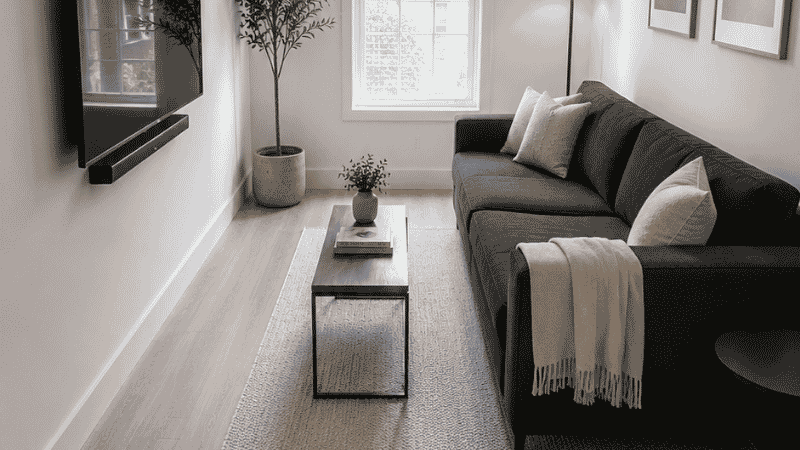
Best for: Long and narrow rooms, rooms with windows on multiple walls, awkward entry placement
Most people treat the TV as the starting point for their layout. The TV goes on one wall, the sofa faces it, everything else fills in around that axis. In a normally-proportioned room, this works fine.
In a long, narrow room — say 9 × 16 or 10 × 18 — this layout creates a bowling alley. The TV at one end, the sofa at the other, and a dead sprint of empty floor between them.
The fix is to break the TV-wall assumption. Mount the TV on the longer side wall instead of the short end wall. This lets you place the sofa perpendicular to the room’s length, shortening the visual axis and making the room feel proportionally wider.
The formula:
- TV: mounted on one of the long walls, 42–52 inches from the floor to center of screen
- Sofa: positioned along the opposite long wall or floating in the center, no more than 10 feet from the TV
- Coffee table: 18 inches from sofa, 24–30 inch clearance on the walkway side
- Use a tall floor lamp behind the sofa rather than a floor lamp that eats into the walkway
Exact viewing distance: The Society of Motion Picture and Television Engineers recommends a viewing angle of 30 degrees. For practical purposes: for a 50-inch TV, you want to sit 6–8 feet away; for a 65-inch TV, 8–10 feet.
Layout Formula 5: The Dual-Zone Setup (For Open-Plan Apartments)
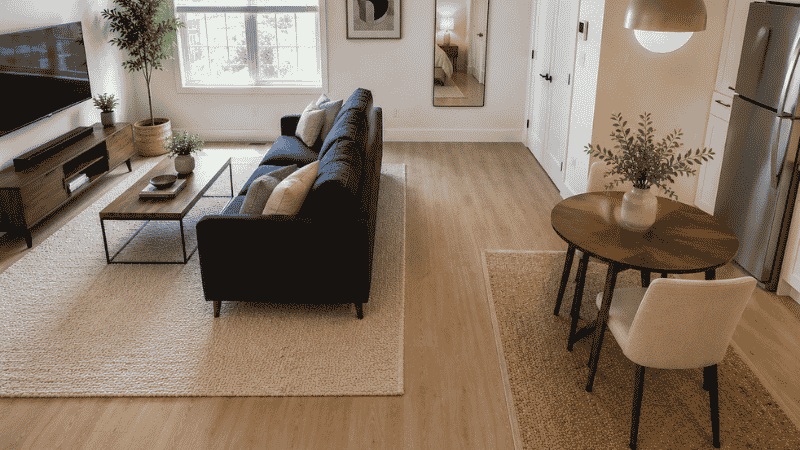
Best for: Studio apartments, open-concept spaces where living + dining share one room
Open-plan spaces are the hardest to layout because the problem isn’t just the living room — it’s how the living room relates to everything else in the space. The most common mistake is trying to define zones with furniture placement alone, while leaving the floor plan as one continuous, undifferentiated rectangle.
Zones need edges. Not walls — edges. A rug, the back of a sofa, a bookshelf used as a divider, a pendant light that drops lower over the dining table — these create visual boundaries that make each area feel intentional rather than randomly parked.
The formula:
- Living zone rug: 8 × 10 minimum, positioned so front sofa legs sit on it
- Sofa back as divider: position the sofa so its back faces the dining/kitchen area — this defines the edge of the living zone even in an open room
- Leave a 36-inch “aisle” between the sofa back and the dining table — this is the kitchen-to-living-room traffic path
- Don’t let the two rugs touch; a 12–18 inch gap between living rug and dining area is enough to signal zone separation
The key rule: A smaller space doesn’t automatically equal a less functional or sophisticated one — finding the right layout and employing a few design tricks is what transforms a small room into something that feels both intentional and livable.
Layout Formula 6: The Multifunctional Pivot (When Your Living Room Has to Do Everything)
Best for: Single-room apartments, home-workers, anyone whose living room doubles as office, guest room, or dining room
Some rooms don’t get to be just a living room. They’re the office on weekday mornings, the guest bedroom when family visits, and the dinner party overflow zone on weekends. Designing for this kind of flexibility requires thinking in modular layers rather than fixed furniture arrangements.
The principle: anchor pieces stay, flex pieces move. Your sofa, rug, and TV wall are permanent. Everything else — side tables, ottomans, chairs, the desk — gets selected for its ability to shift roles.
The multifunctional formula:
- Sofa: choose a model with a tight back and legs (not a skirted base) — it reads lighter, and if it folds out, it becomes a guest bed
- Ottoman: must do double duty — storage lid + extra seat + coffee table surface with a tray on top
- Side table: choose nesting tables (two stack together) so you can expand surface area when entertaining
- Desk: wall-mounted fold-down (Murphy-style) or a console table that doubles as a desk — keep it 20 inches deep maximum to preserve walkway
The dimension to protect at all costs: 36 inches of clearance from any furniture to any doorway. This is the minimum needed for two people to pass comfortably, and it’s what makes a multifunctional room feel livable rather than jammed.
What To Do If Your Layout Still Feels Wrong
Sometimes you follow all the formulas and it still doesn’t feel right. Before you move anything again, run through this checklist:
Check your rug size first. The most common reason a correct layout feels wrong is an undersized rug. A rug that only fits under the coffee table with the sofa floating above it visually disconnects everything. For a small living room, the minimum is an 8 × 10 — ideally with front sofa legs sitting on it.
Check your furniture height. In a small room, low-profile pieces (sofa seat height 17–18 inches, coffee table 16–18 inches, TV console under 24 inches) keep sightlines open and make the room read larger. Tall, bulky pieces — especially anything with a high solid back — compress the space visually even if the footprint is identical.
Check your focal point. Every room needs one thing the eye lands on first. If that’s the TV, great — make the TV setup intentional (gallery wall around it, floating shelves flanking it). If it’s a window, great — face the seating toward it. If there’s no clear focal point, the eye bounces around and the room feels chaotic regardless of how good the layout is.
Check for visual clutter at floor level. Cables, a tangle of cords behind the TV, shoes by the sofa — all of these compress the perceived size of the room more than an extra piece of furniture would. Elevated furniture (pieces with legs rather than skirted bases) shows more floor, which reads as more space.
If You Only Have 10 Minutes: The Quick Reconfigure
No time for a full rearrange? Start here:
- Pull your sofa 6 inches forward from the wall
- Move your coffee table 2 inches closer to the sofa (shoot for 18 inches between them)
- Angle one accent chair 15 degrees toward the sofa instead of facing straight forward
- Remove one piece of furniture from the room entirely (even temporarily)
Most people are shocked at how different the room feels from just steps 1 and 4.
FAQ: Small Living Room Layout Questions
How do I arrange a small living room with a TV and a fireplace on different walls? Choose one as the primary focal point — usually the fireplace, since it’s architectural and the TV can be repositioned. Mount the TV at a 45-degree angle in a corner if needed, or consider a TV cabinet with doors so the screen can be closed when not in use. Avoid angling the sofa toward both at once; pick one and design around it.
Should I put the sofa against the wall in a small living room? Usually no. Wall-to-wall placement makes traffic awkward, cuts off the room’s visual depth, and creates a “waiting room” aesthetic. Pulling the sofa 4–8 inches forward and floating it in the space almost always looks and functions better — even in very small rooms.
What size rug for a small living room? In a room under 12 × 14 ft, an 8 × 10 rug is the minimum worth using. A 5 × 8 will usually look too small and disconnect your seating from the floor plane. If budget is a concern, a larger rug with a simpler pattern will always outperform a smaller rug with a complex design.
How much space do I need between the sofa and coffee table? 18 inches is the design standard. Less than 14 inches feels cramped when you try to sit down or put things on the table; more than 24 inches breaks the conversational connection between the seating and the table surface.
Can I use a sectional in a small living room? Yes — but choose carefully. Look for apartment-size sectionals under 100 inches on the long side, with a chaise arm no deeper than 58 inches. Avoid oversized sectionals with deep seats (over 38 inches depth) — they consume floor space disproportionate to their seating capacity. A 2-seat sofa + separate chaise is often more flexible than a built-in sectional.
What’s the minimum size living room for two people to sit comfortably? An 8 × 10 room can accommodate two people with a loveseat (max 60 inches) and a small chair. Anything smaller than 8 feet in either dimension requires the single-chair swap layout (Formula 3) or a built-in window seat solution.
My room is long and narrow. What layout works best? Use Formula 4 (TV-Free Wall) — mount the TV on the long wall rather than the short end wall. This shortens the room’s visual axis. Pair it with a sofa no deeper than 34 inches and a narrow console/sofa table (max 14 inches deep) behind it if you need the divider.
The Bottom Line
The biggest mistake in small living room layout isn’t choosing the wrong sofa or the wrong rug — it’s starting with the wrong assumption. Most people assume you need to maximize seating, minimize furniture, or fill every wall. The layouts that actually work do the opposite: they define one clear zone, leave breathing room, and choose pieces that earn their floor space.
Start with your room dimensions. Match them to one of the six formulas above. Measure before you move anything. And remember: in a small space, one piece of furniture removed is almost always worth more than one piece added.
Looking for furniture that fits small living room layouts? Read our guides on the best sofas for small spaces and choosing a coffee table for a small living room — both include specific size recommendations for rooms under 200 sq ft.
References
- SMPTE (Society of Motion Picture and Television Engineers) ST 2036-1: Ultra High Definition Television standards for viewing distances
- National Kitchen and Bath Association: Clearance and aisle standards for residential design (minimum 36-inch traffic paths)
- Apartment Therapy Home Tours Archive, 2025–2026: Real-world small space layout examples
Published on Grainv.com | Category: Small Living Room | Related: Small Apartment Layout, Furniture Ideas for Small Living Room, Sofa Placement Small Living Room