
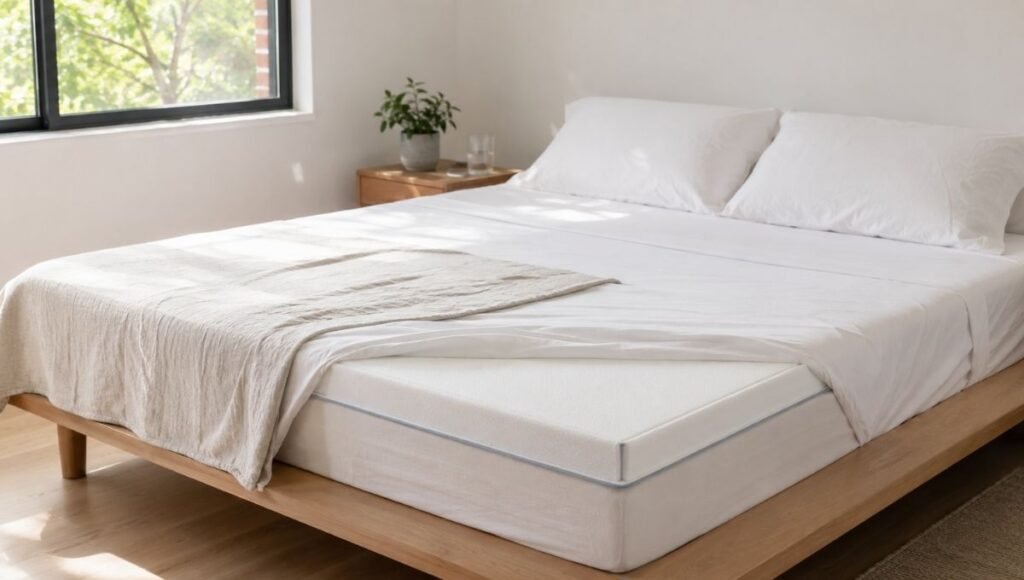
You bought one. Maybe even two. The gel memory foam one that felt cool for approximately eight minutes after you lay down on it, then turned into a warm damp sponge by midnight. Or the bamboo-covered one that was aggressively marketed as “temperature regulating” and did, technically, regulate your temperature — straight up to 78 degrees.
This is the shared experience of most hot sleepers who’ve tried a cooling mattress topper: the first night felt promising, and by the end of the week you were back to lying in your own heat pocket, one leg dangling off the side of the bed, wondering if you imagined the brief improvement or if your body just adapted to whatever tiny effect the topper was providing.
Here’s the thing nobody in the marketing copy told you: not all cooling mattress toppers actually cool. Some of them just feel cool to the touch for the first 10 minutes. Some of them cool the mattress surface without addressing the heat your body generates under the covers. And some of them — specifically the $400-800 water-cooling systems — genuinely do work in a way that surprises people who’ve given up on everything else.
This guide explains what’s actually happening inside the different types, why your previous one probably underdelivered, and how to match a topper to your specific situation rather than just buying the one with the most glowing product page.
Key Takeaways
- There are two fundamentally different types of cooling mattress topper: Passive cooling (gel foam, latex, wool) which absorbs and dissipates heat gradually, and active cooling (water circulation systems) which continuously removes heat — they’re different products with different expectations
- Your mattress type is the biggest variable: Adding a gel foam topper to a dense memory foam mattress is like putting a small fan next to a heat lamp — the mattress itself is generating and trapping heat faster than the topper can dissipate it; this is why the same topper works much better on an innerspring or hybrid bed
- The “cool to touch” feeling is not the same as sleeping cool: Most gel foam toppers are cool to touch at room temperature because the gel conducts heat away from your hand — this effect fades within minutes of body contact when the gel reaches skin temperature
- Thickness affects comfort more than cooling: A 3-inch topper doesn’t cool 50% better than a 2-inch topper; thickness primarily affects pressure relief; cooling comes from the material and ventilation design, not the thickness
- A recent CNET survey found that 6 in 10 US adults are willing to spend over $1,000 per year on better sleep — a cooling mattress topper is one of the most cost-efficient interventions available, but only if you’re buying the right type for your situation
Why Your Last Cooling Mattress Topper Didn’t Work
Let’s get this out of the way, because it’s the question that brings most people to this page.
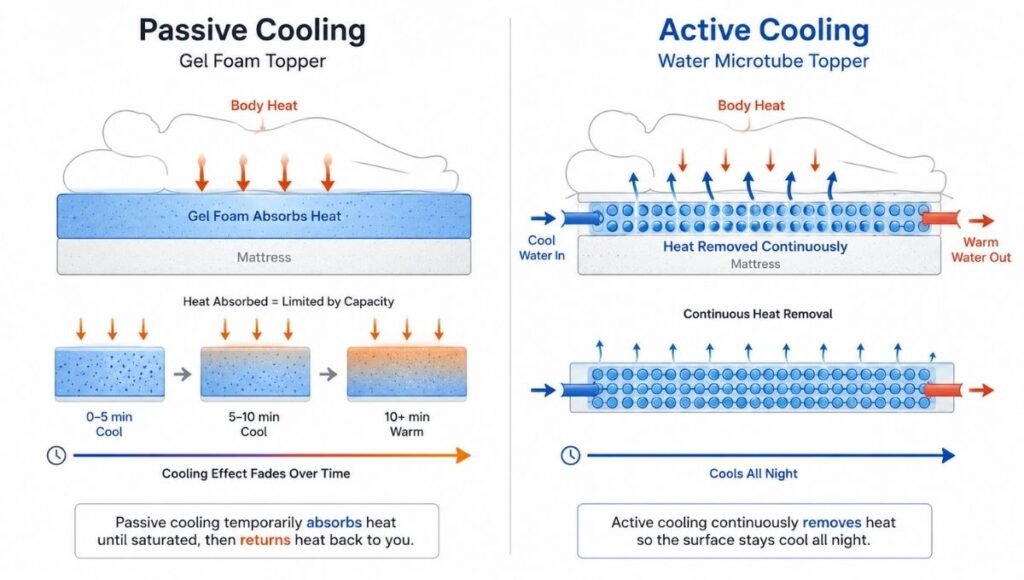
The most common failure mode is buying a passive gel foam topper and expecting active cooling performance. Here’s the physics of what’s actually happening.
A gel foam topper has gel particles or a gel layer embedded in memory foam. These gel elements conduct heat away from your skin faster than foam alone — that’s the “cool to touch” feeling. But “conducts heat away faster” doesn’t mean “removes heat from the system.” The heat has to go somewhere, and in a passive topper, it goes into the foam itself. As the foam warms up to body temperature — which happens within minutes — the cooling sensation disappears and you’re left sleeping on warm foam.
This is not a defective product. It’s a mismatched expectation. Gel foam toppers are genuinely better for temperature regulation than standard memory foam, but “better than memory foam” is a low bar. They work for light-to-moderate hot sleepers who run warm rather than actively sweating. For serious hot sleepers, they’re often not enough.
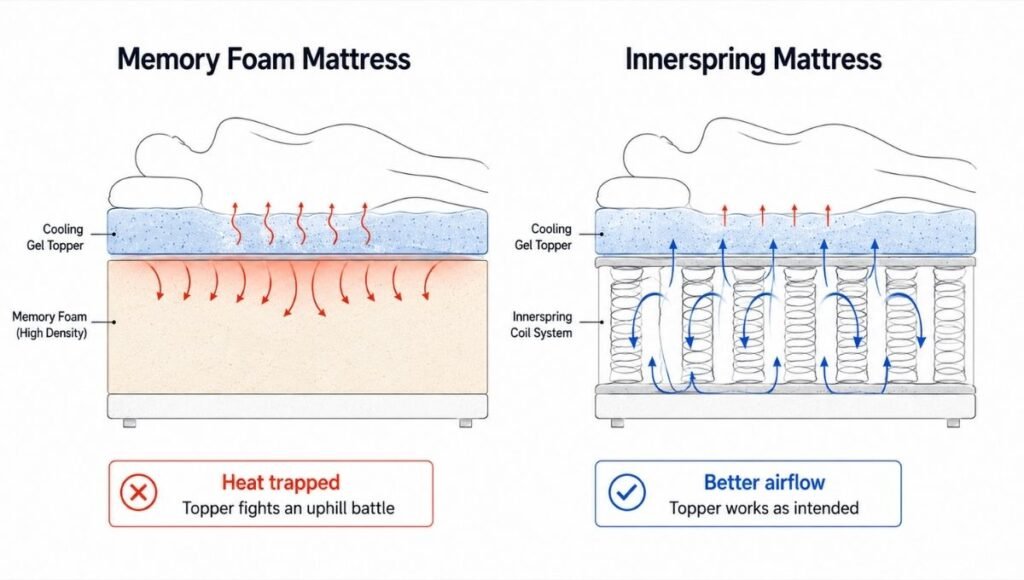
The mattress underneath compounds this problem. If you have a dense memory foam mattress — and memory foam mattresses are the single best-selling mattress category in the US — your mattress is actively trapping heat at a rate that a gel topper sitting on top simply cannot outpace. Memory foam conforms closely to the body, reducing airflow around your sleep surface, and the foam itself retains heat. A $200 gel topper on a memory foam mattress is fighting the physics of the mattress below it.
The same $200 gel topper on an innerspring or hybrid mattress works significantly better, because the coil system provides air circulation beneath the sleep surface that the topper doesn’t have to overcome.
The Three Types of Cooling Mattress Topper: An Honest Map
Passive Cooling: Gel Foam, Copper-Infused, and Graphite
How it works: These toppers use thermally conductive materials — gel beads, copper particles, graphite powder — embedded in foam to draw heat away from your body surface faster than standard foam. They’re passive because they rely on thermal conductivity rather than any active heat removal mechanism.
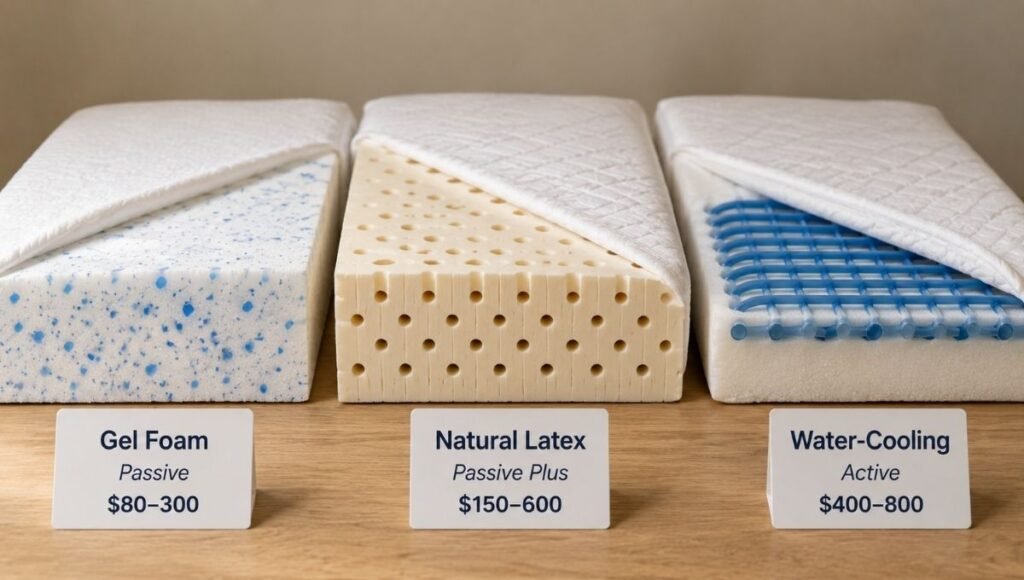
Who they work for: Light-to-moderate hot sleepers on innerspring or hybrid beds. People who sleep hot in summer but not year-round. Anyone looking for a marginal improvement in comfort at a reasonable price ($80–$300 range).
Who they don’t work for: People who wake up sweating regularly on any mattress, any season. Anyone sleeping on dense memory foam who expects a dramatic temperature change. Serious hot sleepers in consistently warm climates.
My honest take: The graphite and copper-infused versions genuinely outperform standard gel foam — graphite in particular is an excellent thermal conductor — but they’re still passive systems. The Saatva Graphite Mattress Topper uses a graphite layer to draw heat away from the body, and that’s real, measurable physics. But “draws heat away” and “keeps you cool” are not synonyms. If you’re a moderate hot sleeper on a non-foam bed, this category is worth your consideration. If you’ve tried two or three of these already and still wake up hot, this type is not your solution.
Passive Cooling 2.0: Latex
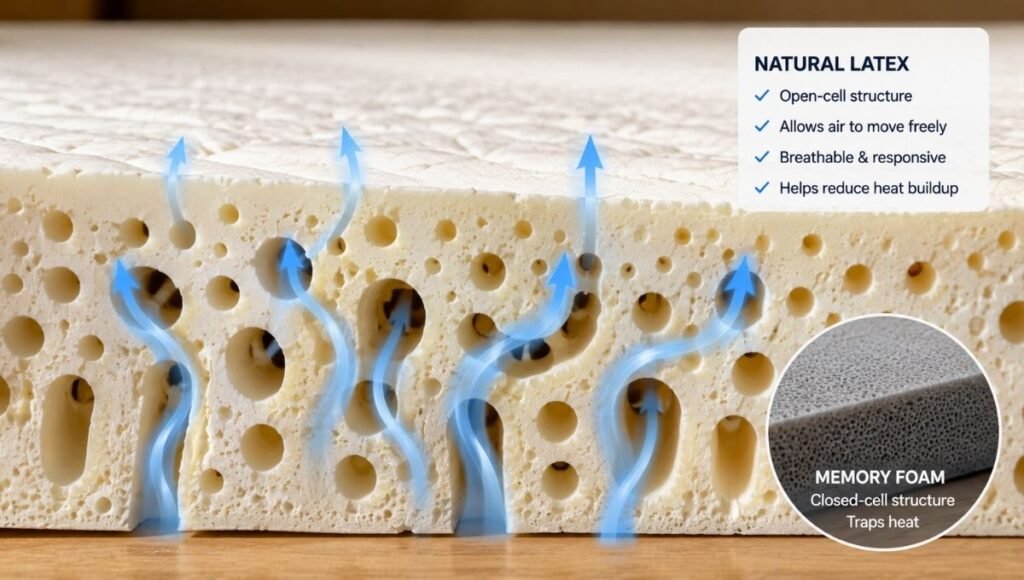
Latex sits in its own category because it has different cooling properties than foam-based toppers. Natural latex is made from rubber tree sap, processed into an open-cell foam structure that — unlike memory foam — doesn’t trap air and heat in dense pockets. It sleeps notably cooler than memory foam and significantly cooler than most gel foam toppers because of its structural breathability rather than any conductivity trick.
The downside: Latex is heavy (a queen-size latex topper can weigh 30–40 lbs), expensive ($250–$600), and has a distinct feel — responsive and bouncy rather than contouring. Some people love it immediately. Others find the lack of contouring uncomfortable.
Who it works for: Hot sleepers who want a significant passive improvement without going to active cooling, people who don’t like the dense “stuck in the mattress” feeling of memory foam, and anyone willing to spend more than the gel foam range for a material that addresses heat at a structural rather than cosmetic level.
Active Cooling: Water Circulation Systems
This is the category that surprises people who’ve given up on everything else.
Active cooling mattress toppers — specifically the water circulation systems like ChiliSleep (formerly ChiliPad), Eight Sleep, and Dock Pro — are fundamentally different products. Instead of relying on thermal conductivity, they circulate cool water through a grid of microtubes in the topper, continuously removing heat from the sleep surface throughout the night rather than absorbing and saturating like passive materials.
Dr. Jeffrey Durmer, MD, PhD, and USA Olympic Weightlifting Sleep and Circadian Program Director, notes: “In preparation for the 2020 Tokyo Olympics, one of the changes to our athletes’ sleeping habits includes the addition of active (microtube water system) cooling mattress toppers.” The feedback from athletes was consistently positive, including for athletes with larger bodies who generate more heat.
The honest version of “does it work”: Yes — meaningfully, not marginally. People who’ve tried three or four passive cooling products and are skeptical often describe active water cooling as the first thing that actually made them feel like they were sleeping in a cool environment rather than a slightly-less-warm one.
The honest version of the downsides: The price is real ($400–$800 for entry-level, over $2,000 for high-end systems like Eight Sleep). The unit itself makes a low humming sound that some people don’t notice and others find disruptive. There’s a water reservoir that needs periodic cleaning. For a renter in a small apartment, these are genuine logistical considerations, not small print.
Which Cooling Mattress Topper Is Right for Your Situation
By Your Mattress Type
Memory foam mattress (dense, contouring): Your mattress is the primary heat source. A gel foam topper will provide minimal improvement. If you’re not ready to replace the mattress, latex is the best passive option because it adds airflow at the sleep surface that memory foam inherently lacks. Active cooling works on any mattress because it doesn’t depend on the mattress below for heat dissipation.
Innerspring or hybrid mattress (coils with foam or latex comfort layer): This is where passive cooling toppers work best. The coil system allows air circulation beneath the topper, so the topper only needs to address surface-level heat — which gel foam and latex can do reasonably well. Start here before considering active cooling.
Latex mattress: Already a naturally cooler surface. If you’re still sleeping hot on a latex mattress, a passive topper won’t provide enough additional improvement to justify the expense. This is an active cooling situation.
By How Hot You Sleep
“I sleep warm and prefer lighter bedding”: Gel foam or copper-infused topper on an innerspring or hybrid bed. Stay in the $100–$200 range. Pair with percale cotton sheets (see our best sheets for hot sleepers guide).
“I wake up sweating a few times a week”: Latex topper or entry-level active cooling. The investment is higher but passive cooling has probably already disappointed you. Budget $250–$500.
“I’m drenched every night regardless of what I do”: Active cooling system. This is also the point at which talking to a doctor is genuinely worth doing — regular drenching night sweats can indicate hormonal, thyroid, or medication-related issues that no mattress topper can address.
By Budget
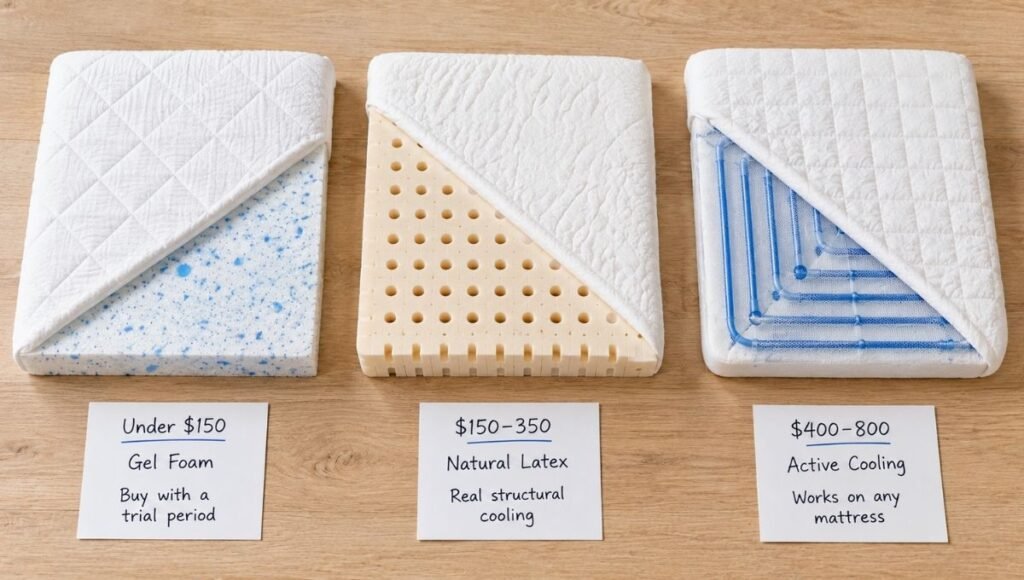
Under $150: Gel foam or copper-infused. Buy from a brand that offers a trial period (most legitimate bedding companies offer 30–100 night trials). If it doesn’t work for you in 30 days, return it and move up.
$150–$350: Latex is the best passive cooling option at this range. Natural latex from brands like Saatva, PlushBeds, or Avocado provides real airflow and structural cooling that gel foam can’t match.
$400–$800: Entry-level active water cooling (ChiliSleep Cube or Dock Pro Lite). Effective. Noisy compared to a passive topper but quieter than a fan. Works on any mattress.
$800+: Premium active cooling (ChiliSleep Cube Pro, Eight Sleep Pod Cover). Better app integration, quieter operation, dual-zone temperature control for couples. Worth the premium if you’re sharing a bed with a partner who sleeps at a different temperature.
Cooling Mattress Topper for Small Apartments: The Practical Considerations
If you’re in a small apartment, a few practical questions become more relevant than they would in a house with dedicated bedroom space.
Noise: Passive toppers are silent. Active cooling units have a water pump and fan — typically 30–40 decibels, similar to a quiet refrigerator. In a small bedroom, this is worth thinking about. Many users adapt completely within a week; others find it genuinely disruptive. Most brands offer trial periods precisely because this is a personal threshold question.
Where the unit goes: Active cooling systems come with a bedside control unit roughly the size of a large thermos or small blender. In a small bedroom, this goes on the nightstand or floor beside the bed. For platform beds with side drawers, verify there’s accessible space before purchasing.
Mattress depth compatibility: Most cooling mattress toppers fit mattresses up to 20 inches deep via deep-pocket fitted sheets. If you’re using your cooling topper with a platform bed that already has a thick mattress, check that your fitted sheets can accommodate mattress + topper thickness combined.
Setup and maintenance: Passive toppers arrive compressed and expand over 24–48 hours. Active cooling systems require filling a water reservoir, connecting hoses, and occasional cleaning (every 2–4 weeks with distilled water to prevent mineral buildup). In a small apartment where every task has to fit into a real life, factor the maintenance cadence in.
Cooling Mattress Topper vs. Cooling Sheets: Do You Need Both?
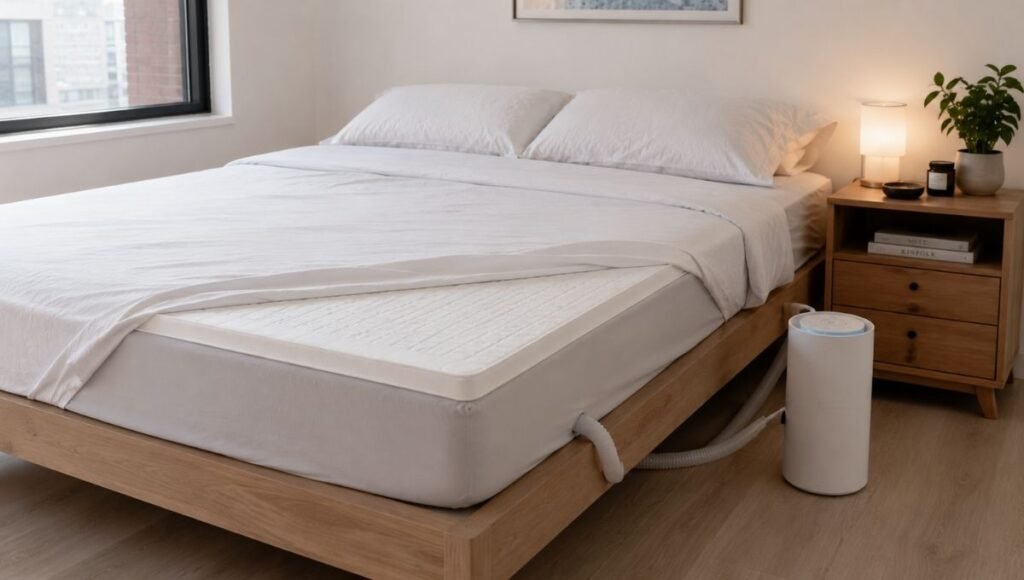
Short answer: they address different parts of the same problem, and the best results come from both. But if you’re choosing one, the answer depends on your primary complaint.
If you feel hot before you start sweating: The ambient heat is the issue. This is usually a sheets and duvet problem before it’s a mattress problem. Start with percale cotton or linen sheets, switch to a lighter duvet or blanket for summer, and see how much improves before adding a topper.
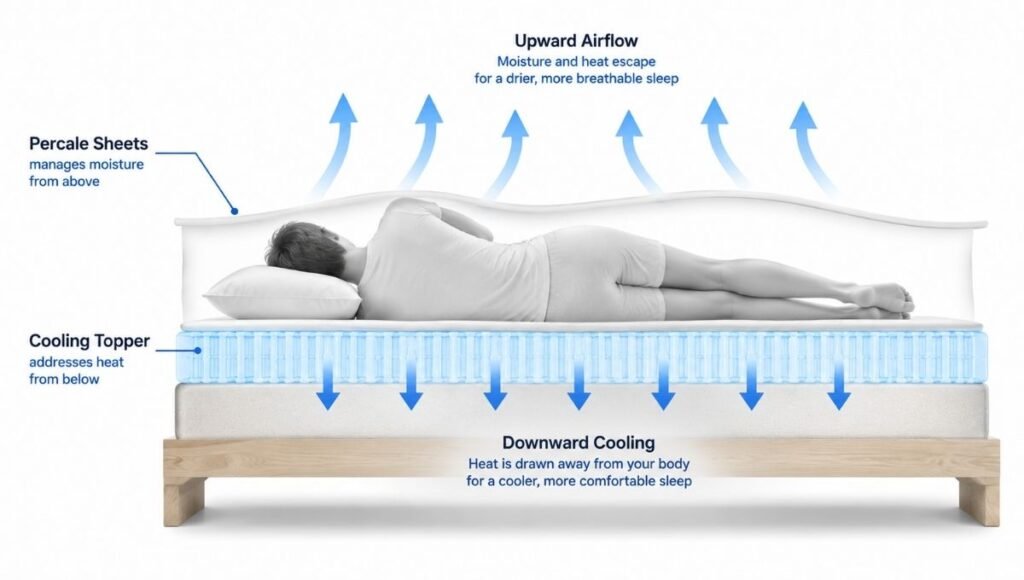
If you fall asleep fine but wake up hot: Your body has warmed the immediate sleep environment over hours. This is where the mattress topper does more work than the sheets — the heat is coming from below as much as from the bedding above. A cooling topper addresses the heat your body is transferring into the mattress.
If you sweat actively during sleep: You need both — breathable sheets to wick moisture away from your skin, and a cooling topper (ideally active cooling) to reduce the heat buildup that triggers sweating in the first place. The sheets manage the symptom (moisture), the topper addresses the cause (heat).
Care and Longevity: Making It Last
Passive toppers (gel foam, latex):
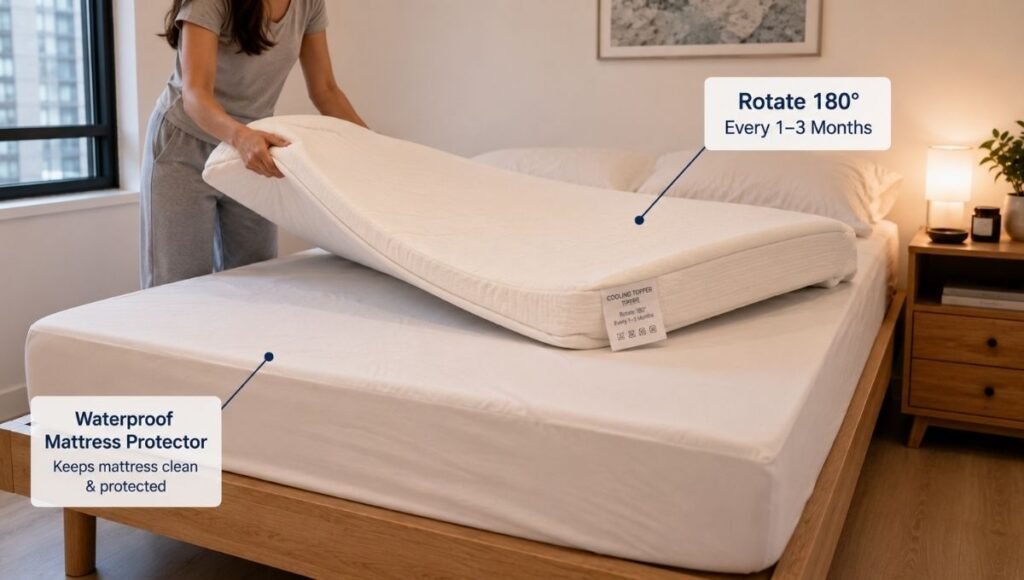
- Rotate every 3–6 months to distribute wear evenly
- Use a mattress protector between the topper and fitted sheet to prevent moisture saturation
- Spot clean only — do not machine wash foam toppers; the structure will be permanently damaged
- Air out monthly by removing the fitted sheet and letting the topper breathe for a few hours
- Expected lifespan: 3–5 years for gel foam, 5–10 years for natural latex
Active cooling systems:
- Flush the water reservoir every 4–8 weeks with a distilled water and hydrogen peroxide solution (brands provide specific ratios)
- Use distilled water only to prevent mineral buildup in the microtubes
- Store the hoses without sharp bends when not in use
- Expected lifespan: 5–8 years for the unit; the pad itself typically lasts as long as the unit
When a Cooling Topper Won’t Be Enough
The cooling mattress topper does one thing: it modifies the temperature of your immediate sleep surface. It cannot compensate for a bedroom at 85°F. It cannot override a down comforter that traps heat around your whole body. And it cannot address night sweats caused by medical factors.
If you’ve invested in quality cooling sheets, a cooling topper, lighter seasonal bedding, and room temperature management — and you’re still waking up genuinely soaked rather than just warm — that’s a signal worth taking to a doctor. Regular drenching night sweats across seasons can indicate thyroid conditions, hormonal changes, certain medications, or other treatable conditions. The investment in better sleep infrastructure is valid regardless, but so is understanding whether there’s a medical component.
FAQ: Cooling Mattress Topper
Do cooling mattress toppers actually work? Passive cooling toppers (gel foam, latex) work for mild-to-moderate hot sleepers, especially on innerspring and hybrid mattresses. They don’t work as well on dense memory foam beds because the mattress itself traps more heat than the topper can dissipate. Active water-cooling systems (ChiliSleep, Eight Sleep) work more reliably across mattress types and for more serious hot sleepers, at a significantly higher price point.
How long does the cooling effect last on a gel mattress topper? The “cool to touch” sensation lasts about 5–15 minutes before the gel reaches skin temperature. After that, the benefit becomes about heat dissipation from the foam rather than active cooling — the foam should sleep somewhat cooler than standard memory foam throughout the night, but the initial cool sensation won’t persist. This is one of the most common sources of disappointment with gel toppers.
Is a cooling mattress topper worth it? Depends on what you’re buying and what’s already on your bed. A $150 latex topper on an innerspring mattress paired with percale sheets is genuinely worth it for most moderate hot sleepers. A $150 gel foam topper on a dense memory foam mattress is a much smaller improvement than the marketing suggests. An active water-cooling system at $500+ is worth it if you’ve already tried passive solutions and found them insufficient — the effectiveness difference is real.
What’s the best cooling mattress topper for memory foam beds? Either a natural latex topper (which adds airflow that memory foam inherently lacks) or an active water-cooling system. Gel foam toppers don’t provide enough cooling to overcome the heat-trapping properties of dense memory foam beneath them. If you love your memory foam mattress and refuse to part with it, the latex topper is the best passive option; active cooling is the most effective solution.
Can a cooling mattress topper help with night sweats? It helps manage the heat that triggers sweating — passive cooling reduces heat buildup at the sleep surface; active cooling continuously removes heat, which can significantly reduce the frequency of sweating episodes. However, if your night sweats are caused by a medical condition (hormonal changes, thyroid issues, medication side effects), a cooling topper will help with comfort but won’t address the underlying cause. If you’re experiencing frequent drenching night sweats across seasons, a conversation with your doctor is worthwhile alongside any bedding investment.
The Bottom Line
The cooling mattress topper category has a credibility problem because the passive gel foam options — which represent the majority of products and the majority of purchases — work for some people and disappoint others based on variables the marketing never mentions: what mattress is underneath, how severely the person sleeps hot, and what they’re comparing it to.
If you’re in the “I’ve tried the gel ones and they don’t do enough” camp, the answer is not to buy another gel foam topper. The answer is latex for a meaningful passive upgrade, or active water cooling for a genuine category-level change in what “sleeping cool” means.
Pair either with breathable sheets, a lighter duvet for warm months, and a room temperature you can actually control — and you’ve built a sleep environment that’s likely to work rather than one that’s optimized for one variable while ignoring the others.
For the sheets that work alongside a cooling topper — percale cotton, linen, and Tencel explained with real thread count science — see our best sheets for hot sleepers guide. And for the bedroom setup that supports better sleep beyond temperature — from bed frame airflow to storage that keeps the room calm — our small bedroom layout guide has the full picture.
References
- Okamoto-Mizuno, K., & Mizuno, K. (2012). Effects of thermal environment on sleep and circadian rhythm. Journal of Physiological Anthropology, 31(1), 14. (Research on sleep surface temperature and sleep quality)
- National Sleep Foundation (2023): Sleep environment temperature guidelines — optimal mattress surface temperature range and its relationship to sleep onset and sleep stages
- Durmer, J. S., MD, PhD. USA Olympic Weightlifting Sleep and Circadian Program Director. Expert commentary on active water-cooling mattress topper use in elite athletes, including hot sleepers with larger body mass (referenced via Tom’s Guide, 2025)
Published on Grainv.com | Category: Bedroom | Related: Best Sheets for Hot Sleepers, Small Bedroom Layout, Small Bedroom Storage Ideas