
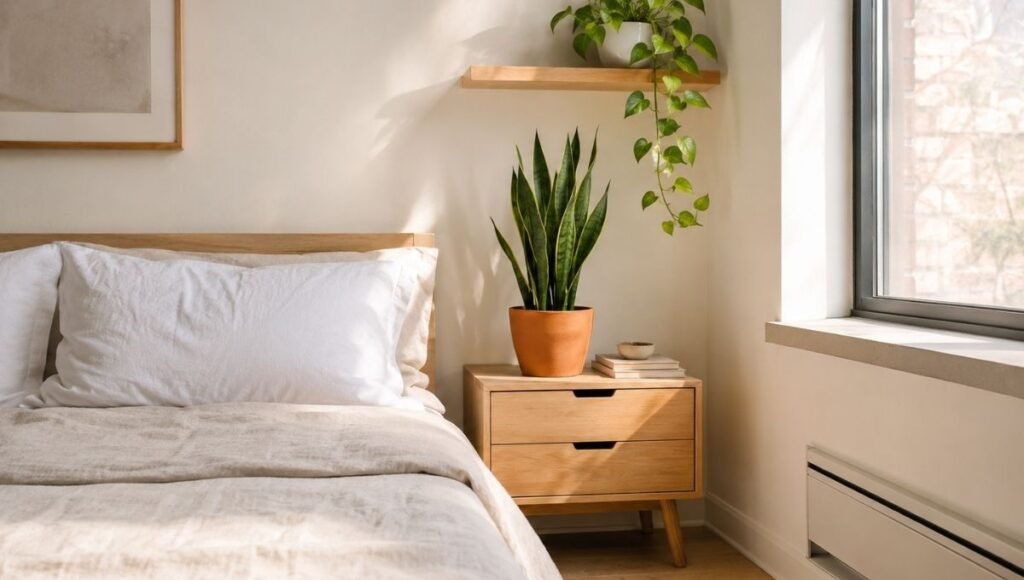
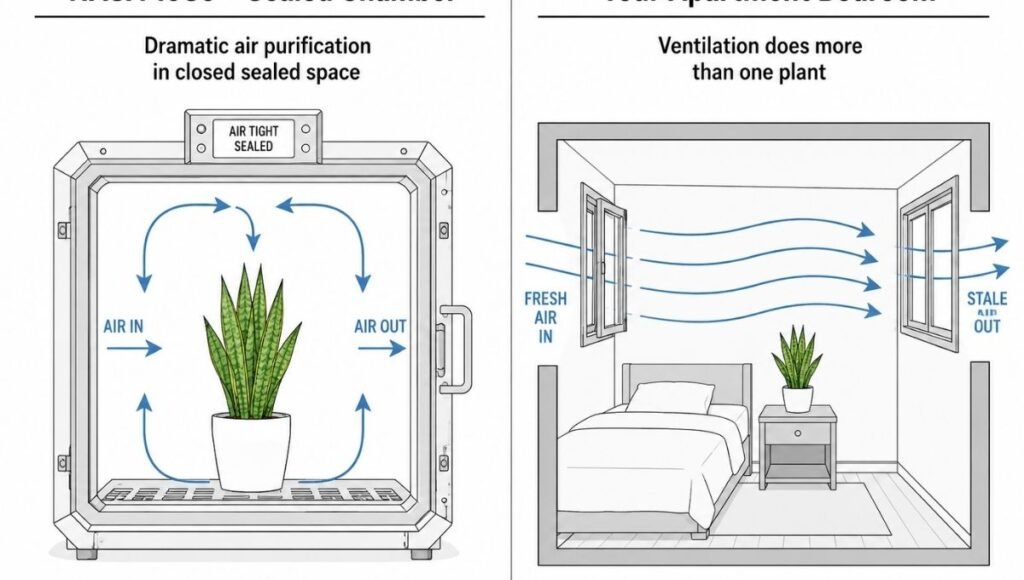
The houseplant Reddit community has a phrase that gets repeated constantly, usually in response to beginners asking which plants will purify their air: “One plant isn’t going to save you. Ventilation will.”
They’re not wrong — but they’re also not the whole story. The nuance that gets lost in both the “plants clean your air!” marketing and the “plants are basically useless for air quality” debunking is that bedroom plants work through multiple mechanisms, not just one. Yes, a single pothos on your nightstand won’t meaningfully change your air chemistry in a normally ventilated apartment. But the same pothos might genuinely help you sleep — through humidity regulation, through the psychological benefit of something living in the room, through the mild cortisol-lowering effect that exposure to greenery produces.
The best plants for bedroom use aren’t the ones with the best NASA air-purifying stats. They’re the ones that do something real for the specific conditions of a small bedroom — which usually means low light tolerance, low-maintenance watering, a manageable footprint, and at least one of the three actual sleep mechanisms: scent, humidity, or oxygen.
This guide separates the plants with genuine bedroom benefits from the ones that are just nice to look at, with honest notes on care requirements for people who travel, forget, or simply don’t have much natural light.
Key Takeaways
- Three mechanisms, not one: Bedroom plants improve sleep through scent (lavender, jasmine — clinically documented), humidity regulation (peace lily — raises humidity by up to 5%), and psychological calm (all plants — cortisol reduction from exposure to greenery is well-documented); air purification requires many more plants than most people keep
- The NASA study honest footnote: The 1989 NASA Clean Air Study was conducted in sealed chambers; a 2019 analysis in the Journal of Exposure Science and Environmental Epidemiology found you would need significantly more plants per room to achieve measurable air filtration comparable to simply opening a window — the psychological and humidity benefits are the more reliable arguments for bedroom plants
- Snake plants and pothos are the most forgiving: Both tolerate low light, irregular watering, small pots, and the temperature swings of apartments; both have some air-purifying properties; both are widely available under $20
- One plant, placed well, beats five plants poorly placed: A single medium snake plant within 2 meters of the bed in a spot with indirect light contributes more than five small struggling plants on a shelf across the room
- Pet households require a different list: Snake plants, pothos, peace lilies, and aloe vera are toxic to cats and dogs; spider plants, areca palms, and Boston ferns are non-toxic alternatives with similar low-maintenance profiles
The Three Ways Bedroom Plants Actually Help Sleep
Before getting into specific plants, it helps to know which of three mechanisms you’re trying to activate — because different plants address different mechanisms, and most articles treat them as interchangeable when they’re not.
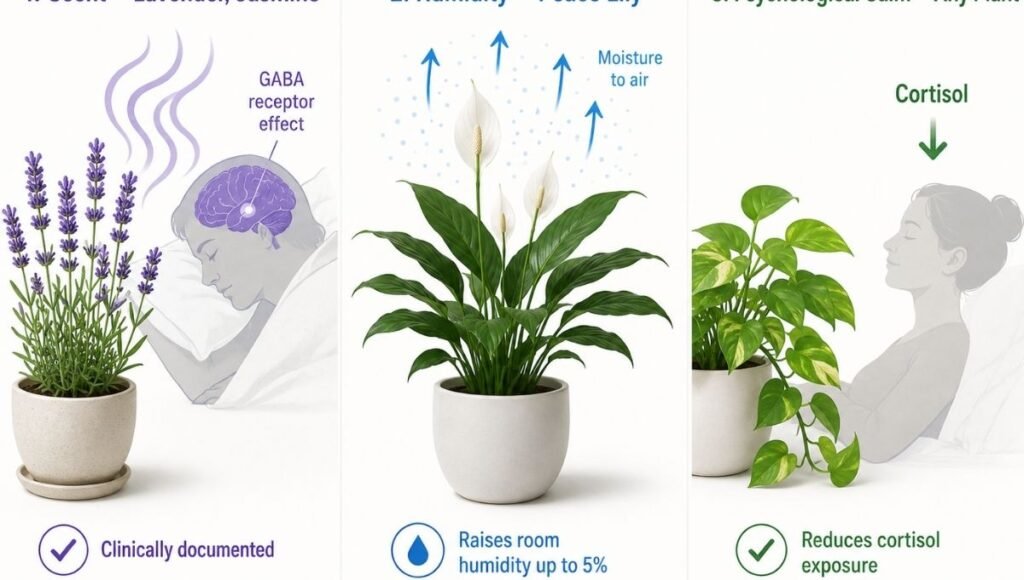
Mechanism 1: Scent-Based Relaxation (The Most Evidence)
This is the mechanism with the most clinical support. Lavender specifically has been studied extensively — studies have shown that the aroma of lavender may alter brain waves and reduce stress, with subjects experiencing greater relaxation, and some studies indicating lavender can relax muscles and slow heart rate, resulting in subjects falling asleep more easily and achieving deeper sleep.
Jasmine has similar evidence. A 2010 study at Wheeling Jesuit University found that jasmine scent reduced anxiety levels and improved sleep quality compared to unscented rooms, with participants in jasmine-scented rooms reporting more alertness the following morning — indicating higher quality rest.
The mechanism: both lavender and jasmine contain volatile compounds (linalool in lavender, methyl jasmonate in jasmine) that interact with GABA receptors in the brain — the same receptors targeted by anti-anxiety medications, at a much milder level. You’re not sedating yourself with a plant, but you are creating a scent environment that reduces physiological arousal before sleep.
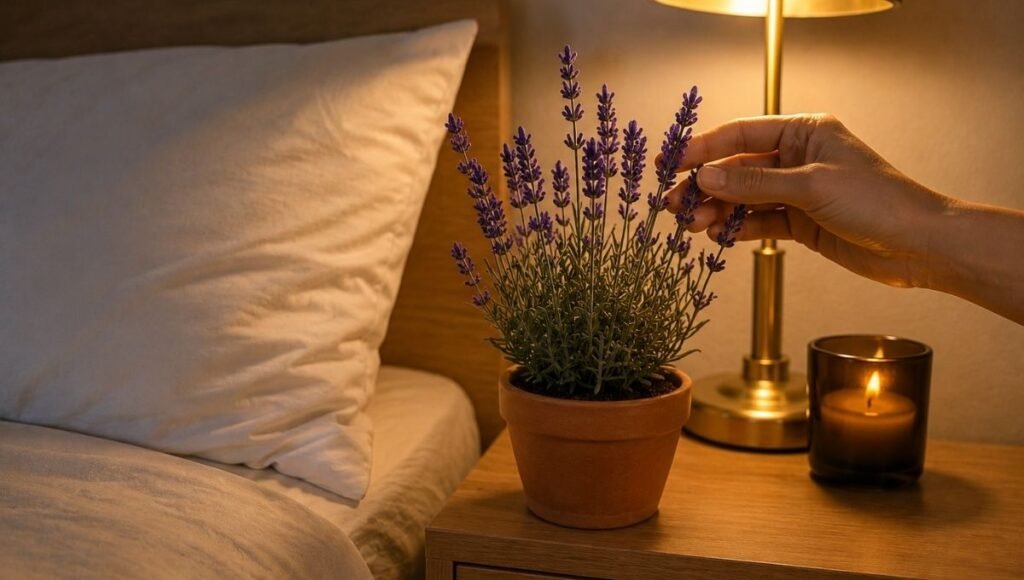
For this mechanism, plant placement matters: The scented plant needs to be close to where you breathe — within 1 meter of the pillow, ideally. A lavender plant across the room provides almost no scent benefit. A lavender plant on the nightstand, especially if you brush the leaves slightly before bed to release the oils, provides measurable benefit.
Mechanism 2: Humidity Regulation (Underrated)
Most heated and air-conditioned apartments run dry — relative humidity below 40%, which causes dry nasal passages, irritated airways, and microparticles remaining suspended in the air longer. Peace lilies can increase room humidity by up to 5%, which is meaningful in a dry apartment bedroom. Most plants contribute some humidity through transpiration, but peace lilies and Boston ferns are the most effective.
This matters for sleep because dry airways increase the likelihood of mouth breathing and microawakenings from respiratory discomfort. In dry climates or heavily heated winter apartments, the humidity contribution from 2–3 medium plants is approximately equivalent to a small passive humidifier.
Mechanism 3: Psychological Calm (Consistent, If Small)
The cortisol-reduction effect of exposure to greenery is well-documented across multiple research contexts — it’s the same mechanism behind why hospital patients with window views recover faster and why urban parks reduce stress markers in city populations. In a bedroom context, having something living in the room contributes to a sense of calm that is measurable in self-reported sleep quality even when the plant has no scent and minimal air-purifying effect.
I have an editorial opinion here: this is the most underrated argument for bedroom plants, and it’s the one that applies to all plants rather than just the specific species. You don’t need a particular NASA-approved variety for this benefit — you need something alive and green in the room. Any plant you actually keep alive accomplishes this.
Best Plants for Bedroom: The Honest Rankings
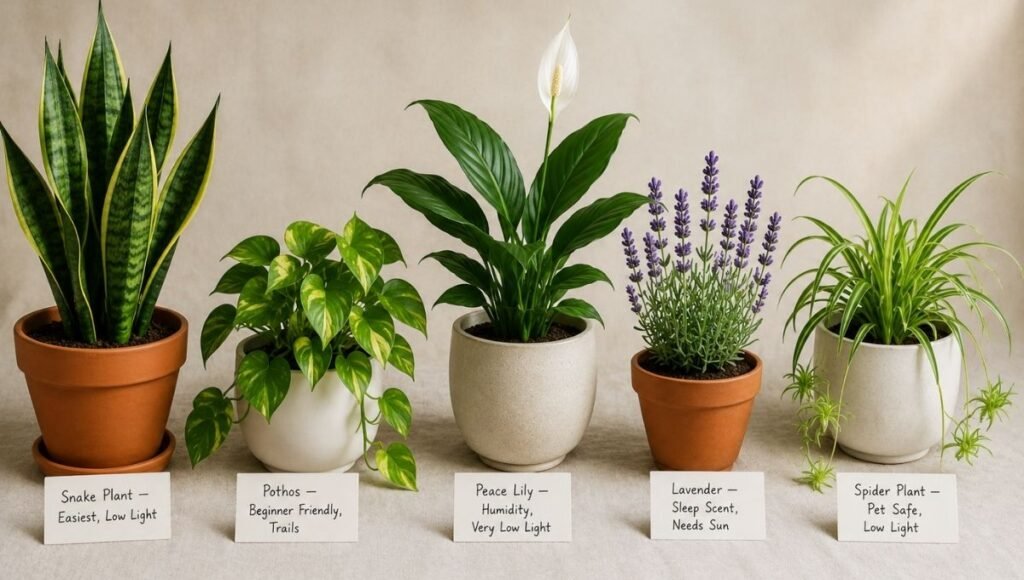
Snake Plant (Sansevieria): The Easiest Right Answer
The snake plant is the correct recommendation for most people asking about bedroom plants, and the reason isn’t primarily its air-purifying properties. It’s that the snake plant is the most forgiving plant for the actual conditions of most apartments — low light, inconsistent watering, temperature variation.
Snake plants use CAM photosynthesis, releasing oxygen at night rather than during the day, and filter formaldehyde, benzene, and trichloroethylene. They’re extremely low-maintenance — tolerating low light and infrequent watering.
Light requirement: Tolerates genuinely low light — 2–3 meters from a window is fine. Will grow faster with indirect bright light but won’t die in a dark corner.
Watering: Every 2–4 weeks in winter, every 1–2 weeks in summer. Check soil — water only when the top 2 inches are completely dry. The most common way to kill a snake plant is overwatering.
Size for a small bedroom: A 6-inch pot with a medium snake plant (30–45 cm tall) sits comfortably on a nightstand or shelf without dominating the space. Larger varieties can be floor plants.
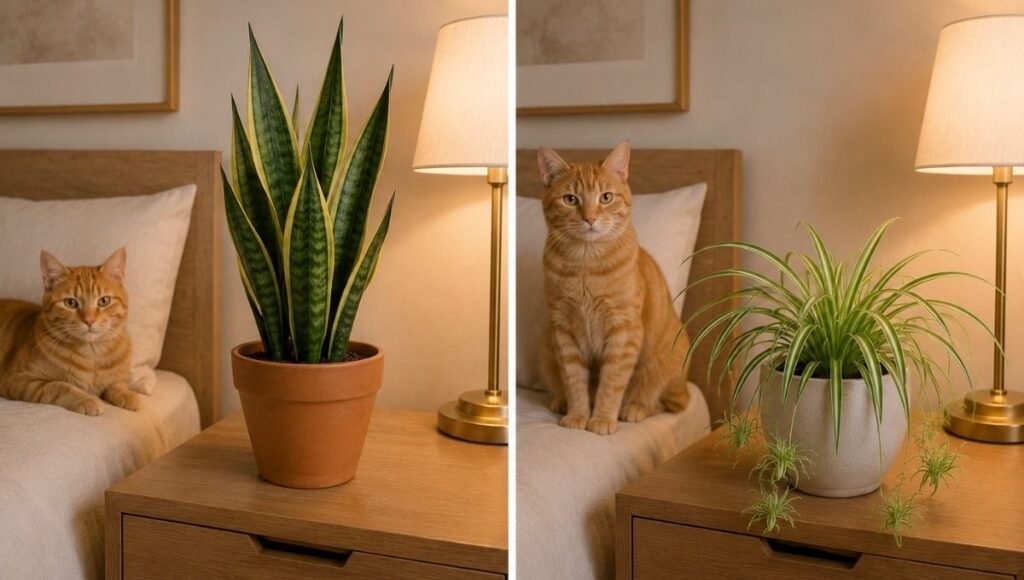
The one caveat: Toxic to cats and dogs. If you have pets, this is not your plant.
Pothos (Epipremnum aureum): The Beginner’s Friend
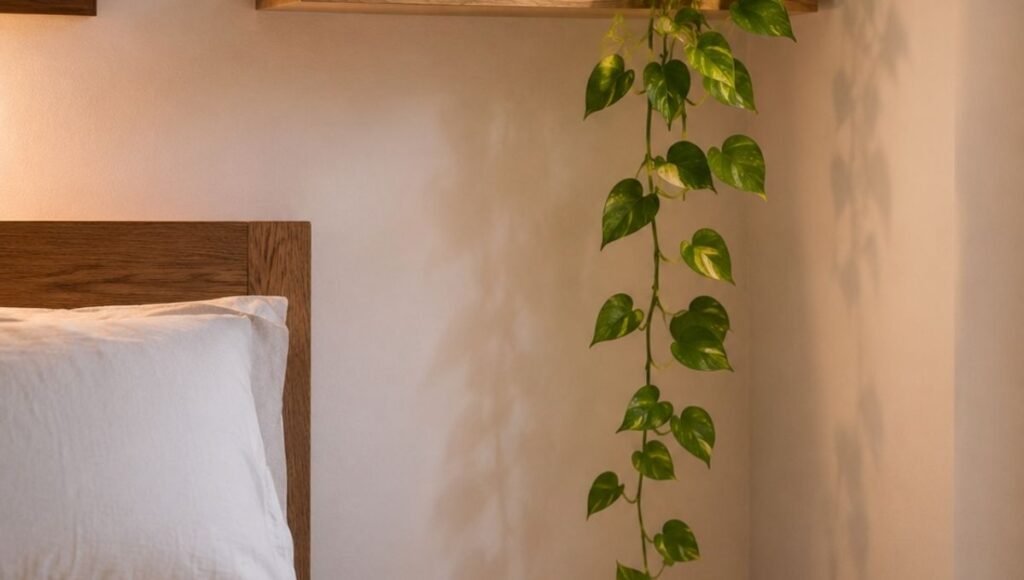
Golden pothos is the most forgiving bedroom plant available. It removes VOCs including formaldehyde, tolerates low light and irregular watering, and grows prolifically. It’s also one of the most visually satisfying plants for small spaces because it trails — a small pot on a floating shelf with trailing vines reads as significantly more decoration than a single upright plant at the same cost.
Light requirement: Tolerates low light well, though variegated varieties (with white or yellow markings) lose their patterning in low light and revert to solid green.
Watering: Similar to snake plant — water when the top soil is dry, roughly every 1–2 weeks. Pothos are more forgiving of occasional overwatering than snake plants.
For small bedrooms: A 4-inch pot on a floating shelf or nightstand, allowed to trail down the wall or furniture, adds significant visual warmth without floor footprint.
Also toxic to pets: Same caveat as snake plant.
Peace Lily (Spathiphyllum): Best for Humidity + Low Light
The peace lily is the most practical choice for bedrooms with very low natural light — it tolerates near-dark conditions that would stress most plants. Its humidity contribution through transpiration is higher than most plants at the same pot size, which is its primary sleep benefit beyond aesthetics.
Peace lilies are amazing air cleaners, as studied by NASA. The added benefit of a peace lily is that it can increase room humidity by up to 5%, which is great for respiration during sleep.
Light requirement: Genuinely tolerates low light — the lowest light tolerance of any plant in this guide. Will grow in a bedroom with minimal window access.
Watering: Weekly or when leaves begin to slightly droop — peace lilies are forgiving and communicate their watering needs clearly.
The honest note: Peace lilies produce pollen that some people find mildly irritating. If you have allergies, this may not be your plant.
Lavender (Lavandula): The Scent Plant That Requires Commitment
Lavender is the only plant in this guide with direct clinical evidence for sleep improvement. It’s also the most demanding in terms of light requirements — and this is where most apartment lavender fails.
Lavender needs full sun. A south-facing windowsill with 4–6 hours of direct light. Most apartment bedrooms don’t have this. A lavender plant in inadequate light will decline slowly over weeks, looking increasingly sad before dying.
If your bedroom has a sunny window: Lavender is worth every bit of the care investment. Keep it on the sill, water sparingly (it’s Mediterranean — it likes to dry out), and brush the leaves before bed to release the oils.
If your bedroom lacks sufficient light: A lavender essential oil diffuser provides the same scent-based sleep mechanism without the plant care demands. This is the honest alternative.
Spider Plant (Chlorophytum comosum): The Pet-Safe Option
Spider plants are the top choice for cat-owning households. They are non-toxic, low-maintenance, and attractive. For households with pets, the spider plant is the correct first recommendation because it combines non-toxicity with the same low-maintenance profile as snake plants and pothos.
Light requirement: Bright indirect light preferred, but tolerates lower light. Avoid direct sun.
Watering: Weekly in growing season, less in winter. Tolerates occasional neglect.
Visual note: Spider plants produce “pups” — small plantlets that dangle on runners from the mother plant. This trailing effect is visually appealing and the pups can be propagated in water, making spider plants self-replicating at essentially zero cost.
Bedroom Plants Low Light: What Actually Survives in a Dark Bedroom
Most bedroom plant guides assume reasonable natural light. The reality of many small apartment bedrooms — particularly those facing north, with windows partially blocked by buildings, or with the bedroom being the most interior room — is that light levels are genuinely low.
The honest low-light plant list for small bedrooms:
Tolerates genuine low light (survives, grows slowly):
- Peace lily
- Pothos
- ZZ plant (Zamioculcas zamiifolia) — extremely drought-tolerant, very low light tolerant, though toxic to pets
- Cast iron plant (Aspidistra elatior) — named for its indestructibility
Tolerates moderate low light (doesn’t thrive but survives):
- Snake plant
- Spider plant
- Dracaena (various species)
Requires more light than most bedrooms have:
- Lavender (needs direct sun — doesn’t work in most bedroom conditions)
- Jasmine (needs bright indirect light at minimum)
- Aloe vera (needs bright light — will stretch and weaken in low light)
If your bedroom is genuinely dark, start with a peace lily or pothos. Both will survive and contribute the psychological and humidity benefits even in low-light conditions.
Feng Shui Bedroom Plants: The Placement Principles That Actually Make Sense
Feng shui plant placement for the bedroom follows two practical principles that hold up independent of the philosophical framework.
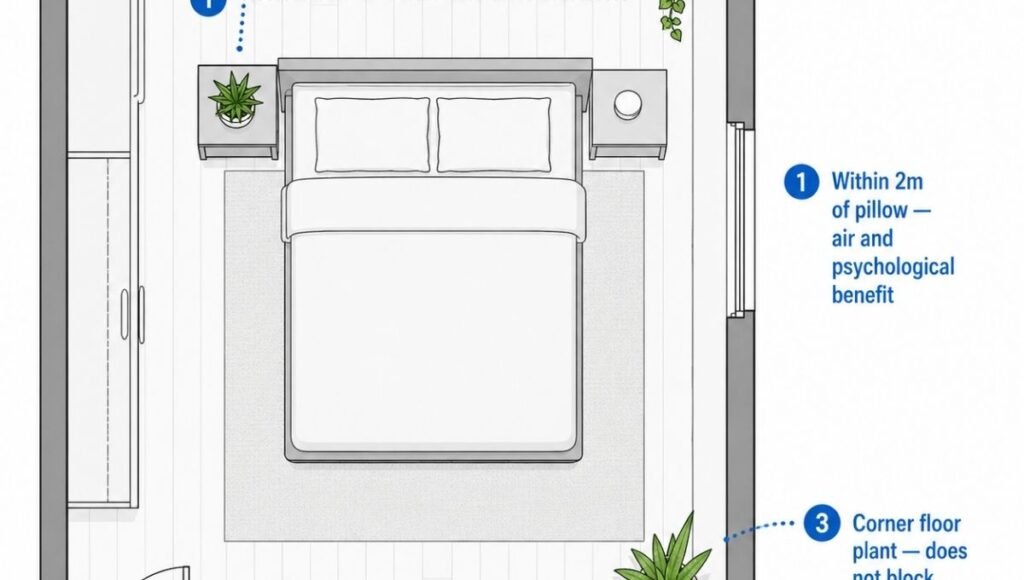
Don’t place large plants directly beside the bed at head height: In feng shui terms, this is about energy flow; in practical terms, a large bushy plant at pillow height reduces the airflow around the sleeping area and can feel visually dominant in a way that disrupts the calm quality of the bedroom. Floor plants work best in corners or beside furniture, not directly beside the pillow.
One plant per focal zone: A single well-chosen plant on the nightstand, one on a dresser, one in a corner — each plant defines a zone rather than competing. Multiple plants clustered in one spot read as a collection rather than as intentional decoration.
Live plants only: Dying or dead plants in the bedroom (in feng shui and in practice) create a visual of neglect rather than life. If you can’t keep a plant alive in your bedroom conditions, a well-chosen ceramic vase is better than a struggling plant.
Plants That Help You Sleep: Setting Honest Expectations
The sleep benefit from bedroom plants is real but modest for most people. Here’s the honest version:
Significant benefit (scented plants — lavender, jasmine — in close proximity): These have documented effects on sleep onset and quality through the scent mechanism. If you can keep one alive with sufficient light, the investment is worthwhile.
Moderate benefit (snake plant, pothos, peace lily): Primarily through psychological calm and mild humidity contribution. The sleep benefit is indirect — these plants make the room feel better, which contributes to sleep quality rather than directly affecting it.
Minimal benefit in isolation (air purification from single plants): A 2019 analysis in the Journal of Exposure Science and Environmental Epidemiology concluded that you would need hundreds of plants in a room to achieve measurable air filtration comparable to simply opening a window. One snake plant doesn’t meaningfully change your air chemistry in a normally ventilated room. It contributes slightly. Multiple plants contribute more. Ventilation contributes more than any number of plants.
This doesn’t mean plants are a waste of time — it means the air-purification argument is the weakest one for bedroom plants, and the psychological and humidity arguments are more honest and more reliable.
How Many Bedroom Plants Do You Actually Need?
The practical guideline for bedroom plants: For sleep and mood benefits, 2–6 plants in an average bedroom. For air purification: 1 plant per 10 m² (100 sq ft).
For a 100 square foot small bedroom: 1–2 medium plants contributes measurably to humidity and psychological calm. 3–4 plants starts to provide some air quality contribution. 6+ plants creates the “urban jungle bedroom” aesthetic that is increasingly popular and provides the maximum passive benefits.
For beginners: Start with one. A single snake plant or pothos, kept alive for three months, teaches you more about what your bedroom conditions support than any amount of research. From there, add a second plant in a different location.
For small bedrooms specifically: Vertical space matters. A trailing pothos on a floating shelf uses wall space rather than floor space. A snake plant in a 6-inch pot on the nightstand uses the same space as a lamp. Both avoid the floor footprint that’s the real constraint in small bedrooms.
If Your Plant Keeps Dying: The Honest Diagnosis
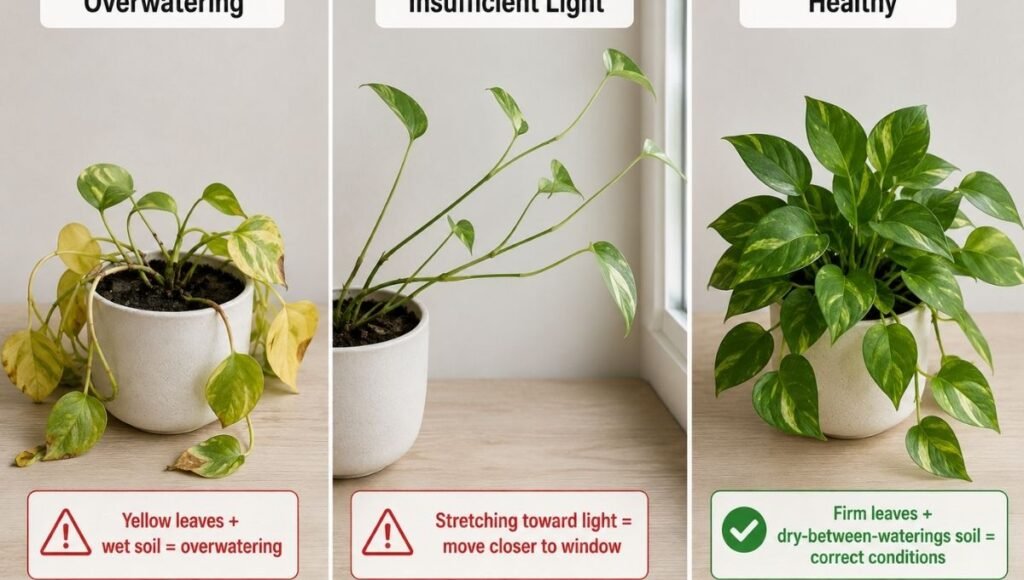
Most bedroom plant deaths come from one of three causes.
Overwatering: The most common. If the soil is damp and the leaves are yellowing, you’re watering too often. Let the soil dry completely between waterings for snake plants and pothos; peace lilies will droop slightly to signal when they need water.
Insufficient light: If the plant is stretching toward the window (leggy, long gaps between leaves) or leaves are pale, it needs more light. Move it closer to the window or consider a small grow light on a 12-hour timer.
Wrong plant for the conditions: If you’ve tried and failed with multiple plants in the same spot, the spot may simply not be suitable for plants without supplemental lighting. This is a legitimate outcome — not every bedroom supports plants, and a ceramic object is a better choice than a dying plant.
FAQ: Best Plants for Bedroom
What is the best plant to put in a bedroom? Snake plant for most people — tolerates low light, irregular watering, and is widely available under $20. Spider plant for pet households — same low-maintenance profile, non-toxic to cats and dogs. Lavender if your bedroom has a sunny window and you want direct sleep benefits through scent.
Do plants in the bedroom improve sleep? Through three mechanisms: scent (lavender and jasmine have clinical evidence), humidity regulation (peace lily raises humidity by up to 5%), and psychological calm (all living plants reduce cortisol exposure). Air purification from a single plant is modest — the psychological and humidity benefits are more reliable in a normally ventilated apartment.
Is it OK to sleep with plants in the bedroom? Yes. The concern that plants “steal oxygen” at night is a myth — the oxygen a single plant uses in the dark is negligible compared to the air volume of a bedroom. Some plants (snake plants, aloe) actually continue releasing oxygen at night via CAM photosynthesis, slightly improving rather than reducing oxygen levels.
What bedroom plants are safe for cats? Spider plants, Boston ferns, areca palms, and calathea are non-toxic to cats. Snake plants, pothos, peace lilies, ZZ plants, and aloe vera are toxic to cats and should be kept out of reach or avoided in pet-access rooms.
How many plants should I have in my bedroom? 1–2 plants for a starting point in a small bedroom; 3–4 for more meaningful humidity contribution; 6+ for the “urban jungle” aesthetic and maximum passive benefits. In a 100 square foot small bedroom, 1 plant per 10 square meters (roughly 100 sq ft) is the practical guideline for air quality contribution.
Where is the best place to put a plant in the bedroom? Within 2 meters of where you sleep for air and psychological benefit. Scented plants (lavender, jasmine) within 1 meter of the pillow. Snake plants and pothos on a nightstand or floating shelf. Peace lilies in a corner with some indirect light. Avoid placing large plants directly at pillow height beside the bed — the floor in a corner or on a dresser is better placement.
The Bottom Line
The best plants for bedroom are the ones you can actually keep alive in your specific conditions. A thriving pothos contributes more to sleep quality through psychological calm and humidity than a dying peace lily with aspirational air-purifying properties.
Start with one plant matched to your light conditions. Snake plant or pothos for most apartments. Spider plant if you have cats. Lavender only if you have a genuinely sunny window. Add a second plant in a different spot once the first has survived three months.
The goal isn’t a particular species — it’s something alive and green in the room that you don’t have to think about constantly.
For the bedroom environment that supports the plants — warm lighting that keeps the room calm, bedding that keeps you cool, and a layout that gives each plant a place — our warm bedroom ideas guide covers the complete atmosphere approach. For the sleep temperature side of the equation — sheets, toppers, and pillows — our best sheets for hot sleepers guide and cooling mattress topper guide cover the full system.
References
- Wolverton, B.C., Johnson, A., & Bounds, K. (1989). Interior landscape plants for indoor air pollution abatement. NASA Technical Report. (The 1989 NASA Clean Air Study — conducted in sealed chambers; baseline reference for plant air-purifying properties)
- Plos One / Journal of Exposure Science and Environmental Epidemiology (2019): Analysis of real-world plant air purification in normally ventilated spaces — concluded that hundreds of plants would be required to match the effect of opening a window
- Goel, N., & Lao, R. P. (2006). Sleep changes vary by odor perception in young adults. Biological Psychology, 71(3), 341–349. (Research on scent and sleep quality, including lavender and jasmine effects)
- Wheeling Jesuit University Study (2010): Jasmine scent and anxiety reduction — referenced in sleep quality research literature
Published on Grainv.com | Category: Bedroom | Related: Warm Bedroom Ideas, Best Sheets for Hot Sleepers, Cooling Mattress Topper, Small Bedroom Storage Ideas