
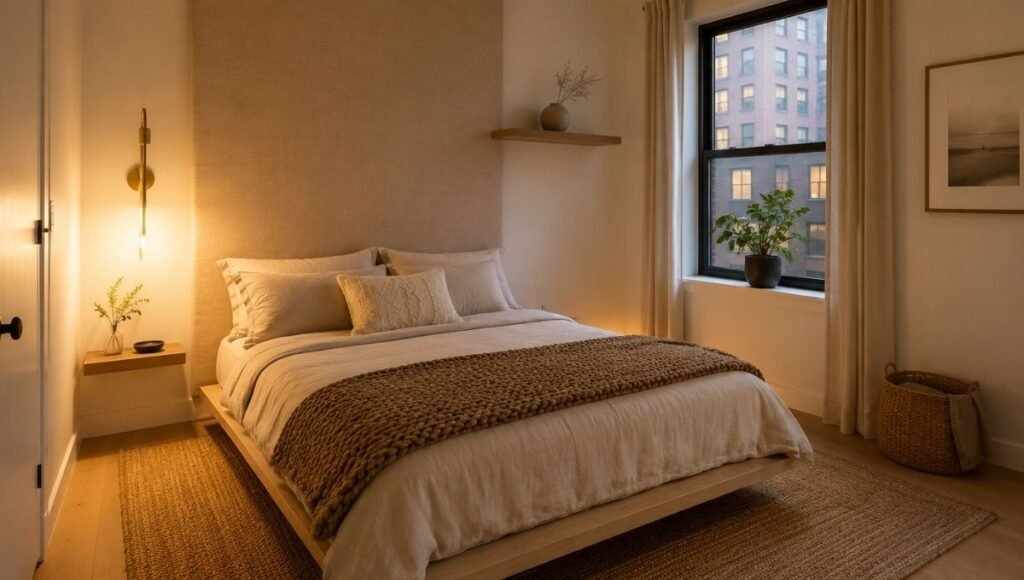
There’s a gap between “I cleaned my bedroom” and “my bedroom looks like someone who has their life together lives here.” You know the gap. The bed is made, the floor is clear, there’s nothing technically wrong — and yet the room looks like temporary housing rather than a place someone chose to live in. Like you’re waiting to move somewhere better before you bother making it feel like yours.
Small bedroom decor is often the casualty of that waiting. The room is too small for a full furniture set. You don’t know what style you’re going for. You spent your furniture budget on the bed frame and now there’s nothing left for anything else. And every time you look at bedroom inspiration photos, they’re all shot in 400-square-foot master suites with vaulted ceilings and professionally styled shelves and you think “well, that’s not applicable to me.”
This guide is specifically for the small bedroom — under 150 square feet, probably rented, probably not something you’re planning to stay in forever but you’d like it to feel livable in the meantime. The strategies here work within real constraints: limited space, renter rules, and a budget that doesn’t include $800 headboards.
Key Takeaways
- The anchor piece is non-negotiable: Every well-decorated small bedroom has one dominant design choice — a headboard, a statement rug, a gallery wall — that gives the eye something to land on; without it, the room reads as unfinished regardless of how many smaller decisions are made correctly
- Vertical space above 60 inches is almost always empty in small bedrooms: Floating shelves, wall-mounted sconces, and art hung higher than eye level use the one resource that small rooms have in abundance — wall height
- Neutral ≠ boring, but it does require texture: A bedroom in all white or all beige needs three or more different textures to read as designed rather than vacant; without texture contrast, neutral rooms just look unfinished
- Research published in Color Research & Application (1996) found that warm-toned rooms are consistently rated as more comfortable, welcoming, and “lived-in” than cool or neutral rooms — which explains why the same furniture in a warm-white room and a cool-white room reads as intentional vs. institutional
- The 60/30/10 color rule adapted for small bedrooms: 60% dominant neutral (walls, bedding, large furniture), 30% secondary tone (rug, curtains, one furniture piece), 10% accent (throw pillows, lamp, small objects) — this proportion works in any room size but is especially visible in small rooms where each element carries more visual weight
Small Bedroom Decor: The Anchor Piece Problem
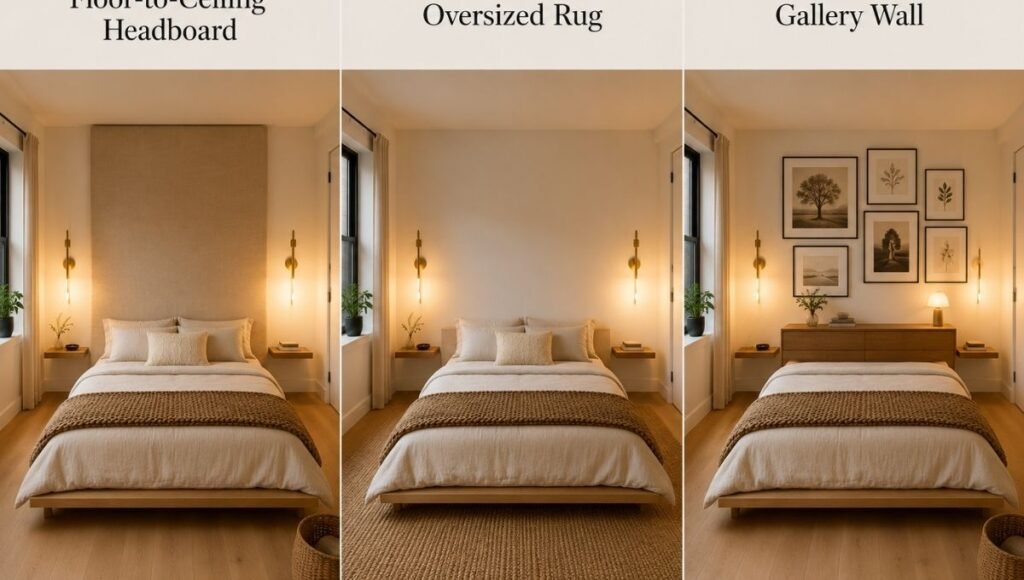
Most small bedrooms that feel unfinished have the same issue: no anchor. The furniture is fine, the colors are inoffensive, the room is functional — but there’s no single decision that makes the room feel deliberate.
An anchor piece is the element that gives the room a visual center of gravity. It’s the thing you notice first when you walk in, and it’s what the other decisions orbit around. In a small bedroom, you get one — two anchors compete and the room looks busy. One anchor gives the room a clear focal point and makes everything else feel like it belongs.
The three most effective anchors for a small bedroom:
A headboard that touches or nearly touches the ceiling: This is my preferred small bedroom anchor, and it’s underused. Most people buy a headboard that sits 24–36 inches above the mattress and leaves 30+ inches of bare wall above it. A floor-to-ceiling headboard panel — even a DIY one made from plywood and fabric — makes the bed feel architecturally integrated into the room rather than just placed against a wall. In a small bedroom, this reads as designed rather than decorated.
A rug that’s larger than you think you need: The most common small bedroom rug mistake is a rug that fits precisely under the bed with a small border. A rug that extends 18–24 inches beyond the sides and foot of the bed anchors the entire sleeping zone and makes the room feel proportional. An 8×10 rug in a 10×12 bedroom doesn’t look too large — it looks like someone measured before they bought.
A gallery wall on the wall you see from the bed: Not from the door — from the bed. The wall you spend most of your time looking at in a bedroom is usually above the dresser or the wall opposite the bed. A thoughtfully assembled gallery wall there — not a random collection of frames, but a considered arrangement with consistent frame tones — gives the room depth and personality without consuming floor space.
Choose one. Execute it well. Build everything else around it.
How to Decorate a Small Bedroom: The Wall You’re Ignoring
Most small bedrooms use approximately 40% of their available wall space for decoration. The other 60% is bare, usually above furniture height. This is backwards.
Floor space is the scarce resource in a small bedroom. Wall space is abundant. Every inch of floor furniture is competing for the same square footage as your circulation, your closet door swing, and your ability to get dressed without turning sideways. Wall fixtures, mounted shelves, and hung art use none of that floor footage.
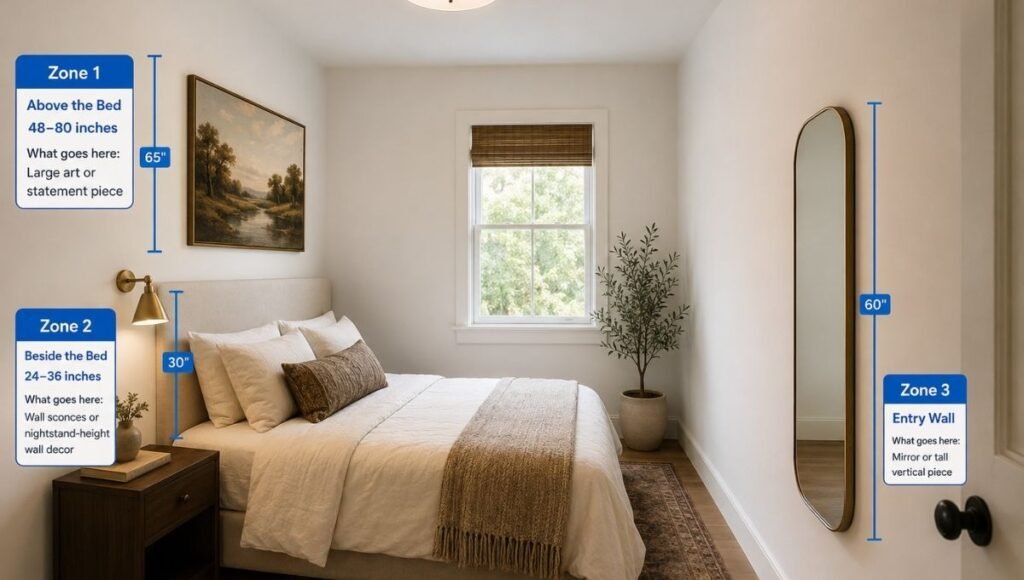
The wall zones worth using:
Above the bed (48–80 inches from the floor): This is prime real estate that most bedrooms leave empty. A piece of art centered above the headboard at 60–70 inches height, a floating shelf with a plant and small lamp, or your gallery wall anchor. Whatever goes here should span at least 2/3 the width of the headboard — smaller and it looks like you couldn’t commit.
Beside the bed at nightstand height (24–36 inches from floor): A wall-mounted sconce replaces the table lamp entirely, freeing the nightstand surface completely. A small floating shelf replaces the nightstand, freeing the floor space the nightstand would have occupied. Both of these are direct trades of floor space for wall space — always worth it in a small bedroom.
The door-facing wall (what you see when you enter): This is where first impressions form. If this wall has nothing on it, the room reads as sparse. A mirror in the 24–36-inch range, a piece of large-format art, or one well-chosen hook arrangement makes this wall do work. A full-length mirror here serves double duty — it adds depth, reflects light, and solves the “where do I check my outfit” problem simultaneously.
How to Make Your Bedroom Cozy: What Changes Everything for Under $100
The most common complaint about small bedrooms isn’t about size. It’s about feeling — the room feels clinical, or temporary, or like a hotel room that hasn’t been checked out of. The things that make a bedroom feel lived-in and cozy are specific and almost all of them are inexpensive.
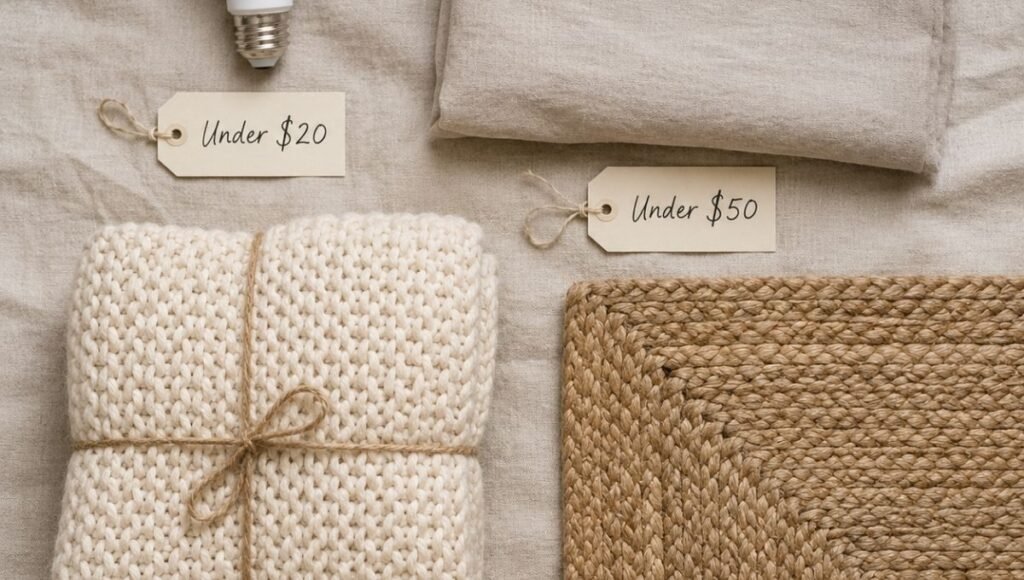
Under $20:
Change the light bulb to 2700K warm white. As covered in our warm bedroom ideas guide, this single change is the highest-return bedroom intervention available. Cool-white or daylight bulbs make every bedroom look temporary. 2700K warm light makes the same room look like somewhere a person chose to be.
Under $50:
Replace any synthetic (polyester or microfiber) pillowcase with a linen or percale cotton one. The texture difference between synthetic and natural fiber pillowcases is visible from across the room — polyester looks flat and slightly shiny, linen looks lived-in and comfortable in a way that reads as intentional.
Add one throw blanket, folded (not thrown) at the foot of the bed. The operative word is folded — a throw draped casually over the corner of a small bed looks like laundry that didn’t make it to the closet. A throw folded in thirds lengthwise and placed at the foot of the bed looks like a design choice.
Under $150:
A jute or wool rug at the correct size (18–24 inches extending beyond the bed on sides and foot). Natural fiber rugs have a texture and warmth that synthetic rugs don’t — the difference is visible in photographs, which is why every styled bedroom photo uses natural fiber rugs. They’re also more forgiving of small bedroom vacuuming challenges because the texture naturally hides minor debris.
Small Bedroom Decor by Style: Three Approaches That Work in Small Spaces
Style guides for bedrooms often present 12 or 15 different aesthetics. In practice, small bedrooms work best with one of three approaches — not because other styles can’t work, but because these three have a built-in logic that works within small-space constraints.
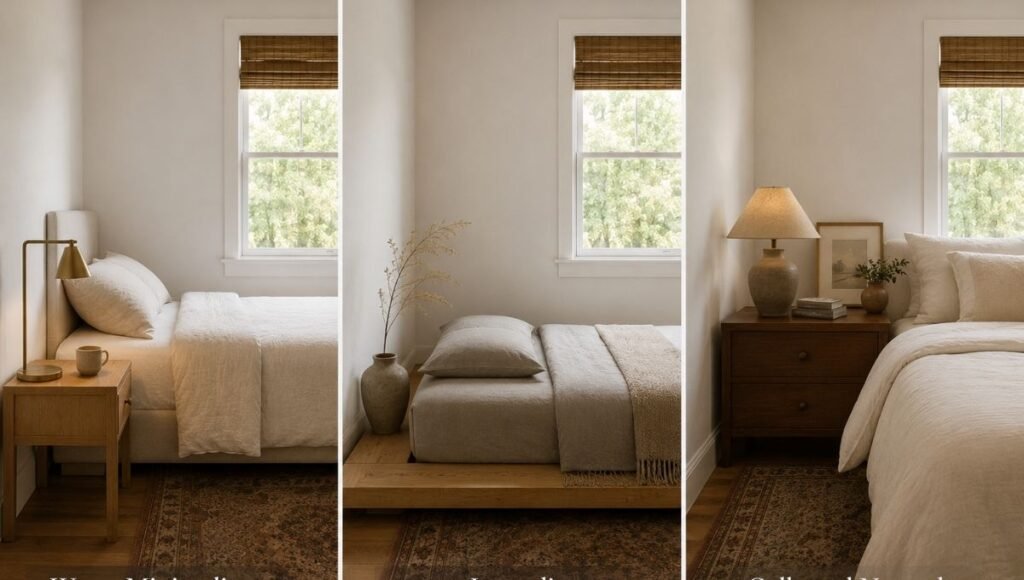
Warm Minimalist
Everything in natural materials and warm neutrals. Linen sheets, one oak wood surface, one ceramic object, warm lighting. No pattern, no color contrast, no accumulated decoration. The warmth comes from material quality rather than decoration quantity.
What makes it work in a small bedroom: No visual noise. Every object is either functional or intentionally decorative — nothing is there because it ended up there. The room feels curated rather than lived-in-by-default. Warm minimalist scales down without effort because you’re not trying to fit in a lot.
The risk: It can read as stark or unfinished if the three-texture rule isn’t followed. Smooth, woven, and one contrasting texture — minimum. Without texture, warm minimalist becomes just beige.
Japandi (Japanese-Scandinavian)
Low furniture, natural materials, muted palette with one earthen accent color. Typically: a low platform bed, light wood tones, linen in natural white or warm gray, and one piece of careful pottery or a natural element (branch, stone, dried grass).
What makes it work in a small bedroom: Low furniture emphasizes ceiling height. The aesthetic actively resists accumulation — it’s difficult to accidentally add too much to a Japandi room because excess reads as obviously wrong. The style is also forgiving of imperfect walls and floors because the aesthetic expects natural imperfection.
The risk: Getting the furniture scale right. Japandi requires genuinely low furniture — a standard 24-inch bed frame defeats the aesthetic. Platform beds at 12–14 inches or floor-level beds are correct. Most standard bedroom furniture is too tall.
Collected Neutrals
One dominant neutral (white, oatmeal, sage, warm gray) as a backdrop, with collected objects in different materials and tones that share the same general warmth temperature. Vintage and new mixed. Organic shapes alongside geometric ones. The room looks like it accumulated over time rather than being assembled in a weekend.
What makes it work in a small bedroom: It’s the most forgiving of the three styles — accumulated over time means that individual imperfect additions can be corrected or removed. It also doesn’t require specific furniture — any furniture in warm neutral tones works as a starting point.
The risk: It tips into clutter easily, especially in a small room where every surface is visible. The “collected” quality requires editing: adding new things while removing others, so the room always reads as curated accumulation rather than just accumulated. If you’re not willing to edit regularly, this style is harder to maintain in a small room.
Small Bedroom Furniture Ideas: What to Add vs. What to Skip
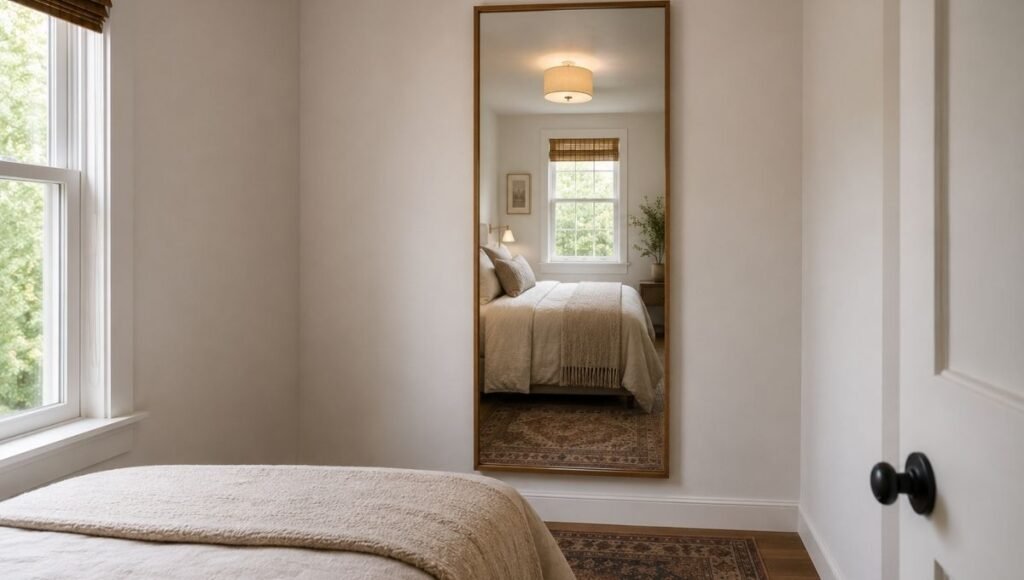
Small bedroom decor fails most often not from bad choices but from overcrowded choices — adding furniture that’s not necessary for the room’s function and that the room’s floor space can’t absorb.
Add:
A full-length mirror (if there isn’t one) — this is the most frequently wished-for addition in small bedrooms and the one most consistently omitted. A 48–60-inch standing mirror or wall-mounted mirror on the door or adjacent to the closet makes the room feel twice its actual size and solves a daily practical need.
One piece of wall art at meaningful scale — not postcard size, not three small frames in a row. One piece of at least 18×24 inches, ideally larger, hung at correct height (center at 57–60 inches from floor). Scale matters; a small room with appropriately scaled art reads as a room, not a corridor.
One plant, maximum one — in a small bedroom, a plant adds life and natural variation in a way that no object can replicate. One well-chosen plant in a correctly sized ceramic pot, positioned where it gets light. Not three plants, not a plant shelf. One.
Skip:
A second nightstand if you don’t share the bed. One nightstand or floating shelf on the primary access side. The other side gets a floating shelf for a glass and phone, or nothing. Two matching nightstands in a small bedroom consume floor space on the side of the bed you access 10% of the time.
A dresser if your platform bed has storage drawers. The storage bed and dresser combination is the most common floor-space inefficiency in small bedrooms — choosing one or the other (not both) frees an entire wall.
A bench at the foot of the bed in rooms under 100 square feet. The foot-of-bed bench is a beautiful piece of furniture in appropriate rooms. In a very small bedroom, it blocks the path from the door to the bed and makes the room feel obstacle-course-like. Save it for your next apartment.
The 10-Minute Version: If You Just Want Something to Feel Different Today
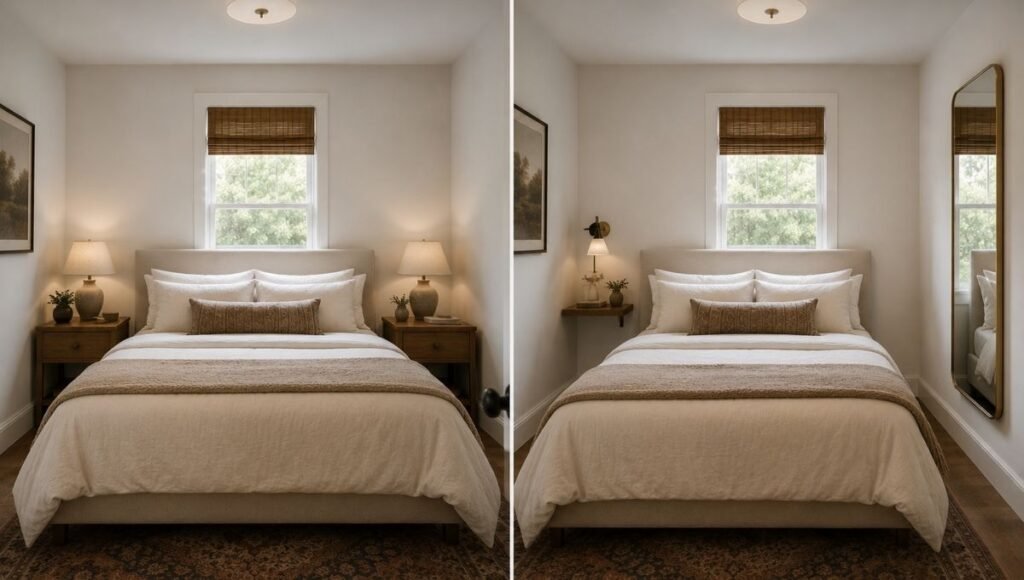
Move one piece of furniture. Not everything — one thing. Move the nightstand to the other side. Turn the bed to face a different wall. Angle a chair. The act of rearranging, even modestly, changes your relationship to the room and often reveals possibilities you stopped seeing because the arrangement had been static.
Put everything off the surfaces. Every surface — nightstand, dresser, windowsill. Into a drawer or closet, temporarily. Now put back only what has a specific purpose or is something you genuinely chose for that spot. Everything else stays in the drawer. If you don’t miss something after a week, it doesn’t come back out.
Change one thing to warm white. One bulb, one pillowcase, one throw. Any one of these changes the temperature of the room and makes it feel more considered in under 10 minutes.
FAQ: Small Bedroom Decor
How do I make a small bedroom look nice? Start with one anchor piece — a statement headboard, an oversized rug, or a gallery wall — and build around it. Then: change lighting to 2700K warm white, add texture to the bedding in three layers (smooth sheets, woven throw, one contrasting accent pillow), use wall space above furniture height rather than leaving it bare, and edit ruthlessly — remove anything that’s there by default rather than by decision.
What decor looks good in a small bedroom? In small bedrooms, decor that uses wall rather than floor space performs best: wall-mounted sconces instead of table lamps, floating shelves instead of nightstands, art hung at correct scale, and mirrors that add depth. On surfaces, use the mixed-material formula: one ceramic object, one wooden object, one metallic element — three different materials read as curated; three of the same material read as a shop display.
How do you decorate a small bedroom on a budget? In priority order: (1) $8–20 for 2700K warm light bulbs — highest impact per dollar in any bedroom; (2) $20–40 for one linen or percale cotton pillowcase to replace synthetic ones; (3) $30–60 for one natural fiber throw blanket; (4) $40–80 for one meaningful piece of art at appropriate scale. These four investments, done in order, address lighting, texture, material warmth, and visual anchoring — the four components of a room that reads as decorated rather than occupied.
What color should a small bedroom be? Warm whites and off-whites consistently outperform cool whites in small bedrooms — they read as warmer and more welcoming under any light source, and they cooperate with warm lighting rather than fighting it. If you want color, warm-toned accents (terracotta, warm sage, dusty rose, caramel) read as grounding in small spaces. Cool colors (cool gray, blue-gray, cool green) can work but require warm lighting to prevent the room from feeling clinical.
What makes a small bedroom look bigger? Five consistent choices: furniture on visible legs (floor seen beneath it reads as more space), one large rug rather than no rug or a small one, ceiling-height curtains even on short windows, a full-length mirror positioned to reflect light or the room’s depth, and warm ambient lighting rather than overhead cool-white light. These five changes make a room feel more open without changing its actual dimensions.
The Bottom Line
Small bedroom decor is not about filling the room — it’s about making deliberate choices that read as intention. One anchor piece. Warm light. Texture in layers. Wall space used above furniture height. Natural materials in at least one place.
The room doesn’t need to be large for it to feel like somewhere a person would want to be. It needs to feel like someone decided — about the light, about the materials, about what stays on the surfaces and what doesn’t.
Make those decisions, and the room will read as designed rather than default.
For the lighting decisions that make the biggest difference in a small bedroom — specifically warm bulb temperature and where to position lamps — our warm bedroom ideas guide covers the full approach. For the layout questions — bed placement, clearances, and which wall the bed goes on — our small bedroom layout guide has five arrangement formulas by room shape. And for bedroom storage that frees the floor space you need to actually decorate — our small bedroom storage guide covers the hierarchy from storage beds to floating shelves.
References
- Kwallek, N., Lewis, C. M., Lin-Apo, J. S., & Woodson, H. (1996). Effects of nine monochromatic office interior colors on clerical tasks and worker mood. Color Research & Application, 21(6), 448–458. (Research on warm vs. neutral color temperature and perceived room comfort)
- Stamps, A. E. (2010). Effects of permeability on perceived enclosure and spaciousness. Environment and Behavior, 42(6), 864–886. (Research on mirror placement, visual depth, and perceived spatial openness in residential settings)
Published on Grainv.com | Category: Bedroom | Related: Warm Bedroom Ideas, Small Bedroom Layout, Small Bedroom Storage Ideas, Fairy Lights Bedroom