
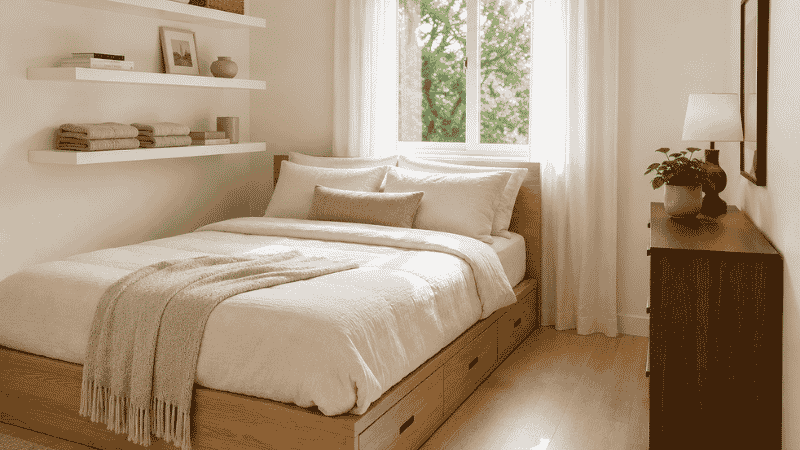
Every morning it’s the same routine. You open the closet and things fall out. You know roughly where the shirt is — somewhere in the second drawer, under a layer of things that don’t belong there. The chair in the corner has become a de facto wardrobe. And somehow, despite multiple reorganization attempts, the room manages to look cluttered within 48 hours of every cleaning session.
This isn’t a discipline problem. It’s a storage infrastructure problem. Small bedrooms fail not because their owners are disorganized, but because the furniture and storage systems weren’t designed to handle the actual volume of belongings that a modern person needs to store. The dresser has five drawers and none of them close properly. The closet rod is a single bar with no shelf above it. The space under the bed is full of things that were put there “temporarily” two years ago.
This guide gives you small bedroom storage ideas organized around a different logic: not “what looks nice” but “where does space actually exist in this room, and how do I access it without adding more furniture to the floor.” We’ll cover every position in the room — under the bed, on the walls, inside the closet, behind the door, and beside the bed — with specific dimensions, capacity numbers, and honest assessments of what works versus what just looks good in photos.
Key Takeaways
- The under-bed zone is your largest untapped storage area: A standard queen bed has approximately 42 × 80 inches of floor space beneath it — equivalent to two large dresser footprints — most of which sits empty in most bedrooms
- Bed frame with storage drawers vs. dresser: A platform bed with four built-in drawers holds roughly the same volume as a 5-drawer dresser while consuming zero additional floor space — the trade-off is drawer depth (typically 6–8 inches vs. 9–12 inches for a standard dresser)
- The 7-inch rule for under-bed storage: You need at least 7 inches of clearance between the floor and the bottom of your bed frame to use rolling storage bins; 10+ inches for low-profile drawer units; 14+ inches for drawer units with full extension slides
- Vertical wall space above 60 inches is almost always empty: Most bedroom furniture tops out at 54–60 inches; the 24–36 inches of wall between the furniture line and the ceiling is the highest-efficiency storage zone that requires zero floor space
- A cluttered bedroom measurably affects sleep quality: Research published in Sleep (2015) found that people surrounded by clutter have significantly more difficulty falling asleep and report lower sleep quality — making bedroom storage a health issue, not just an aesthetic one
First: Identify Which Bedroom You Have
The right small bedroom storage ideas depend entirely on one factor most guides skip: whether your room has a built-in closet or not. These are fundamentally different storage problems with different solutions.
Bedroom with a built-in closet: Your clothing storage is partially solved. The priority is maximizing the closet’s capacity (it almost certainly has a single rod and one shelf — the least efficient possible configuration) and finding supplemental storage for overflow and non-clothing items.
Bedroom without a built-in closet: You’re solving clothing storage from scratch on top of everything else. This requires either a wardrobe/armoire system or a creative combination of open storage, a dresser, and under-bed solutions that together approximate what a closet would provide.
Every section below specifies which scenario it addresses. Read the sections that match your room.
Under-Bed Storage: Your Bedroom’s Biggest Untapped Zone
The space under the bed is the most significant storage opportunity in a small bedroom, and it’s consistently underused — usually because what’s under there now is a random collection of things put there without a system. Before adding anything, clear it out completely and measure the clearance.
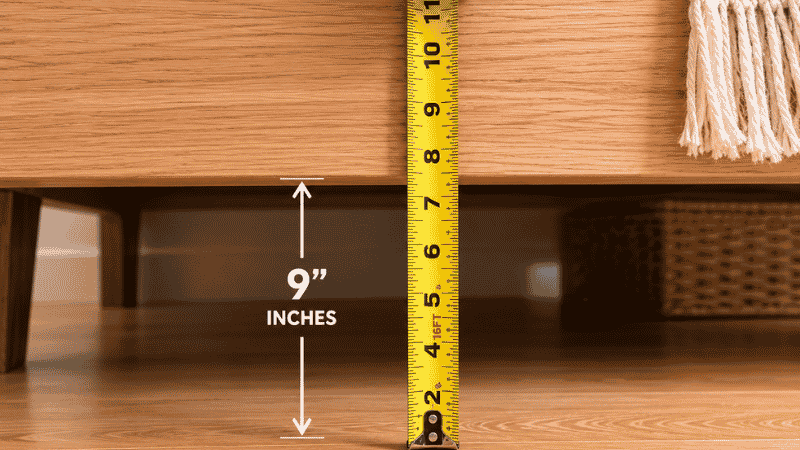
How to Measure Your Under-Bed Clearance
Lie on your stomach and measure from the floor to the bottom of the bed frame at the lowest point — usually near the center of the longest rail. This measurement determines which storage solutions are viable:
- Under 5 inches: Only flat vacuum storage bags work here. No bins, no drawers.
- 5–7 inches: Low-profile fabric bins with flat lids. No rolling drawers.
- 7–10 inches: Rolling storage bins with wheels, fabric cube bins with lids, shallow woven baskets.
- 10–14 inches: Low-profile under-bed drawer units (rolling or stationary).
- 14+ inches: Full under-bed drawer systems with extension slides, storage drawers that match the bed frame.
Most platform beds have 7–10 inches of clearance. Most traditional bed frames on legs have 10–14 inches. Beds on risers (adding 3–6 inches of height) can reach 14–18 inches with clearance to spare.
What to Store Under the Bed
The best candidates for under-bed storage are items you need occasionally but not daily:
- Seasonal clothing (the clothes for the season you’re not in)
- Extra bedding (a spare set of sheets, an extra duvet)
- Shoes (a flat rolling shoe organizer holds 12–16 pairs in the same footprint as one pair of shoes standing upright)
- Off-season accessories (scarves, hats, gloves in summer; sunglasses and light bags in winter)
Daily-use items do not belong under the bed. If getting dressed requires you to pull out and push back under-bed bins every morning, you won’t maintain the system.
Bed Frames with Storage Drawers: The Case for Replacing Your Bed
If you’re in the market for a new bed frame or willing to invest in one, a storage platform bed is the single highest-impact storage decision you can make for a small bedroom. Here’s the actual math:
A queen platform bed with four built-in drawers (two per side, roughly 28 inches wide × 8 inches deep × 6 inches tall each) provides approximately 3,584 cubic inches of storage — roughly equivalent to the capacity of a standard 5-drawer dresser. The difference: the dresser sits on the floor and consumes 36–42 inches of wall width and 18–20 inches of depth. The storage bed consumes zero additional floor space.
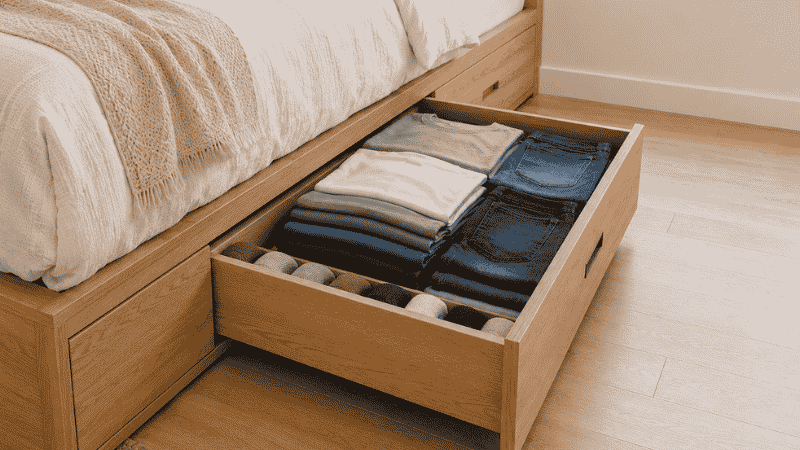
What to look for when buying a bed frame with storage drawers:
- Drawer depth of at least 6 inches (shallower than this and folded clothing won’t fit flat)
- Full-extension drawer slides (so you can access the back of the drawer without fully removing it)
- Soft-close mechanism (prevents slamming damage over time)
- Platform height that maintains at least 18–19 inches of seat height — critical for comfortable daily use
Wall Storage for Small Bedrooms: Going Vertical Without Going Crazy
The bedroom wall above the furniture line — roughly 54–96 inches from the floor — is where small bedroom storage ideas consistently underperform. Most people have furniture that tops out at 54 inches and a ceiling at 96 inches. That 42-inch gap is 42 inches of wall that holds nothing.
Floating Shelves: The Highest ROI Wall Storage
A single floating shelf at 72 inches height holds what a side table or short bookcase would hold, while using zero floor space. Three shelves at 48, 60, and 72 inches create a storage column that replaces a freestanding bookcase entirely.
Shelf dimensions for bedroom use: 8 inches deep for books and display objects; 10–12 inches deep for fabric bins or baskets. Length: match the wall span or work in multiples — 24-inch and 36-inch shelves are the most common available sizes and work well in standard bedroom wall widths.
What works above 60 inches: Books (spines facing out), small plants, display objects, a basket for seasonal accessories. Avoid bins and heavy objects at this height — they’re hard to access and look visually heavy.
What works at 48–60 inches: Baskets with lids (frequently accessed items), a shelf for bags, a display of framed photos.
Rental note: Command strips rated 7.5 lbs per strip support display shelves for light objects. For shelves that need to hold books or heavier baskets, wall anchoring into studs is required. If renting, consider a freestanding shelf unit that reaches ceiling height instead.
Wall-Mounted Nightstand Alternatives
A standard nightstand consumes 18–22 inches of floor width beside the bed. In a narrow bedroom where that space is critical, a wall-mounted floating shelf at nightstand height (22–24 inches from the floor) provides the same surface function — a lamp, your phone, a glass of water, a book — while freeing the entire floor space beneath it.
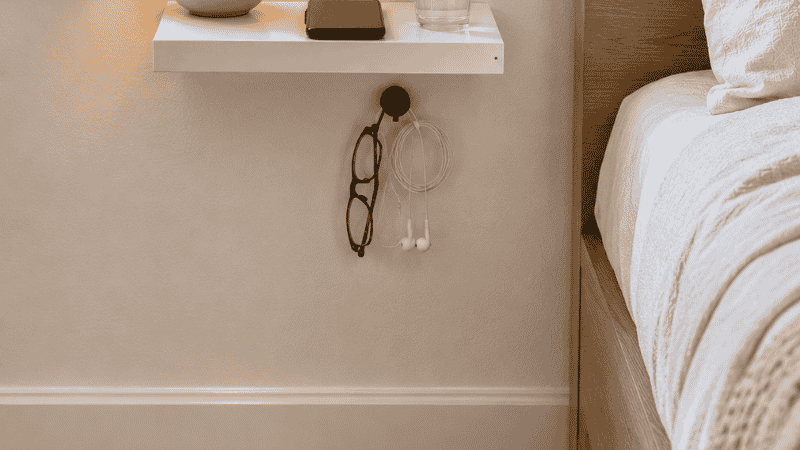
Look for a shelf at least 10 inches deep to accommodate a lamp base and a few items. A small wall-mounted hook below the shelf adds a place for glasses, headphones, or a small bag.
Dresser for Small Bedroom: What Size Actually Works
The dresser is where most small bedroom storage decisions go wrong. The instinct is to buy the largest dresser that fits — more drawers means more storage. In practice, an oversized dresser in a small bedroom makes the room feel like a furniture showroom and creates a walkway problem you’ll resent every morning.
The Right Dresser Dimensions for Small Bedrooms
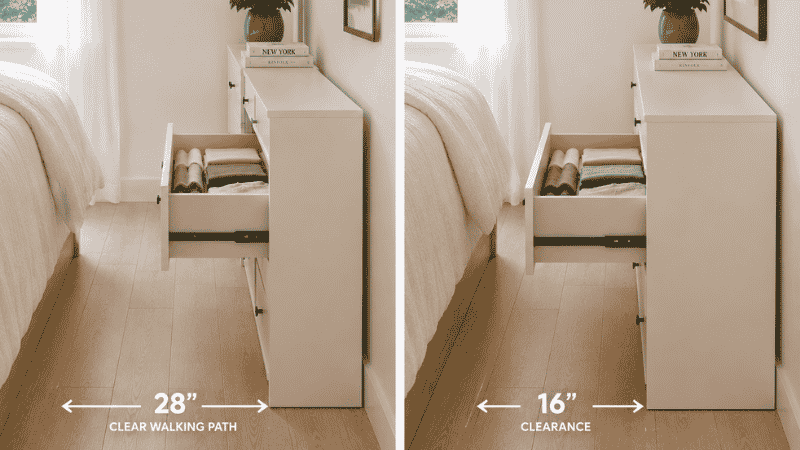
Width: 36–42 inches maximum. A dresser wider than 42 inches on a wall in a room under 120 sq ft starts to feel institutional. If you need more than 42 inches of dresser width, split the storage — use a 36-inch dresser and supplement with a bed frame with drawers rather than going wider.
Depth: 16–18 inches maximum. This is the measurement most people don’t check and most regret. A 20-inch-deep dresser in a narrow bedroom means the drawer front extends 20 inches from the wall when closed — and another 18–20 inches when the drawer is open. In a 10-foot-wide bedroom, that’s 40 inches of your narrowest dimension consumed by one piece of furniture that’s open. Keep it at 16–18 inches deep.
Height: 30–36 inches for a standard dresser. Taller chests (40–50 inches) hold more per square foot of floor space because they go vertical — this is the right trade-off when floor space is genuinely constrained and the room has enough height to absorb a taller piece without making the ceiling feel low.
Dresser as Nightstand: The Double-Duty Solution
One of the most effective small bedroom storage ideas is replacing the traditional nightstand with a small dresser. A 3-drawer dresser at 24–28 inches wide, 16 inches deep, and 26–30 inches tall sits at nightstand height, provides surface space for a lamp and essentials, and adds three drawers of clothing storage where a nightstand would have added only one small drawer.
The trade-off: you lose floor space compared to a floating wall shelf alternative, but you gain significantly more storage capacity. For bedrooms where clothing storage is the primary constraint, this trade-off almost always makes sense.
Closet Storage Ideas for Small Bedrooms
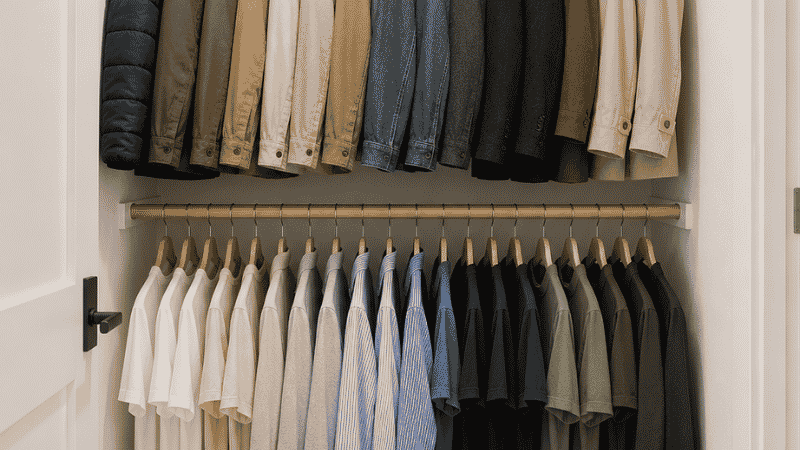
If you have a built-in closet, the single highest-impact change you can make costs almost nothing: add a second hanging rod.
Most standard bedroom closets are configured with one hanging rod and one shelf above it. This configuration leaves the bottom 24–30 inches of the closet completely empty (the space below the hanging clothes) while the single rod limits you to one layer of hanging items. A second rod, positioned below the first at 40 inches height, doubles your hanging capacity and uses the previously empty lower zone.
How to add a second rod: A tension rod rated for clothing weight (look for one rated at 50+ lbs) placed at 38–42 inches height below the existing rod works for short items — shirts, folded trousers, jackets. The existing rod at 64–66 inches handles long items. The two rods together hold roughly twice the clothing volume of a single rod.
Closet Organization for Maximum Capacity
The shelf above the rod: The shelf that sits 2–3 inches above the rod is the most underused space in most closets. It’s awkward to reach and usually accumulates random items. Replace the single shelf with two: one at its existing height for less-frequently accessed items (out-of-season bags, spare bedding), and a second shelf at 84–90 inches (near the ceiling) for rarely accessed items.
The floor of the closet: Below hanging clothes, add a shoe rack rather than leaving shoes in piles. A two-tier shoe rack holds 12–16 pairs in the same floor space that 4 pairs of shoes occupy when stored loosely. Alternatively, shallow drawers (6–8 inches tall) on the closet floor hold folded items — gym clothes, loungewear, underwear — that don’t need to hang.
Storage Ideas for Bedrooms Without Closets
This is the hardest version of the small bedroom storage problem, and it’s where most guides fall short because they assume a closet exists. If your bedroom has no built-in closet, you’re solving for the same clothing volume with zero dedicated infrastructure. Here’s the honest framework.
The Wardrobe System (Best for Permanent Residents)
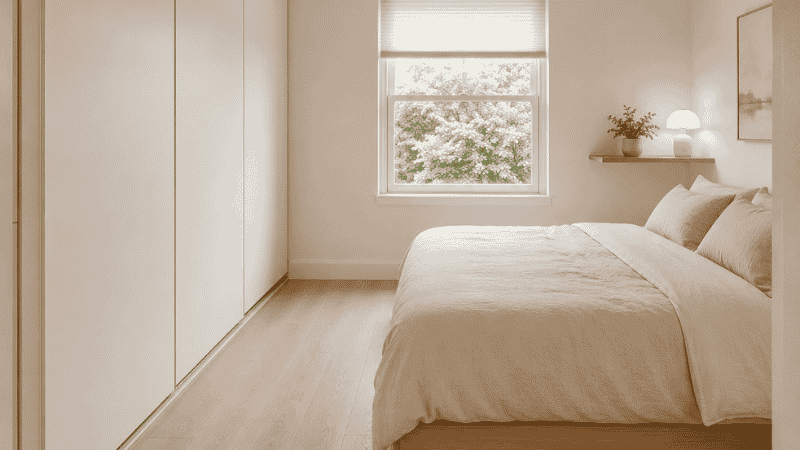
A floor-to-ceiling wardrobe with sliding doors (not hinged — hinged doors consume 20–22 inches of floor clearance when open) is the closest functional equivalent to a built-in closet. The critical dimension: minimum 20 inches deep for hanging clothes. Anything shallower and garments crease against the back wall.
Position it on the wall with the most linear footage and fewest interruptions (no windows, no doors). A full-wall wardrobe from corner to corner, 20 inches deep, floor to ceiling, holds as much or more than most built-in closets while costing a fraction of a custom build.
For renters, a modular PAX-style system can be disassembled on move-out. For owners, a built-in wardrobe using IKEA or similar modular components with custom millwork around it creates a permanent, high-value storage solution that reads as a built-in.
The Open Closet System (For Renters or Minimalists)
If a full wardrobe doesn’t work for the space or budget, an open closet system — a clothing rack or open hanging rail with supplemental shelving — handles the hanging clothing need without requiring a large furniture footprint.
A single freestanding clothing rack (48 inches wide × 18 inches deep × 66 inches tall, approximately) holds the equivalent of a 24-inch wide section of a standard closet. Add a dresser for folded items, under-bed storage for seasonal clothing, and floating shelves for bags and accessories, and the combined system approximates full closet functionality across four different storage zones.
The drawback of open systems: everything is visible. This requires either a highly curated wardrobe (fewer, better pieces that are worth displaying) or curtain panels that can close across the rail for a cleaner look.
How to Store Clothes Without a Dresser
If you’ve eliminated the dresser to reclaim floor space, the clothing that would have lived in it needs somewhere else to go. Here’s how to redistribute that storage:
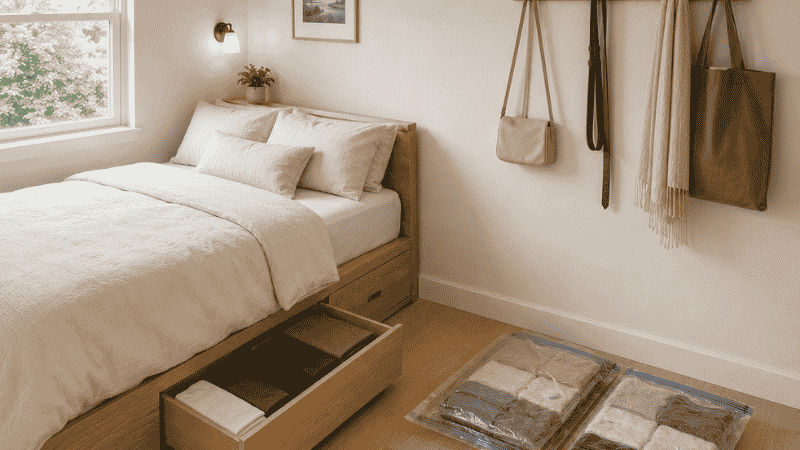
To the bed frame: A queen storage bed with four drawers holds most of what a standard 5-drawer dresser would hold — underwear, socks, t-shirts, gym clothes, casual trousers. The drawer dimensions are shallower (6–8 inches vs. 10–12 inches for a dresser) so folded items need to be stored flat rather than rolled.
To the closet floor: Shallow drawer units (3–4 inches tall, designed to stack) on the closet floor handle folded items that previously lived in dresser drawers. A 3-stack configuration holds roughly the equivalent of two dresser drawers.
To wall-mounted storage: A wall-mounted peg rail (a row of hooks at 60–66 inches height) handles bags, belts, scarves, and the items that previously sat on top of or in the top drawer of a dresser.
To vacuum bags under the bed: Seasonal clothing — the items you don’t need for 3–4 months at a time — compresses dramatically in vacuum storage bags. Three sets of seasonal clothing vacuum-bagged fit in approximately the same space as one set stored normally.
If Your Small Bedroom Storage System Stops Working
If you’ve implemented a storage system and it collapsed within a month, the most likely cause is that the storage capacity doesn’t match the actual volume of belongings. No organizational system can fix a bedroom that has more clothing than storage capacity. Before rebuilding the system, do an honest audit:
Pull everything out of every storage location. Lay it all on the bed. Count the items. Now count the storage slots. If the items exceed the capacity by more than 20%, the solution is editing the wardrobe, not finding more storage.
Research published in the Journal of Consumer Psychology (2017) found that people consistently underestimate how many possessions they own and overestimate how much storage they have — a cognitive bias that leads to repeated storage system failures that feel like organizational failures but are actually inventory management failures.
If You Only Have 10 Minutes: The Immediate Bedroom Storage Fix
No time for a full reorganization? Do these four things right now:
- Clear the floor completely — every item on the bedroom floor goes somewhere else (a bag, a closet, another room). Floor space is the most psychologically important surface in a small bedroom; keeping it clear has an immediate effect on how the room feels.
- Remove the chair — if your bedroom has a chair that functions as a clothes dump, remove it. The chair is not providing seating; it’s providing a surface for things that should be put away. Remove the surface.
- Close everything — every drawer left half-open, every closet door ajar, every bin with items spilling over the edge. Close them all. The room looks significantly more organized immediately.
- Stack the nightstand — move everything currently on the nightstand surface into two categories: what needs to be there (lamp, phone charger, glass of water) and what ended up there (everything else). Put the second category away.
FAQ: Small Bedroom Storage Ideas
What is the best storage for a small bedroom? The highest-impact combination: a bed frame with built-in storage drawers (eliminates the need for a dresser while adding equivalent capacity), floating wall shelves at 48–72 inches height (uses wall space without consuming floor space), and one closed-door wardrobe or a properly organized closet with a second hanging rod. These three elements together handle most small bedroom storage needs without adding to the furniture footprint.
How do I add storage to a small bedroom without more furniture? Four approaches that add storage without adding furniture: (1) add a second hanging rod in the existing closet — doubles hanging capacity instantly; (2) use vacuum storage bags for seasonal clothing stored under the bed — compresses volume by 60–75%; (3) add hooks to the inside of closet and bedroom doors — creates hanging storage for bags, belts, and accessories with zero floor use; (4) clear the nightstand surface and replace any floor nightstand with a floating wall shelf — frees floor space.
What size dresser is best for a small bedroom? Maximum 42 inches wide and 18 inches deep. Prioritize depth over width — a 16-inch-deep dresser that’s 42 inches wide is more functional in a small bedroom than a 36-inch-wide dresser that’s 22 inches deep, because the shallower depth keeps walkways clear and drawers accessible without backing into the bed. For very small rooms under 100 sq ft, replace the dresser entirely with a bed frame with storage drawers.
How do I store clothes in a bedroom with no closet? Three-system approach: (1) a full-wall wardrobe with sliding doors handles hanging clothing (minimum 20 inches deep), (2) a bed frame with storage drawers handles folded clothing, (3) wall-mounted hooks and floating shelves handle bags, accessories, and display items. The combined system approximates a full closet’s function across three separate storage zones rather than one.
How much clearance do I need for under-bed storage? Minimum 7 inches for rolling fabric bins; 10 inches for low-profile rolling drawer units; 14 inches for drawer units with extension slides. Measure the clearance at the lowest point of your bed frame (usually the center of the side rail) before purchasing anything. If your current bed frame has less than 7 inches of clearance, bed risers (available in 3-inch and 6-inch heights) can raise the frame to a usable clearance level for under $30.
Can I use under-bed storage if I have a box spring? A traditional box spring adds 8–9 inches of height between the mattress and the bed frame, which means the bed is higher — giving you more under-bed clearance. However, the box spring itself sits on slats with little to no air gap, and most box springs rest directly on a low-profile frame. Measure from the floor to the bottom rail of the frame to determine your actual usable clearance. If the frame sits on legs at 12+ inches, you likely have workable clearance even with a box spring.
What are the best nightstand alternatives for small bedrooms? Ranked by space efficiency: (1) wall-mounted floating shelf at 22–24 inches height — zero floor footprint, lamp and essentials fit comfortably on 10-inch depth; (2) a small 3-drawer dresser at nightstand height — adds drawer storage where a nightstand would have added only one; (3) a C-shaped side table that slides under the bed edge — tucks completely away when not in use; (4) a wall-mounted swing-arm lamp with a small wall shelf — frees the nightstand surface while keeping lighting accessible.
The Bottom Line
Small bedroom storage isn’t about finding clever tricks — it’s about systematically using every zone the room offers, starting with the zones that consume no additional floor space (under the bed, on the walls, in the closet) before adding any new freestanding furniture.
The bed frame, the walls, and the closet together can handle most of what a small bedroom needs to store. Every piece of freestanding furniture you add after that should replace something else, not join it.
Once you’ve sorted the storage, the bed placement matters as much as what’s in it. Our small bedroom layout guide covers five arrangement formulas with exact clearance measurements. And if your bedroom is part of a studio or open-plan space, the living room storage guide covers how storage solutions carry across zones.
References
- Crum, A. J., Corbin, W. R., Brownell, K. D., & Salovey, P. (2011). Mind over milkshakes: Mindsets, not just nutrients, determine ghrelin response. Health Psychology, 30(4), 424–429.
- Harding, E. C., et al. (2015). The temperature dependence of sleep. Frontiers in Neuroscience, 13, 336. (Environmental conditions and sleep quality)
- Roster, C. A., Ferrari, J. R., & Jurkat, M. P. (2016). The dark side of home: Assessing possession ‘clutter’ on subjective well-being. Journal of Environmental Psychology, 46, 32–41.
- St-Onge, M. P., et al. (2016). Sleep duration and quality: Impact on lifestyle behaviors and cardiometabolic health — a scientific statement from the American Heart Association. Circulation, 134(18), e367–e386.
Published on Grainv.com | Category: Bedroom · Storage Furniture | Related: Small Bedroom Layout, Living Room Storage Ideas, Studio Apartment Layout Ideas