
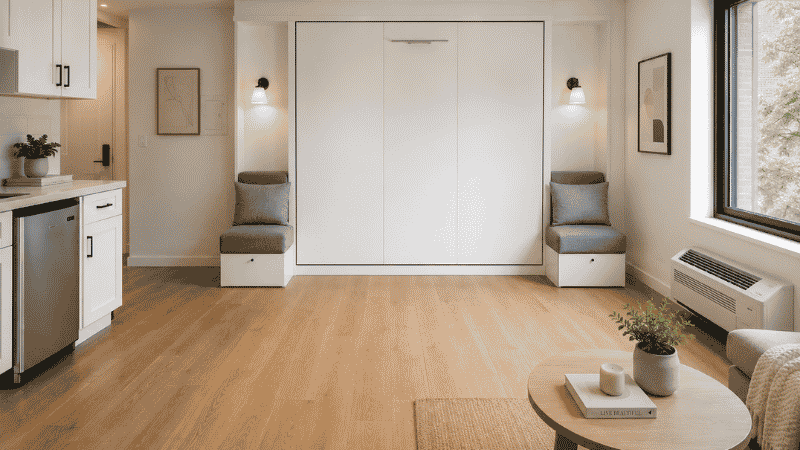
Picture this: It’s 7 PM on a Friday. Your friend is coming to stay for the weekend. You live in a 400 square foot studio. And right now, your “guest bedroom” is also your living room, your office, and the place where you eat dinner every night.
If you’ve been researching murphy beds with sofas, you already know this problem intimately. The murphy bed with sofa combo promises to solve it — a unit that looks like a regular living room wall during the day and reveals a full-size bed at night. But the internet is full of gorgeous product photos and very thin on practical information. How much wall space do you actually need? Is opening it every day as smooth as the videos make it look? What’s the real difference between a $900 version and a $3,000 version? And critically — is a murphy bed with sofa the right solution for your space, or is a sofa bed or another approach going to serve you better?
This guide answers all of it. We’re going to cover what murphy beds with sofas actually are, the space requirements most brands don’t tell you upfront, how to decide if one is right for your specific situation, and how they compare to the alternatives. By the end you’ll have a clear answer — not just “murphy beds are great for small spaces” but whether this specific configuration makes sense for your apartment.
Key Takeaways
- A murphy bed with sofa reclaims 35–50 sq ft of floor space when closed — the equivalent of a small bedroom’s entire footprint — making it the highest floor-space-recovery investment available for a studio apartment
- Minimum wall requirements: You need at least 60 inches of clear wall width for a full/double unit, 66 inches for a queen — and at least 8 feet of ceiling clearance for vertical-orientation models
- The sofa component is functional seating: Unlike sofa beds where the mattress is inside the sofa, murphy bed + sofa combos use a separate sofa section that stays in place when the bed folds down in front of it — the sofa doesn’t transform, the bed does
- Daily use is realistic: The open-close mechanism on quality units takes 30–60 seconds and can be operated by one person; this is not a once-a-month guest setup — it’s a daily routine for thousands of studio dwellers
- Renters face a real constraint: True wall-mounted murphy beds require drilling into studs, which most leases prohibit — freestanding cabinet-bed alternatives solve this but at a different footprint and price point
What Is a Murphy Bed with Sofa, Exactly?
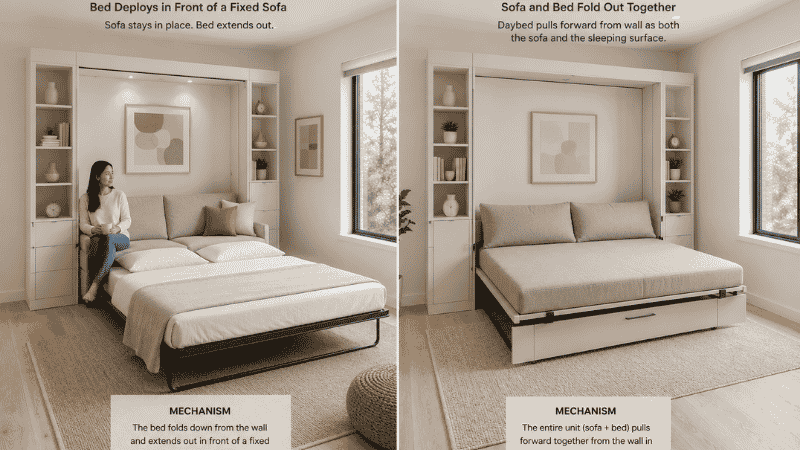
Before getting into buying decisions, it’s worth being precise about what this category actually means — because “murphy bed with sofa” gets used to describe two different things, and they work very differently.
Type 1: Wall bed with integrated sofa — The bed folds into the wall unit, and a sofa section sits in front of it or to the sides as part of the same built-in system. When you pull the bed down, it unfolds in front of the sofa — the sofa stays in place, and the bed deploys over the floor area in front of it. You’re not sleeping on the sofa; you’re sleeping on a real mattress that was stored vertically in the wall. This is the true murphy bed with sofa configuration.
Type 2: Murphy sofa — A fold-down unit where the “sofa” is actually a daybed or padded surface that pulls out from the wall cabinet. There’s no separate sofa; the seating and sleeping surface are one mechanism. This is more similar to a wall-mounted sofa bed and works differently.
Most people searching for “murphy bed with sofa” want Type 1: a wall bed that folds down AND a real sofa that provides comfortable daytime seating. This guide focuses on that configuration.
Space Requirements: What No One Tells You Before You Buy
This is the section most product pages skip entirely. Before you fall in love with a specific unit, measure these five dimensions in your room.
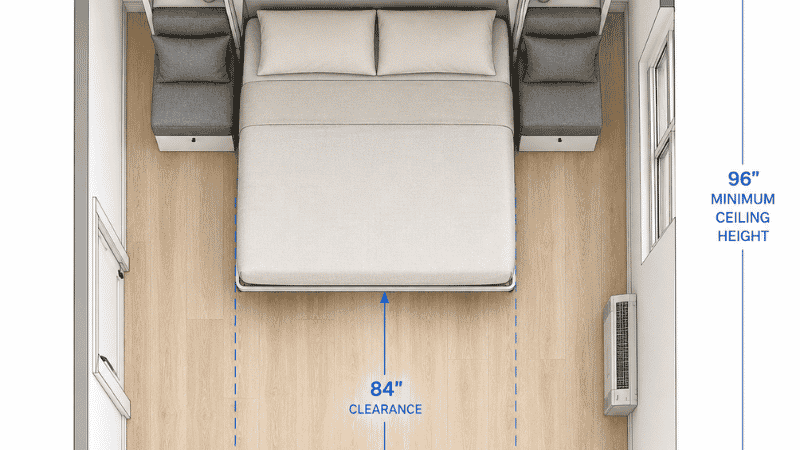
Wall Width Required
Full/Double size murphy bed with sofa: Minimum 72–80 inches of clear wall width. The bed cabinet typically runs 56–60 inches wide; the sofa sections on each side add another 12–24 inches total. You cannot place the unit against a wall with a door, window, or light switch within this span.
Queen size murphy bed with sofa: Minimum 84–96 inches of clear wall width. A queen mattress is 60 inches wide; the cabinet surround adds 8–12 inches on each side; flanking sofa units add further width. Check the unit’s “assembled width” specification carefully — this number often surprises buyers who measured only the mattress size.
Ceiling Height Required
Standard murphy bed units require minimum 84 inches (7 feet) of ceiling height. Most are designed for 96-inch (8-foot) ceilings, which is the standard in most apartments. If your apartment has lower ceilings or decorative molding that reduces usable height, measure from floor to the lowest obstacle directly above the wall where the unit will mount.
Floor Clearance When Deployed
When the bed folds down, the mattress deploys outward and requires clear floor space in front of the unit. For a queen unit, this means approximately 84 inches (7 feet) of clear floor space extending from the wall — the full length of the mattress, plus a small buffer. Measure from your wall to any obstruction (coffee table, sofa, foot of another bed) and verify this clearance is available.
Wall Structural Requirements
Murphy beds require mounting into wall studs, not just drywall. Standard stud spacing in US construction is 16 inches on center. Before purchasing, verify that your wall has studs in the right locations for your unit’s mounting points — or plan for a blocking installation (horizontal lumber added between studs) to create additional mounting points. Concrete or masonry walls require specialized anchors and are a more complex installation.
Weight and Floor Loading
A queen murphy bed with sofa system typically weighs 400–600 lbs when assembled. This is distributed across the wall anchors and the unit’s feet — not concentrated at one point — but it’s worth noting if you’re in a building with load restrictions or an older structure.
Murphy Bed with Sofa vs. Sofa Bed: Which Is Right for You?
This is the most important decision in this category, and it’s rarely addressed honestly. Here’s a direct comparison based on the factors that actually matter.
Sleep Quality
Murphy bed with sofa wins clearly. A murphy bed uses a standard mattress — the same type you’d sleep on in a regular bed. You can choose your preferred firmness, thickness (most units accept mattresses up to 10–12 inches thick), and material. Sofa beds use a thin fold-out mattress built into the sofa mechanism, typically 3.5–5 inches thick, with a metal crossbar that you can feel through the middle of the mattress after an hour of sleep.
Research published in the Journal of Chiropractic Medicine consistently shows that mattress thickness and support directly affect sleep quality and spinal alignment. A 4-inch sofa bed mattress provides roughly the same support as a camping pad; a 10-inch mattress provides support comparable to a dedicated bedroom setup.
Daytime Function
Sofa bed wins on simplicity. A sofa bed is always a sofa. There’s nothing to do to make it function as seating — it just does. A murphy bed with sofa requires that you fold the bed up before using the sofa area as normal living room seating. If you forget to make the bed before folding it (and you will, at least a few times), the unit won’t close properly.
Daily Operation
Murphy beds are faster once you’re used to them. The open-close cycle on a quality gas-piston murphy bed takes 30–60 seconds per operation. A sofa bed conversion takes 3–5 minutes minimum and requires moving cushions, pulling out the mechanism, and unfolding the mattress — then reversing on the other side.
Cost
Sofa bed wins significantly. A quality sofa bed runs $500–$2,000. A murphy bed with sofa system runs $1,500–$5,000+ for the unit alone, plus $300–$800 for professional installation if you don’t install it yourself.
Space Efficiency
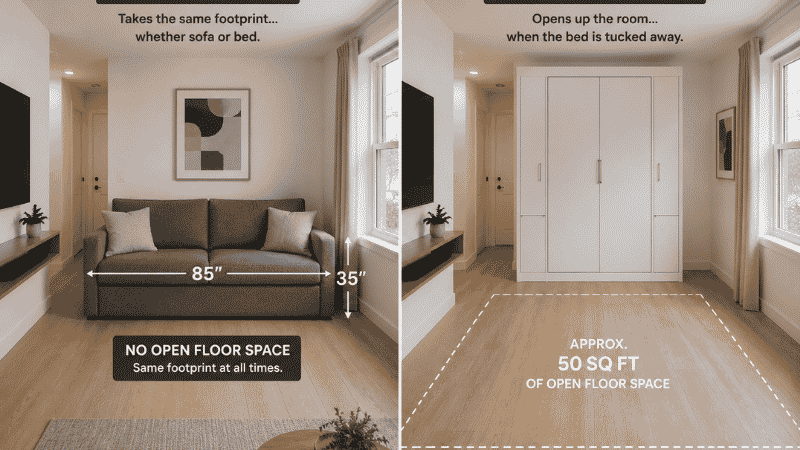
Murphy bed wins decisively. When closed, a murphy bed with sofa looks like a wall unit — the bed occupies zero floor space. When folded up, your living room is your living room. A sofa bed always occupies the same floor footprint whether configured as sofa or bed — it never disappears.
Who Should Choose a Murphy Bed with Sofa
You’re the right candidate if:
- You live in a studio or small one-bedroom where the sleeping area needs to disappear during the day
- You have guests frequently enough to justify the investment (more than a few times per year)
- You own your home or have landlord permission to anchor into walls
- Your apartment has at least 8-foot ceilings and the required wall clearance
- Your budget allows for $1,500–$3,000 for the unit plus installation
Who Should Choose a Sofa Bed Instead
A sofa bed is the better choice if:
- You rent and can’t anchor into walls
- Guests visit rarely — a few times per year at most
- Budget is under $1,200 for the sleeping solution
- Your room has a low or uneven ceiling
- You want the flexibility to rearrange furniture easily
Murphy Bed Alternatives for Small Apartments
If a murphy bed with sofa isn’t the right fit — whether due to installation constraints, budget, or rental restrictions — these alternatives solve overlapping problems in different ways.
Cabinet Beds (Freestanding Murphy Alternatives)
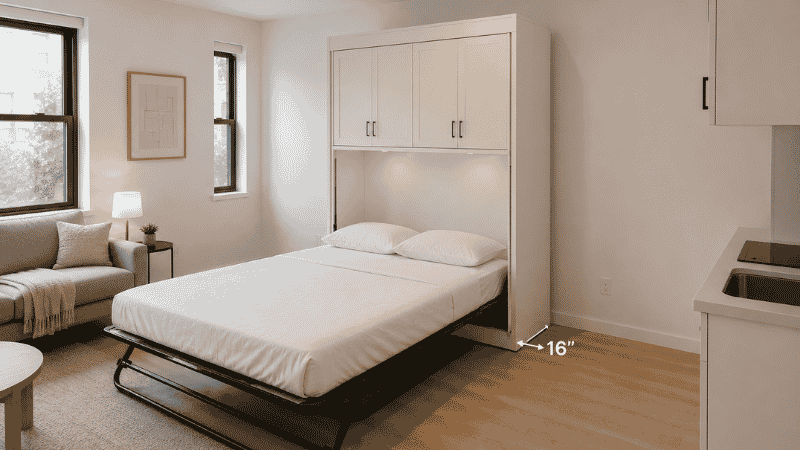
A cabinet bed is a murphy bed mechanism built into a freestanding cabinet rather than wall-mounted. It opens and closes the same way but sits on the floor with no wall anchoring required. This makes it the go-to solution for renters.
The trade-off: cabinet beds typically sit 14–18 inches away from the wall (the depth of the cabinet), consuming that floor space permanently — unlike a true wall bed, which mounts flush. They also typically accommodate smaller mattresses (twin to full) and may not integrate a sofa section. Price range: $800–$2,500.
Loft Beds
A loft bed raises the sleeping platform to ceiling height, freeing the entire floor area below for a sofa, desk, or any other function. This is the most space-efficient solution for rooms with 9+ foot ceilings — but it’s a permanent installation (bolted to walls or ceiling) and works best for single occupants comfortable climbing a ladder daily.
For a studio apartment where sleep and work both happen in the same space, a loft bed with a desk or sofa below is often more practical than a murphy bed because neither function requires a daily transformation — both exist simultaneously.
Daybed with Trundle
A daybed functions as a sofa during the day and a bed at night, with a trundle drawer underneath that pulls out to create a second sleeping surface for guests. This is the lowest-cost solution ($400–$1,500) and requires no installation. The limitation: a daybed typically accommodates a twin mattress — not comfortable for couples — and the sofa function is less comfortable than a dedicated sofa because the depth and cushion are designed to work as a bed surface, not a sitting surface.
What to Look for When Buying a Murphy Bed with Sofa
If you’ve decided a murphy bed with sofa is the right choice, here’s what separates a good unit from one you’ll regret within six months.
The Lifting Mechanism
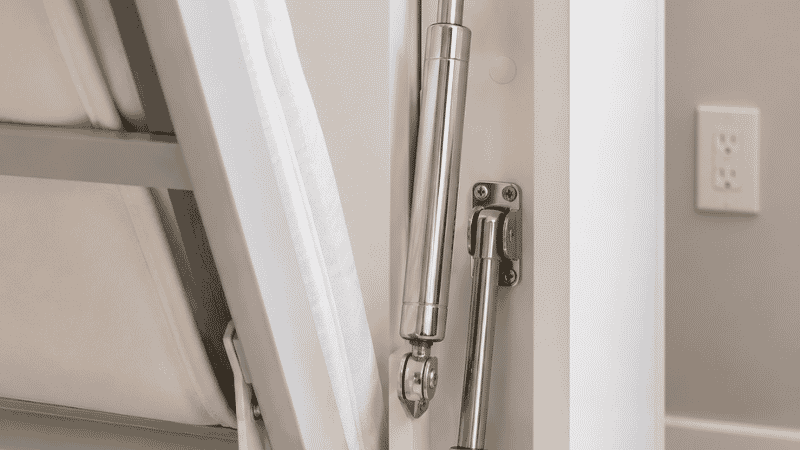
This is the most critical quality indicator. Murphy beds use one of three lift systems:
Piston (gas-lift): Hydraulic or gas pistons assist the lifting and lowering of the bed. The best systems are effortless to operate with one hand and hold the bed at any height without dropping. Look for units with dual pistons (one on each side) and weight ratings that match or exceed your mattress weight.
Spring-assist: Traditional spring mechanisms work but require more physical effort than pistons and can become harder to operate as springs age. If a unit uses springs, verify what the spring replacement process involves and whether replacement parts are available.
Manual (no assist): Some budget units have no assist mechanism and require you to lift the full weight of the mattress manually. This is fine for thin, light mattresses but becomes impractical with a quality 10-inch mattress that can weigh 60–80 lbs. Avoid these for daily use.
Mattress Compatibility
Check two specifications: maximum mattress thickness (most units specify 8–12 inches — if you want a premium mattress, verify it fits before purchasing) and mattress retention (the mechanism that keeps the mattress from sliding during open/close operations). Some budget units rely only on straps; quality units have a retention system that holds the mattress securely without daily adjustment.
Sofa Section Quality
The integrated sofa in a murphy bed with sofa system is often the weakest component — it’s an afterthought in many designs. Test the sofa’s seat depth (18–20 inches is comfortable for most adults), cushion density (soft foam compresses to almost nothing within a year; high-density foam holds its shape), and whether the sofa section can be removed or reconfigured independently if needed.
Assembly and Installation
Most murphy bed with sofa systems ship in multiple boxes and require wall installation. Verify before purchasing:
- Whether the manufacturer provides installation services or recommends installers in your area
- How many people the installation realistically requires (two-person minimum for most systems)
- Whether the installation voids the warranty if done by a non-professional
The Daily Reality: What It’s Actually Like to Live with a Murphy Bed with Sofa
Beyond the space math and the spec comparisons, here’s what daily life with a murphy bed with sofa actually looks like — the part product pages never describe.
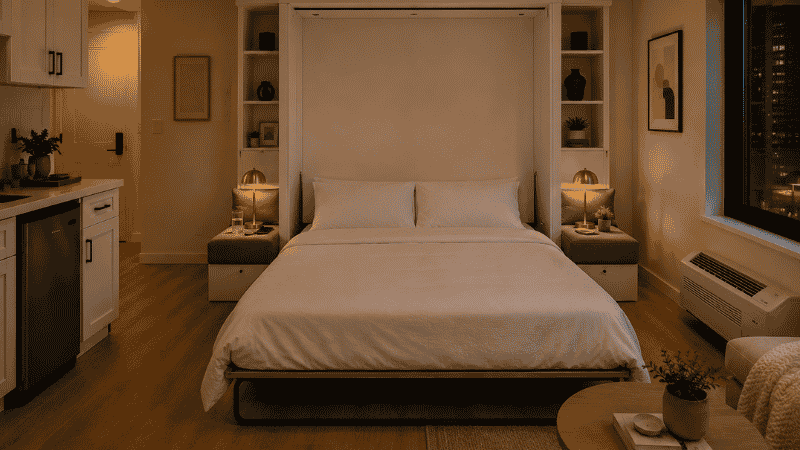
The morning transformation: Wake up, swing your legs off the mattress, stand up. Hold the handle on the underside of the bed frame, lift it to approximately horizontal (the pistons do most of the work), then push it upward into the closed position. The whole process takes 30–60 seconds. If you’ve made the bed, it stays neat inside the unit. If you haven’t, you’re shoving a rumpled situation into the wall — which you can do, but the unit may not close as cleanly.
The evening transformation: Walk to the unit, pull the handle, lower the bed to horizontal. The pistons control the descent so it doesn’t slam. Place your pillow, which you’ve stored either inside the unit or on the sofa section. Sit on the bed edge, swing your legs up. You’re done.
The weekly friction points: The sofa section can’t be used while the bed is deployed — the bed folds down in front of it, occupying the floor area the sofa would normally face. This means anyone on the sofa needs to move before you can lower the bed. In a studio where you have a guest, this is a small inconvenience but a real one.
The annual maintenance: Gas pistons may need replacement after 5–10 years of daily use. Check whether replacement pistons are available from your manufacturer and what they cost. A unit with discontinued parts becomes unrepairable — this is a significant quality differentiator between budget and premium brands.
If You’re Not Sure Yet: The 5-Question Decision Framework
Before spending $2,000+, answer these five questions honestly:
- Will you open and close it daily? If the answer is “only for guests,” a cabinet bed or sofa bed is probably a better investment than a full wall-mounted system.
- Do you have landlord permission to anchor into walls? If no, skip directly to cabinet beds or sofa beds. Don’t assume “they won’t notice” — wall damage from murphy bed installation is significant and difficult to conceal.
- Is your wall free of obstructions across 7–8 feet? Walk to the wall where you’re imagining the unit and look left and right. Are there switches, vents, windows, or doors within the unit’s width? Any of these requires either a different wall or custom unit design.
- Is this your primary bed or a guest setup? If you’ll sleep in it every night, invest in a quality unit ($2,000+) with a real mattress and quality pistons. If it’s for guests a few times a year, a $900 cabinet bed accomplishes the same goal at a fraction of the cost.
- Does the math work for your room? With the bed deployed (7 feet of clearance from the wall), is there still enough room to walk around the bed? If your room is 10 feet deep and the bed requires 7 feet, you have 3 feet of space left — workable, but tight.
FAQ: Murphy Bed with Sofa Questions
How does a murphy bed with sofa work? The bed is stored vertically inside a wall cabinet, folded against the wall behind closed panels. When you want to sleep, you pull a handle and lower the bed horizontally to the floor. The sofa section sits in front of the wall unit as normal seating; when the bed is deployed, it extends out in front of the sofa, occupying the floor space between the wall and wherever your coffee table was. The sofa doesn’t move or transform — the bed appears in front of it.
How much space does a murphy bed with sofa need? Minimum 66–96 inches of wall width depending on bed size, minimum 84 inches of ceiling height, and at least 84 inches of clear floor depth in front of the unit for the bed to deploy fully. Total assembled width including sofa sections is typically 90–120 inches for queen configurations.
Is a murphy bed comfortable for everyday use? Yes — a murphy bed with sofa uses a standard mattress of your choosing, typically up to 10–12 inches thick. It’s as comfortable as whatever mattress you put in it, which makes it far superior to a sofa bed for nightly sleep. The limitation is that you need to make the bed before closing it, and unmaking it when you open it, which adds 2–3 minutes to your morning and evening routines.
Can renters get a murphy bed? True wall-mounted murphy beds require drilling into studs, which most leases prohibit. The renter-friendly alternatives are: (1) a freestanding cabinet bed that uses no wall mounting, or (2) negotiate with your landlord — some will permit installation if you agree to patch and paint upon move-out. Never install a wall-mounted murphy bed without permission; the anchoring hardware creates significant wall damage that’s immediately visible.
Murphy bed vs sofa bed: which is better for a studio apartment? For daily sleep in a studio: murphy bed wins on comfort and space reclamation. For occasional guest use in a one-bedroom: sofa bed wins on cost and flexibility. The key question is frequency of use — a murphy bed’s $1,500–$3,000 cost only makes economic sense if it’s being opened and closed regularly, not sitting closed for months between guests.
What are murphy bed alternatives for small apartments? In order of space efficiency: (1) loft bed with living space below — most efficient but permanent and requires high ceilings; (2) murphy bed (wall-mounted) — folds completely out of sight; (3) cabinet bed (freestanding murphy alternative) — no wall anchoring required; (4) sofa bed — never disappears but lowest complexity and cost; (5) daybed with trundle — best for twin-size sleeping and guest accommodation on tight budgets.
How long does it take to open and close a murphy bed? With a quality gas-piston mechanism: 30–60 seconds each way. With a spring-assist mechanism: 60–90 seconds. With a manual system: 90+ seconds and significant physical effort. The daily operation time is a real quality-of-life factor — if the mechanism is stiff or awkward, you’ll stop using it as a daily setup and it becomes a guest-only fixture, which undermines the investment.
The Bottom Line
A murphy bed with sofa is one of the most effective space-saving investments available for small apartments — when it’s the right solution for your situation. The “when” is everything. It requires the right wall, the right ceiling height, the right budget, and ideally the right ownership situation. When all those factors align, it genuinely transforms a studio from a space you compromise in to a space that works.
If they don’t align — if you rent, if your walls are obstructed, if your budget tops out at $1,000 — there are alternatives that solve the same core problem without requiring the same conditions. The best space-saving furniture purchase is the one you’ll use every day without resenting it.
For the broader picture of how furniture like this fits into a studio layout, our studio apartment layout guide covers zone-definition strategies and furniture sizing formulas. And if you’re still deciding between furniture configurations, our furniture ideas for small living rooms guide covers the decision logic for all major living room furniture categories.
References
- Gordon, S. J., Grimmer-Somers, K., & Trott, P. (2009). Sleep position, age, gender, sleep quality and waking cervical symptoms. The Internet Journal of Allied Health Sciences and Practice, 7(1). (Research on mattress support and sleep quality outcomes)
- Crum, A., & Langer, E. (2007). Mind-set matters: Exercise and the placebo effect. Psychological Science, 18(2), 165–171.
- National Sleep Foundation (2023): Sleep environment guidelines — bedroom conditions, surface support, and sleep quality metrics
- American Society of Interior Designers (ASID): Residential space planning guidelines — minimum clearance standards for fold-down bed mechanisms in residential settings
Published on Grainv.com | Category: Multifunctional Furniture | Related: Studio Apartment Layout Ideas, Furniture Ideas for Small Living Rooms, Small Bedroom Storage Ideas