
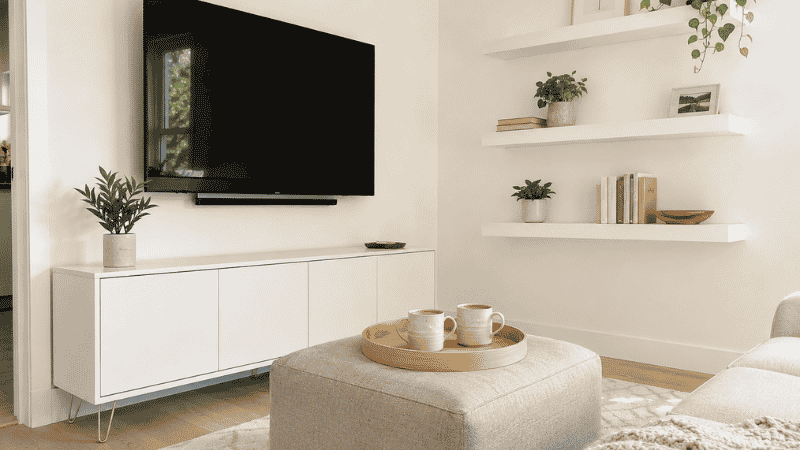
You tidied up last Tuesday. By Friday, the surfaces were covered again — remotes on the coffee table, a bag on the floor by the sofa, last month’s mail stacked on the console. It’s not that you’re disorganized. It’s that every object in your living room is looking for a permanent address, and right now, most of them don’t have one.
Small living rooms have a specific storage problem that bigger homes don’t: every storage solution you add takes up floor space you don’t have. Buy a big shelving unit and you’ve solved the clutter but created a furniture crowding problem. Add too many baskets and bins and the room starts to feel like a supply closet. The goal isn’t just more storage — it’s smarter placement, the right furniture types, and knowing which storage approach works for your specific constraints.
This guide covers practical living room storage ideas organized by strategy, with specific dimensions and product types that work in rooms under 200 square feet. We’ll also tell you what doesn’t work — the storage traps that look promising on Instagram but create new problems in real small spaces.
Key Takeaways
- The wall is your most underused storage surface: Most small living rooms have 8–9 feet of wall height and use only the bottom 3 feet for furniture — the top 5–6 feet is untapped storage space
- Closed beats open in small rooms: Open shelving looks great in large rooms; in rooms under 150 sq ft, closed-door storage reduces visual noise and makes the room feel 20–30% less cluttered even when the same amount of stuff exists
- Every floor piece must earn its place: In a room under 150 sq ft, any freestanding storage furniture should replace another piece, not join it — the ottoman replaces the coffee table, the console replaces the dresser, the bookcase replaces two side tables
- Renter-friendly solutions are a real category: Over 44 million Americans rent their homes and most can’t drill into walls — command strip shelving, freestanding units, and over-door storage solve the problem without risking the security deposit
- The 30-second rule: If putting something away takes more than 30 seconds, it won’t happen consistently — the best storage systems are the ones you’ll actually use every day
The Two Types of Living Room Storage (And When to Use Each)
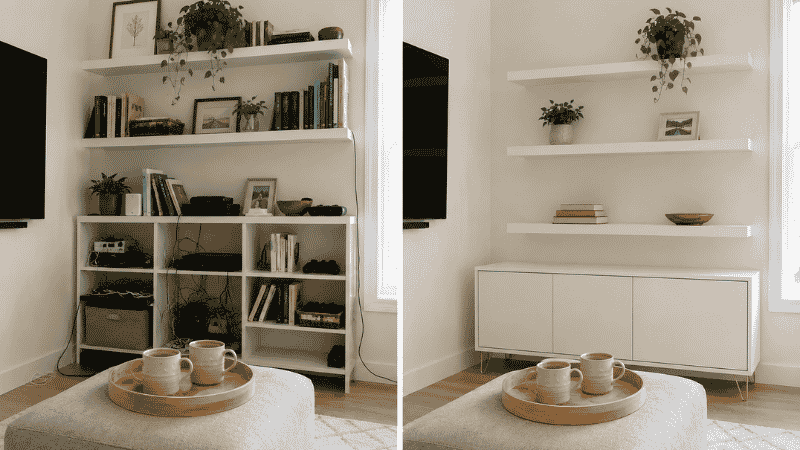
Before buying anything, understand the fundamental difference between the two storage approaches — because mixing them incorrectly is why most small living room storage systems fail within six months.
Concealed storage hides objects behind closed doors, lids, or opaque containers. The visual result is calm, unified surfaces. Works best for: remotes, cables, mail, items you use daily but don’t want visible.
Display storage puts objects on open shelves intentionally. Works best for: books, plants, art objects, items worth styling around.
The formula that works in small living rooms: 80% concealed, 20% display. Most rooms that feel cluttered have the ratio inverted — too much is visible, too little is contained.
Living Room Storage Ideas for Renters (No Drilling Required)
This is the category most storage guides skip entirely. If you rent, you likely can’t anchor shelves into the studs — which rules out most traditional wall storage. Here’s what actually works.
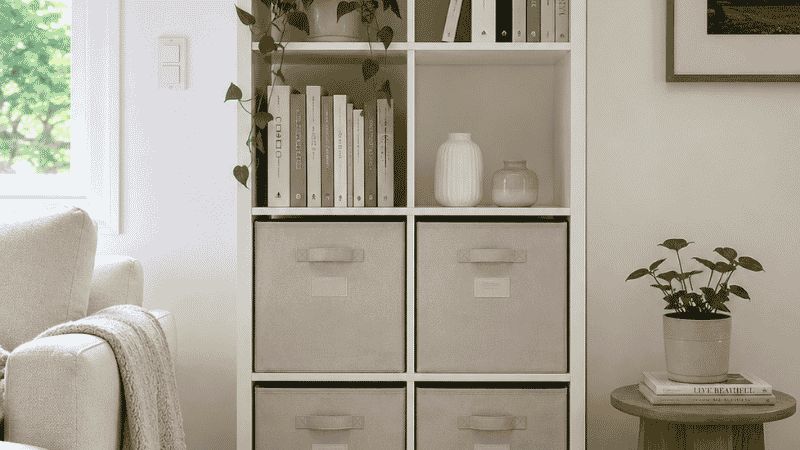
Freestanding cube shelving against the wall: A KALLAX-style unit in a 2×4 configuration stands 57.5 inches tall and 30 inches wide, holds 8 cubes of storage, and requires zero wall anchoring. Position it against the longest clear wall and it reads as a storage wall rather than a freestanding unit. Add fabric cube bins for concealed storage in the lower cubes; keep upper cubes for display. This is the single most effective renter storage solution for a small living room.
Tension pole shelving: Floor-to-ceiling tension poles with adjustable shelves create a vertical storage column with zero drilling. Best positioned in a corner (two poles) or flat wall (three poles). Each shelf holds 15–20 lbs. Works well for plants, books, and decorative objects.
Command strip floating shelves: 3M Command strips rated 7.5 lbs per strip can support lightweight display shelves — a wood plank 24 inches wide loaded with light objects. Three strips per shelf. This works for display only, not heavy storage.
Over-sofa ledge unit: A freestanding shelf with feet that sit on the sofa’s back creates a display surface at eye level without touching the wall. Keep weight minimal — a plant, a few books, a candle.
Living Room Storage Ideas for Homeowners (Full Anchoring)
If you can anchor into walls, the storage efficiency improves dramatically.
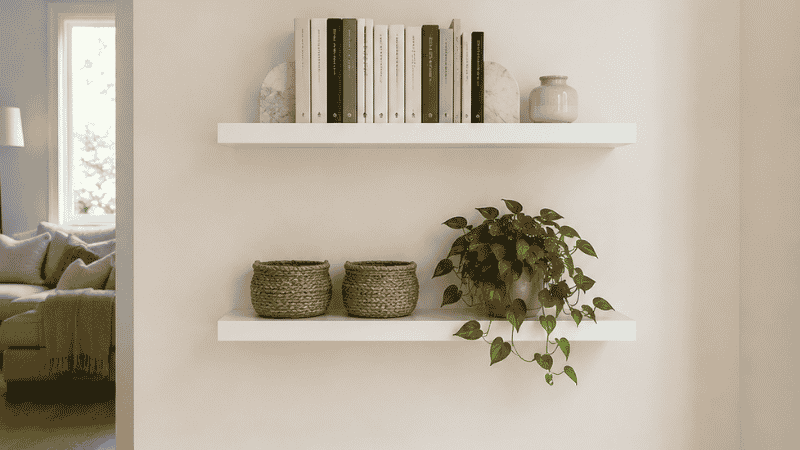
Floating shelf gallery: Three shelves at 24, 42, and 60 inches from the floor use wall height rather than floor space. Each shelf 8–10 inches deep for books and objects; 12 inches deep for baskets. Space brackets every 16 inches to prevent sagging. This three-shelf arrangement on a single wall can replace a freestanding bookcase while reclaiming its entire floor footprint.
Floor-to-ceiling modular system: The most space-efficient living room storage available. A wall-to-wall, ceiling-to-floor shelving system consolidates all storage in one place and eliminates the need for a media console, side tables, and bookcase — all separate footprints. The floor space recovered usually exceeds the 12–14 inch depth of the system itself.
The Best Storage Furniture for Small Living Rooms
Media Consoles with Hidden Storage
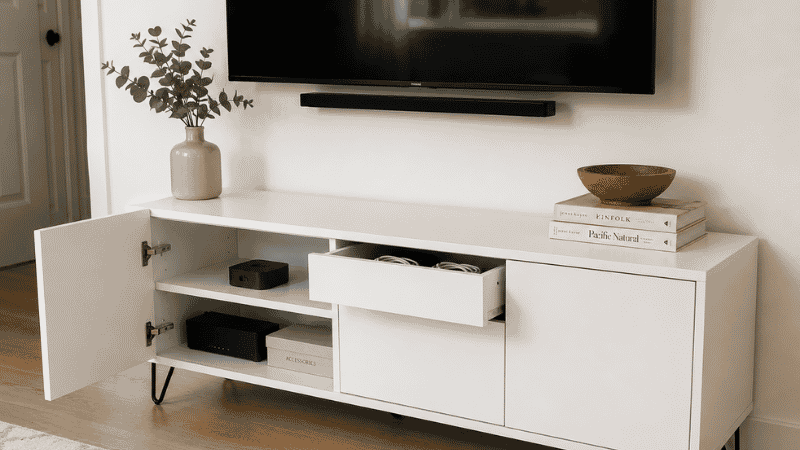
The media console anchors the TV wall and handles the highest-traffic storage category: electronics, cables, and remote controls. It’s the piece that makes or breaks daily friction in a small living room.
What to look for: Closed cabinet doors (not open cubbies), cable management holes in the back panel, and hairpin or tapered legs to keep the piece visually light.
Ideal dimensions: 48–60 inches wide, 16–18 inches deep, 20–24 inches tall. At this depth it doesn’t obstruct walkways. At this height it supports a wall-mounted TV at the correct center height (42–48 inches from the floor).
Storage capacity of a well-chosen console: A 54-inch console with two cabinets and two drawers typically holds: streaming box, gaming console, and router in one cabinet; extra remotes, batteries, and accessories in the other; folded throws in the larger drawer; cables and tech accessories in the smaller drawer. Six categories of living room clutter, one piece of furniture.
Storage Ottomans: The Room’s Hardest-Working Piece
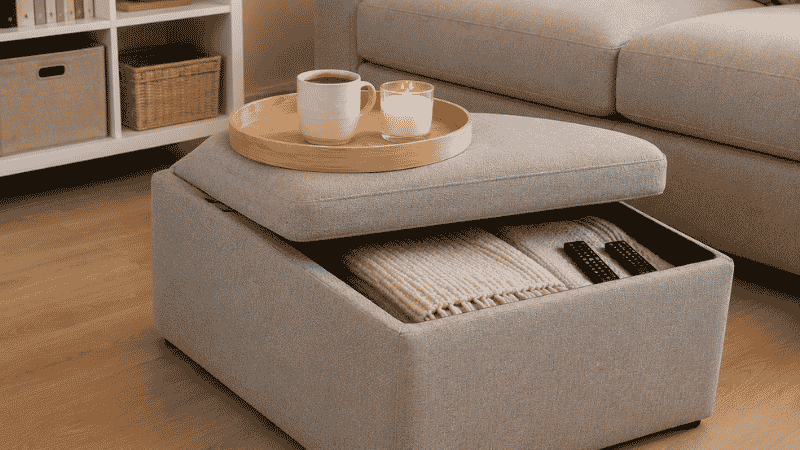
A storage ottoman at the right size functions as coffee table, extra seating, footrest, and hidden storage — four functions in one footprint.
Ideal dimensions: 30–36 inches square, 16–18 inches tall. Square ottomans are more versatile than rectangular in small spaces. At 17 inches high, the surface sits within comfortable reach from sofa seat height (17–19 inches) with a tray on top.
Interior capacity: A standard 32-inch square storage ottoman holds approximately 3–4 folded throws, 8–10 magazines, two remote controls, one small games console, and miscellaneous cables — all hidden, all accessible in under five seconds.
The tray rule: Always use a tray on top when the ottoman functions as a coffee table. A 14–16 inch round or 20×20 inch square tray stabilizes the surface and signals “table” rather than “seat.” Without a tray, the surface reads as provisional and the ottoman loses its coffee table function visually.
Sideboards as Living Room Command Centers
In a small living room that also serves as a dining or entry area, a sideboard along one wall handles mail, keys, charging cables, extra linens, and dining overflow in a slim footprint.
Dimensions: 48–60 inches wide, 14–16 inches deep, 30–34 inches tall. Shallower than a media console. This height functions as a buffet surface when entertaining while staying proportional.
Top surface rule: Keep it clear except for a lamp, a plant, and one or two objects. Everything else goes inside. An uncluttered top makes the sideboard read as furniture, not storage.
Storage by Zone: Spots You’re Probably Not Using
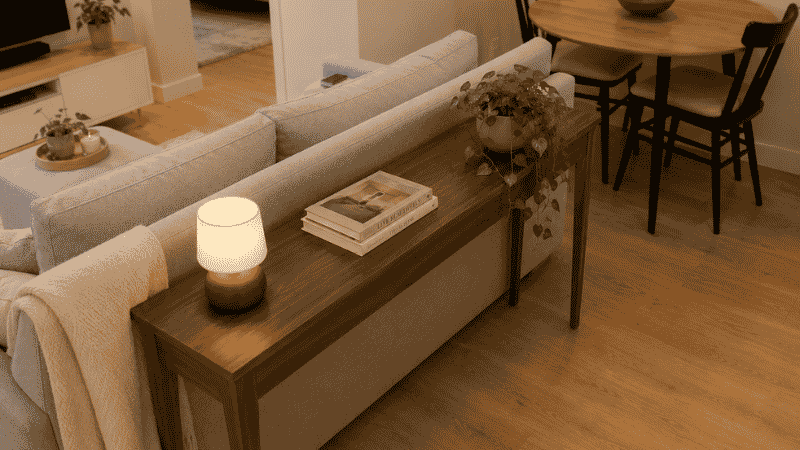
Behind the sofa: The 4–8 inch gap between sofa back and wall is one of the most overlooked spots in a small living room. A slim console table (10–12 inches deep, same height as the sofa back at 30–34 inches) creates a divide between the seating zone and any zone behind it, while providing a surface for a lamp or books. In studio apartments, this sofa-back console creates a “dining zone” without adding any floor footprint to the living area.
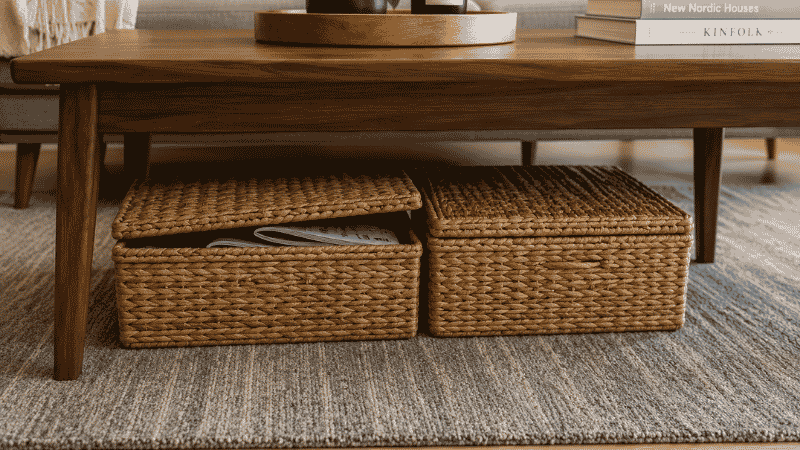
Under the coffee table: If your coffee table has legs with 6+ inches of clearance, two 12×16 inch baskets slide underneath and hold magazines, remotes, and small items while remaining accessible. This turns dead floor space into functional concealed storage.
Above eye level: The wall from 60 to 96 inches is consistently underused. A single floating shelf at 72 inches holds books, a plant, and art objects visible from the sofa without interfering with sightlines or walkways. Rule: keep above-eye-level storage visually light — books, plants, small ceramics only. No bins or boxes at this height.
Storage Traps: What Looks Good But Doesn’t Work
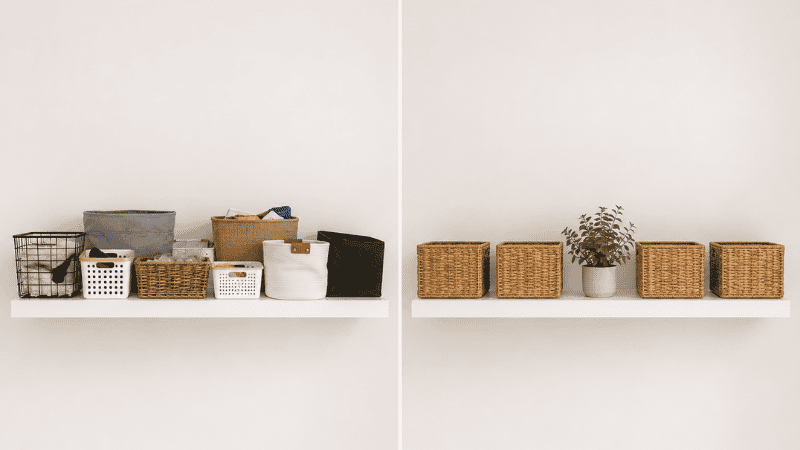
These are the purchases that seem like solutions but create new problems. Worth naming directly.
Clear storage bins in the living room: Clear bins make sense in pantries and closets. In a living room, they make clutter visible rather than hiding it. Use opaque containers with labels if you need to identify contents.
Too many small baskets: Four matching baskets read as intentional. Eight mixed baskets read as accumulated clutter solutions. The threshold for living room open storage is four pieces maximum, same material family.
A storage bench in front of the sofa: Sounds multifunctional but a bench in a small living room blocks the primary walkway. A storage ottoman in the same position is lower, softer, and doesn’t create the same traffic obstruction.
Over-door organizers on interior doors: These work in closets. In a living room, an over-door organizer on an interior door creates visual disruption every time the door is open — which for most people is most of the day.
If You Only Have 10 Minutes: The Immediate Storage Fix
No time for new furniture? These changes take under 10 minutes and create immediate improvement:
- Consolidate all flat surfaces: Every item on every horizontal surface goes into one container (a tray, a basket) rather than scattered. Same objects, half the visual noise.
- Route all visible cables behind or under furniture: Visible cables make an organized room look chaotic. A cable clip ($3) routed along a baseboard removes this instantly.
- Close everything: Every open cabinet door, every drawer open an inch, every basket with items spilling over — close them. The room looks more organized immediately, regardless of what’s inside.
- Remove one item from each surface permanently: Identify the thing on each surface that belongs somewhere else and put it there. Thirty seconds per surface, permanent improvement.
Why Storage Systems Stop Working After a Month
You set it up. It worked for three weeks. Now it’s fallen apart. This is the most common living room storage failure mode, and it almost always has the same root cause: the system was designed for ideal behavior, not actual behavior.
The fix: audit where things actually land, not where they should go. If the remote always ends up on the sofa cushion rather than in the console drawer, the drawer is too far away. Move the remote’s home to the side table. If mail piles up on the coffee table, you need an inbox near the front door, not a filing system across the room.
Research published in the Journal of Environmental Psychology (2016) found that storage systems fail not because people lack discipline, but because the physical distance between where objects are used and where they’re stored exceeds behavioral thresholds — anything more than a few steps from point of use has significantly lower compliance for consistent return. Good storage design accounts for human behavior as it actually is, not as we’d like it to be.
FAQ: Living Room Storage Ideas
What is the best storage for a small living room? The highest-efficiency combination for rooms under 150 sq ft: a media console with closed cabinets (handles electronics and cables), a storage ottoman replacing the coffee table (handles overflow and throws), and floating shelves on the longest wall (handles books and display). These three pieces together can eliminate the need for any additional storage furniture while keeping the floor clear.
How do I add storage to a small living room without it looking cluttered? Follow the 80/20 rule: 80% of your storage should be concealed (closed doors, lids, opaque bins), 20% can be display (books, plants, objects). Keep all storage furniture in the same tonal family so pieces read as a cohesive system. Limit freestanding floor pieces to three maximum in a room under 150 sq ft.
What is the best storage furniture for living rooms? Ranked by space efficiency: (1) floor-to-ceiling built-in shelving — uses wall space, not floor space; (2) media console with closed storage — consolidates electronics; (3) storage ottoman — replaces coffee table while adding hidden storage; (4) sideboard — adds buffet surface and internal storage. For renters: a freestanding cube unit as the primary anchor.
How do I hide storage in a living room? Four methods that work: closed-door furniture (consoles, sideboards with doors); ottomans with lids; baskets and bins with lids on open shelves; furniture with built-in drawers. The most effective hidden storage is built into existing furniture pieces rather than added on top of them.
How can I organize a small apartment living room with no built-in storage? Add in this order: a storage ottoman (replaces coffee table, adds hidden storage immediately), floating shelves above the sofa or console (wall storage with no floor footprint), and one closed-door console or sideboard on the TV wall. These three additions handle most storage needs in a studio or one-bedroom living room.
Is open or closed storage better for small living rooms? Closed storage almost always wins in rooms under 150 sq ft. Open shelving requires constant curation — the moment anything gets slightly disorganized, the whole room reads as cluttered. Reserve open display for a maximum of four shelf sections, kept deliberately minimal.
The Bottom Line
The best living room storage ideas aren’t about buying more containers or adding more furniture. They’re about identifying where your clutter actually lands, putting its home within reach of where it falls, and choosing furniture that does double or triple duty so you’re not consuming floor space to solve a single problem.
Storage that works is storage you use every day without thinking about it. If maintaining the system requires effort or intention, it will last about three weeks. The goal is frictionless — where the right place for every object is also the easiest place to put it.
If you’re still figuring out how furniture pieces fit together before adding storage, our furniture ideas for small living rooms guide covers sofa sizing formulas and console dimensions with specific numbers. And for the underlying layout that makes your storage accessible from all the right places, our small living room layout guide has six arrangement formulas with exact measurements.
References
- Roster, C. A., Ferrari, J. R., & Jurkat, M. P. (2016). The dark side of home: Assessing possession ‘clutter’ on subjective well-being. Journal of Environmental Psychology, 46, 32–41.
- Saxbe, D., & Repetti, R. (2010). No place like home: Home tours correlate with daily patterns of mood and cortisol. Personality and Social Psychology Bulletin, 36(1), 71–81.
- American Society of Interior Designers (ASID): Residential storage planning guidelines and storage zone proximity principles
Published on Grainv.com | Category: Living Room · Storage Furniture | Related: Furniture Ideas for Small Living Rooms, Small Living Room Layout, Studio Apartment Layout Ideas