
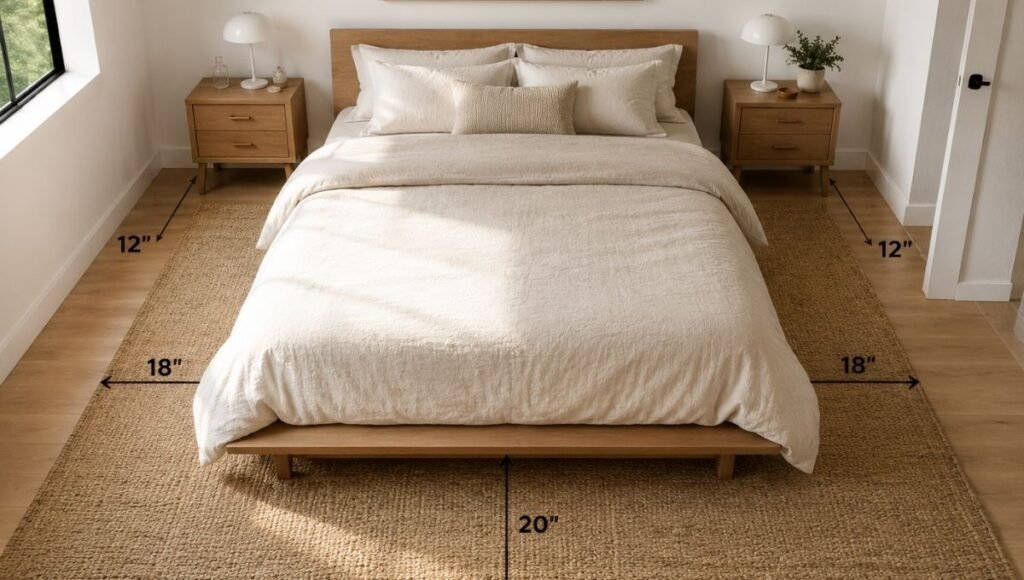
The 18-to-24-inch rule is everywhere in rug placement guides. Extend 18 to 24 inches beyond the sides of your bed. Every guide says it. Every interior designer repeats it. And it’s good advice — in a bedroom large enough to accommodate it.
The problem is that in a 10×12-foot small bedroom with a queen bed, the mattress alone consumes 60 × 80 inches (5 × 6.7 feet). That leaves roughly 30 inches on each short side and 62 inches at the foot. A rug extending 18 inches on each side of a 60-inch queen = 96-inch minimum rug width (8 feet). An 8-foot-wide rug in a 10-foot-wide room leaves 12 inches from rug edge to wall on each side. Which is technically fine — but it means the rug is almost wall-to-wall, which changes the visual entirely.
Most bedroom rug placement guides assume you have a large enough room to follow their rules. This guide doesn’t. It covers the formula, the standard placements, and specifically — what to do when the standard approach doesn’t work in your actual room.
Key Takeaways
- The 18-inch rule is the minimum, not the only option: A rug extending 18 inches beyond the sides of the bed looks grounded and correct; extending 24 inches looks more generous; but in small bedrooms, even 12 inches of visible rug on each side is acceptable if the rug is large enough to extend beyond the foot of the bed
- The rug-to-wall gap matters as much as the rug-to-bed extension: Leave at least 10–12 inches between the rug edge and the wall — a rug that touches the wall looks like fitted carpet, which makes the room feel smaller, not larger
- Under-the-bed placement has three options: All the way under (rug extends from headboard to foot), two-thirds under (most practical for small bedrooms), or foot-of-bed only (smallest rug option, best for tight spaces)
- The correct size rug for a queen bed in a standard bedroom is 8×10 feet: This is the most widely recommended size — it extends appropriately on three sides in most layouts and doesn’t overwhelm the room
- For small bedrooms specifically: A 6×9 rug placed two-thirds under a queen bed exposes 18 inches on each side and about 18 inches at the foot — the minimum that reads as intentional rather than undersized
How to Place a Rug in a Bedroom: The Three Options
Every bedroom rug placement decision is a variation on one question: how much of the rug do you want visible, and how much goes under the bed?
There are three standard answers.
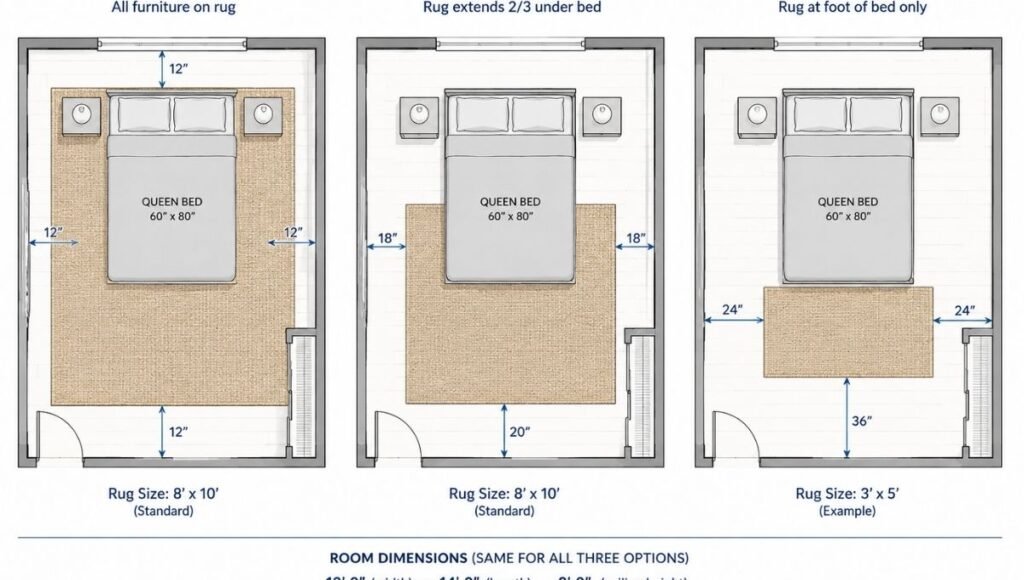
Option 1: Full Under — All Furniture on the Rug
The bed, both nightstands, and any bench at the foot of the bed all sit on the rug. The rug extends to near the wall on all sides with 10–15 inches of clearance from each wall.
When it works: Large bedrooms (12×14 feet or more) with a defined sleeping zone that the rug can anchor as a distinct area within the room. This placement reads as the most designed and cohesive because everything in the sleeping zone is visually grounded by one surface.
When it doesn’t work: In small bedrooms, a rug large enough to place all furniture on it would be wall-to-wall or close to it — which eliminates the border effect that makes a rug look like a deliberate design choice rather than just flooring.
Rug size needed: For a queen bed + two nightstands, this requires at least a 9×12 rug in most layouts. In a standard bedroom, a 9×12 is appropriate; in a small bedroom, this is often too large.
Option 2: Two-Thirds Under — The Practical Standard
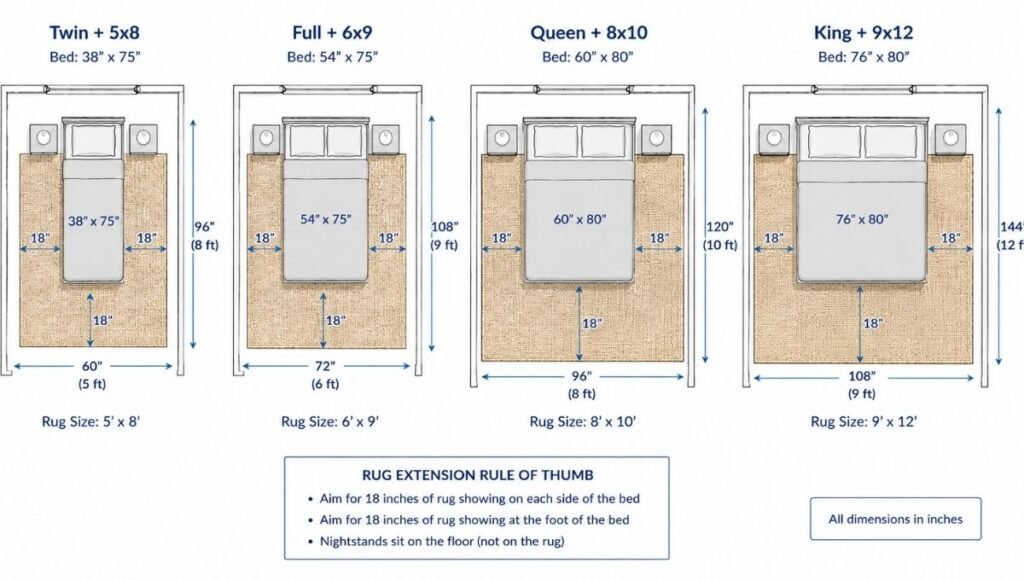
The rug slides under the lower two-thirds of the bed, starting approximately at the point where you’d lay your hands if you were sitting up in bed. The nightstands sit off the rug, on the bare floor or on the hardwood/tile. The rug extends 18–24 inches on each side of the bed and 18–24 inches beyond the foot.
This is the most recommended placement for a reason: it uses a smaller rug than the full-under option while achieving the visual of a anchored bed. Because the nightstands are off the rug, the rug doesn’t need to span their full width — which allows for a narrower, less expensive rug in the same room.
When it works: Most standard and small-to-medium bedrooms. Works with any bed frame style. The most forgiving option if you’re unsure which rug size to buy.
When it doesn’t work: In rooms where the gap between the bed and the wall is less than 30 inches — the rug’s sides may be too short to read as intentional. In that case, consider a runner on each side instead (covered below).
Rug size needed: For a queen bed, an 8×10 is the standard recommendation. A 6×9 works in smaller rooms with this placement.
Option 3: Foot of Bed Only — The Small Bedroom Solution
A smaller rug (5×7 or 4×6) is placed at the foot of the bed, covering the area where you step out rather than sliding under the bed at all. The rug anchors the end of the bed rather than the sides.
This is the most practical option for small bedrooms where the gap beside the bed is under 24 inches, or where a larger rug would make the room feel wall-to-wall.
When it works: Tight bedrooms where the primary access side has limited clearance. Also works when the bed is against one wall — the rug covers the accessible side and the foot without needing to extend to the wall-side, which has no traffic anyway.
When it doesn’t work: If the rug is too small to read as intentional — a 3×5 foot rug at the foot of a queen bed looks like a bath mat that migrated. A 4×6 or 5×7 is the minimum for this placement to read as a design decision.
What Size Rug for a Bedroom: The Bed-Size Formula
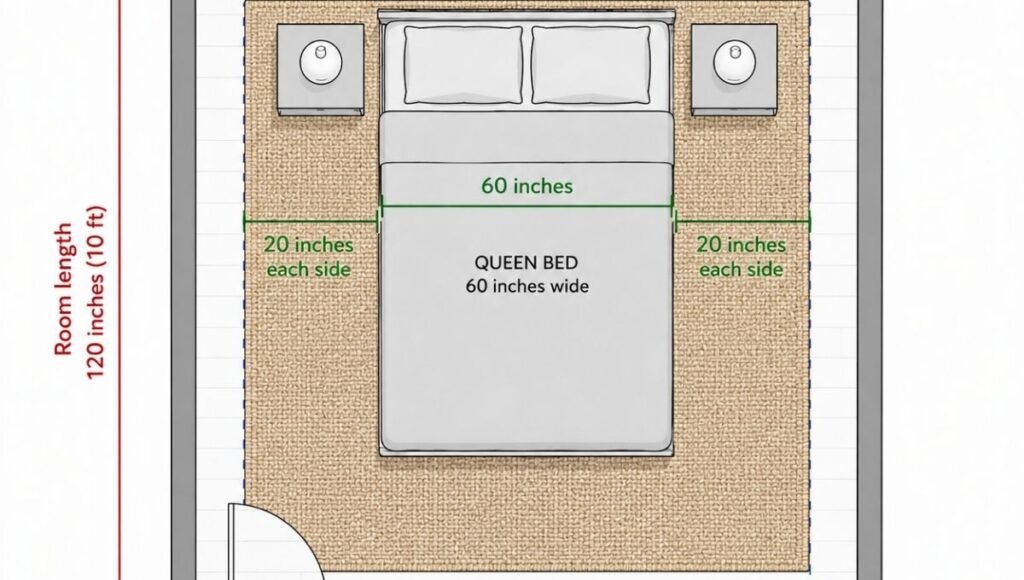
This is the question most people search for, and the answer is simpler than the guides make it seem. The formula:
Rug width = bed width + 18 inches minimum on each exposed side
For the two-thirds-under placement (the standard):
| Bed Size | Bed Width | Rug Width Needed (18″ each side) | Recommended Rug |
|---|---|---|---|
| Twin | 38 inches | 74 inches (6.2 ft) | 5×8 or 6×9 |
| Full/Double | 54 inches | 90 inches (7.5 ft) | 6×9 or 8×10 |
| Queen | 60 inches | 96 inches (8 ft) | 8×10 |
| King | 76 inches | 112 inches (9.3 ft) | 9×12 |
For a queen bed: An 8×10 rug is the most commonly recommended size because its 8-foot width provides exactly 18 inches on each side of a 60-inch queen mattress. A 9×12 provides more generous clearance (24 inches each side) in a larger room.
For a full bed in a small bedroom: A 6×9 rug placed two-thirds under provides 15 inches on each side — slightly under the 18-inch ideal, but adequate for rooms where 18 inches would push the rug too close to the wall.
Rug Placement for Small Bedrooms: When the Rules Don’t Fit
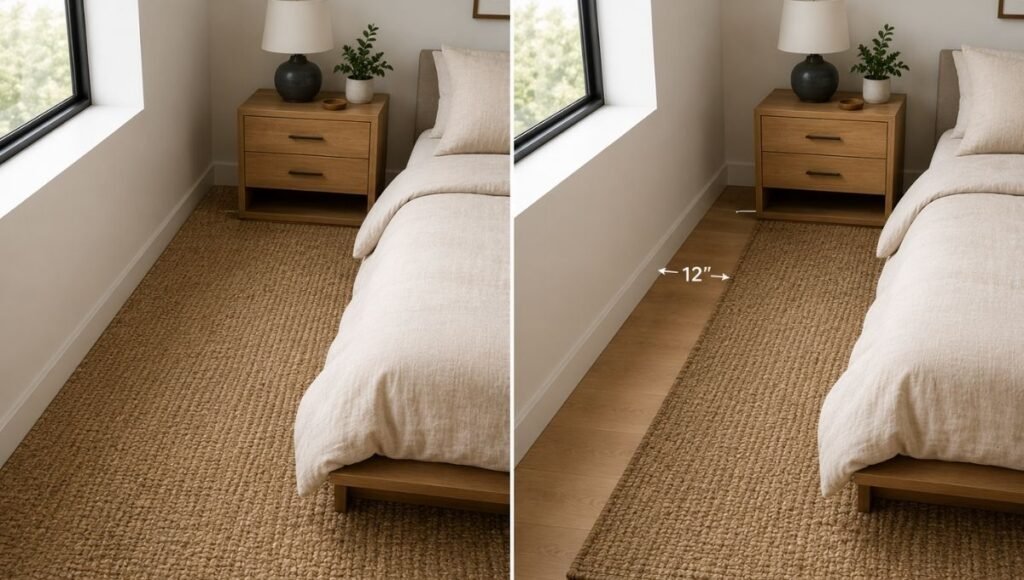
Here’s where most guides stop being useful. They give you the 18-inch rule and move on. But what happens when 18 inches on each side would put the rug’s edge 6 inches from the wall, which looks like you miscalculated rather than chose?
I have an editorial opinion here: the rug-to-wall gap matters as much as the rug-to-bed extension. A rug that runs almost wall-to-wall reads as fitted carpet. A rug that leaves 10–15 inches from the wall to the rug edge reads as a designed element. Both the bed extension and the wall gap need to work simultaneously.
The small bedroom calculation: Before buying any rug, do this:
- Measure your room width
- Subtract 20 inches (10 inches per wall for the wall gap)
- The result is your maximum rug width
- Check that this width leaves at least 12 inches on each side of the bed
Example: 120-inch (10-foot) room. Minus 20 inches = 100-inch maximum rug width (roughly 8 feet). Queen bed is 60 inches wide. 100 − 60 = 40 inches remaining, split between two sides = 20 inches per side. An 8-foot rug works in a 10-foot room with a queen bed.
Tighter example: 108-inch (9-foot) room. Minus 20 inches = 88-inch maximum rug width (7.3 feet). Queen bed is 60 inches wide. 88 − 60 = 28 inches remaining = 14 inches per side. A 7-foot-wide rug (close to 6×9) works, providing 14 inches per side — below the ideal 18 but above the 10-inch minimum. A standard 8×10 would leave only 4 inches from the wall — too close.
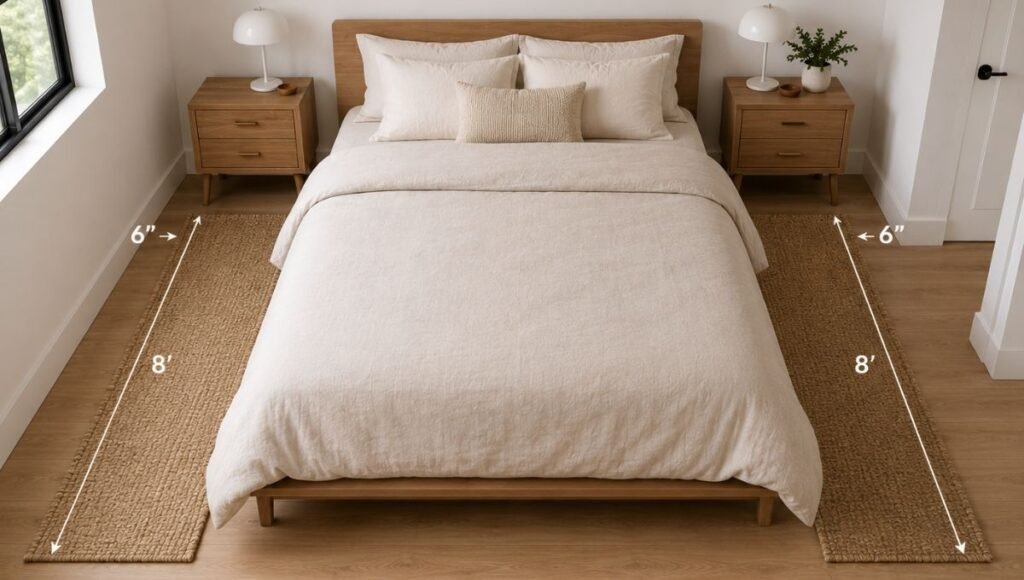
The two-runner alternative: In bedrooms where any single rug would either crowd the wall or be too small beside the bed, two runners — one on each accessible side, each 2×6 or 2.5×8 feet — solve the problem. They provide the soft landing, define the sides of the sleeping zone, and use zero space under the bed. This placement works particularly well when the bed is pushed against one wall and only one side needs coverage — one runner beside the accessible side, leaving the wall side bare.
Bedroom Rug Placement Rules: The Non-Negotiables
Beyond the size formula, four placement rules apply regardless of room size.
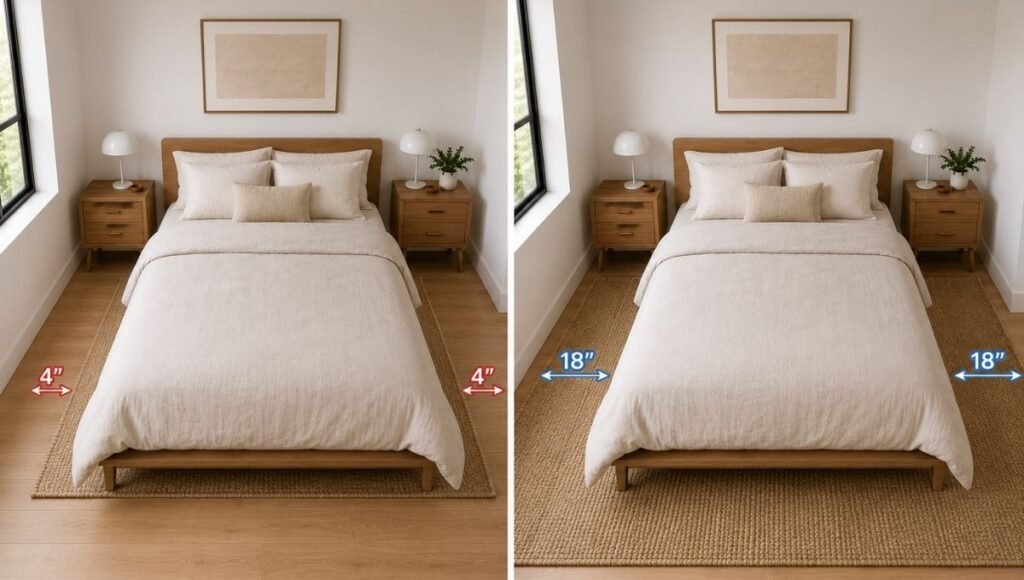
Never let the rug touch the wall: Leave a minimum of 10 inches between the rug edge and the baseboard. This gap is what separates a rug from carpet. It lets the floor breathe visually and makes the rug read as furniture rather than flooring.
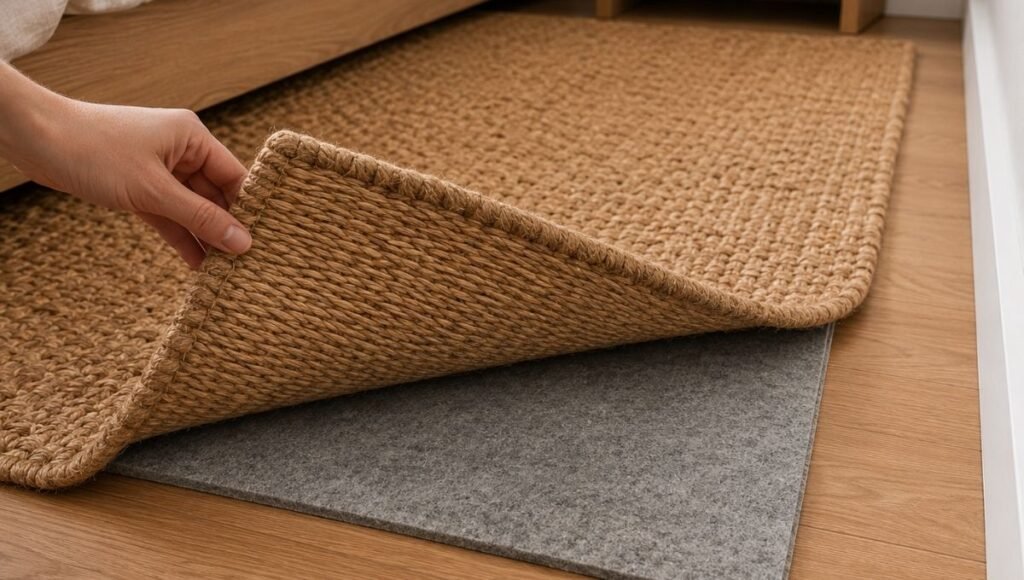
Always use a rug pad: A rug on hardwood or tile without a pad shifts. Over days, it shifts to an angle. Over weeks, it’s visibly crooked. A non-slip rug pad costs $20–$40 and eliminates this problem permanently. It also adds cushioning and prevents the rug from wearing thin at the edges where it’s lifted and replaced.
The rug should be perpendicular to the bed, not the room: Most bedrooms have the bed’s length along one wall. The rug runs perpendicular to that wall — its long dimension running across the bed’s width rather than along its length. This is how most standard rectangular rugs work with beds.
Consistent clearance on both exposed sides: The rug should extend the same distance on the left and right sides of the bed. An off-center rug reads as a placement mistake even if the room is asymmetrical. Center the rug relative to the bed, not relative to the room.
Rug Materials for the Bedroom: What Works and What Wears
Material matters more in bedrooms than in living rooms because bedroom rugs get stepped on barefoot, near the edge of the bed where concentration is highest, and laundered less frequently. The material determines how the rug ages, how it feels, and how much maintenance it requires.
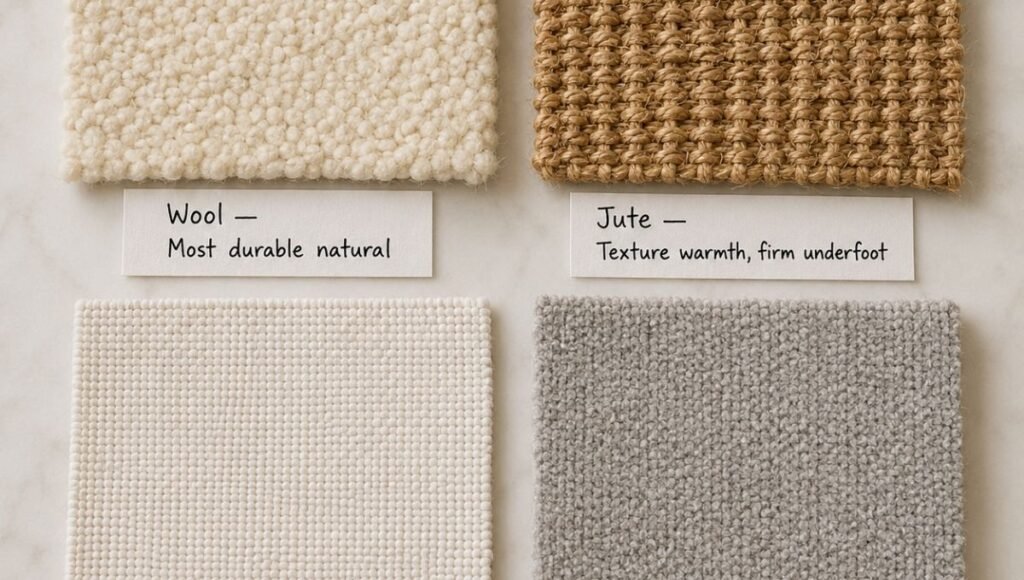
Wool: The best natural fiber for bedroom rugs. Durable, naturally stain-resistant, soft underfoot, and gets better with age. Sheds slightly when new — this resolves within the first few weeks of use. The most expensive natural fiber option, but the longest lasting.
Jute and sisal: Natural fibers with excellent texture and warmth. Jute is softer; sisal is more durable. Both provide the warmth and organic character that makes a bedroom feel designed rather than furnished. The honest caveat: neither is soft enough for walking barefoot on extended contact — they’re better as layering rugs or as the base of a layered setup than as a standalone bedroom rug if barefoot comfort is the priority.
Cotton: Soft, washable, affordable. The most practical choice for bedrooms where the rug sees high-traffic foot contact. Many cotton rugs are machine washable — a genuine advantage in a bedroom context. Less luxurious-looking than wool but far more practical for daily use.
Synthetic (polypropylene): The most budget-friendly and most durable. Stain resistant, easy to clean, holds color well. The honest trade-off: it doesn’t have the same visual warmth as natural fibers, and lower-quality synthetic rugs can look flat or cheap under certain lighting. Worth considering for high-traffic bedrooms or where budget is constrained.
What to avoid: High-pile shag rugs in small bedrooms. They look inviting in product photos and feel soft underfoot, but in a small bedroom they visually amplify the room’s mass, catch vacuuming difficulty, and accumulate dust at a higher rate. A mid-pile wool or flat-weave in a small bedroom consistently reads better than a deep shag.
If Your Rug Doesn’t Look Right: The Diagnosis
If the rug looks too small: It is. A rug that’s too small reads as an afterthought regardless of its quality. Return and size up. The most common mistake in bedroom rug shopping is buying one size too small because it seemed more proportional in the store or online.
If the rug looks off-center: Remeasure. Pull the rug out from under the bed completely, re-center it to the bed (not the room), and slide it back. The gap on each side of the bed should be equal.
If the rug bunches or shifts: No rug pad, or a rug pad that’s the wrong size. The pad should be approximately 1 inch smaller than the rug on all sides. If it’s the same size or larger, it creates a bump at the edges.
If the rug looks good but the room still feels unfinished: The rug is probably fine — the issue is likely the wall above the bed, the lighting, or the lack of an anchor piece in the room. Our small bedroom decor guide covers the anchor piece concept and the wall treatments that complete the room beyond the rug.
FAQ: Bedroom Rug Placement
What size rug do I need for a queen bed? An 8×10 rug is the standard recommendation for a queen bed in a standard-sized bedroom. It extends 18 inches on each side of the 60-inch queen mattress and 20+ inches at the foot. In a smaller room (9 feet wide or less), a 6×9 rug placed two-thirds under the bed provides 14–15 inches per side — below ideal but functional.
Should the rug go under the bed or just in front of it? Both work, depending on room size and rug size. The most common placement is two-thirds under — the rug extends from roughly mid-bed to beyond the foot, with 18–24 inches showing on each side. Foot-of-bed placement (rug only at the foot, not under) is a good option for small bedrooms where a full placement would crowd the walls.
How far should a rug extend past the bed? Minimum 18 inches on each exposed side, minimum 18 inches at the foot. The rug should extend far enough that when you step out of bed, your entire foot lands on the rug rather than on the cold floor. Less than 12 inches of visible rug reads as undersized regardless of the rug’s total dimensions.
What size rug for a full bed in a small bedroom? A 6×9 rug placed two-thirds under a full bed (54 inches wide) provides 15 inches on each side. In tighter rooms, a 5×8 provides 11 inches on each side — workable if the room is narrow. The foot-of-bed placement with a 5×7 rug is also an option for very tight small bedrooms.
Can you put a rug over carpet in a bedroom? Yes. A flat-weave or low-pile rug over low-pile carpet with a rug-over-carpet pad (a specific type with a different backing than standard rug pads) works well and looks intentional if the rug is the right size. High-pile or deep shag rugs over carpet create instability and trip hazards.
Should bedroom rug touch the wall? No. Leave at least 10 inches between the rug edge and the baseboard on all sides. A rug that touches or nearly touches the wall reads as fitted carpet rather than a placed rug, eliminating the visual benefit of a defined rug as a design element.
The Bottom Line
Bedroom rug placement comes down to two numbers — the extension beyond the bed (minimum 18 inches) and the gap from the wall (minimum 10 inches) — and working backward from your room’s dimensions to find a rug size that satisfies both simultaneously.
For most queen beds in standard rooms: 8×10. For small bedrooms: 6×9 two-thirds under, or two runners if the room is very tight. Always use a rug pad. Always center the rug to the bed, not the room.
The rug is the most space-efficient design element available in a bedroom — it adds warmth, texture, and visual grounding without consuming a single inch of floor space beyond what it covers. Getting the placement right is the difference between a rug that reads as designed and one that reads as an afterthought.
For the bedroom layout decisions that work alongside the rug — bed placement, clearances, and which wall works best for the bed — our small bedroom layout guide covers five arrangement formulas by room shape. And for the decor decisions that complete the room above the rug — anchor pieces, wall treatments, lighting — our small bedroom decor guide covers the full picture.
References
- American Society of Interior Designers (ASID): Residential space planning guidelines — minimum clearance standards for area rug placement in residential bedroom settings, including wall-gap and furniture-overhang recommendations
- Stamps, A. E. (2010). Effects of permeability on perceived enclosure and spaciousness. Environment and Behavior, 42(6), 864–886. (Research on visual proportion and perceived spatial openness — basis for the rug-to-wall gap effect on room spaciousness perception)
Published on Grainv.com | Category: Bedroom | Related: Small Bedroom Layout, Small Bedroom Decor, Warm Bedroom Ideas