
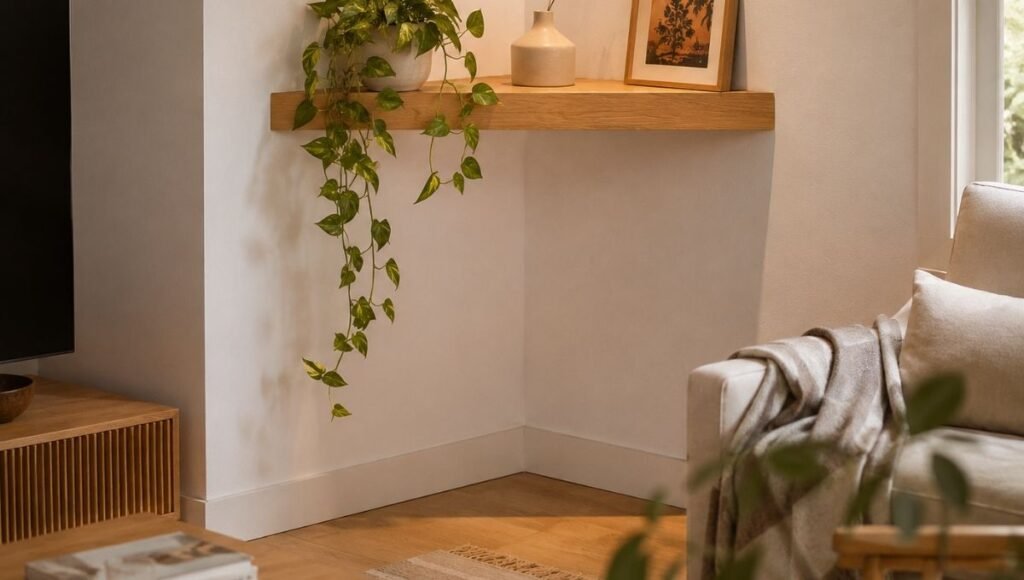
Every apartment has corners. Most apartments treat them as the place where the lamp gets pushed when you rearrange furniture, or where things accumulate because nobody decided what should live there. A corner is the one spot in a room that’s simultaneously out of the way and completely visible — which means an unused corner is just a gap in your space’s visual logic that visitors’ eyes snag on without knowing why.
A floating corner shelf solves this specific problem. Not by filling the corner with a bulky piece of floor furniture that cuts off circulation, but by claiming the vertical space above where furniture would go and turning it into a functional, designed surface. It’s the opposite of adding furniture — it’s using architecture.
The reason most people hesitate is the same reason most corner spaces stay empty: they don’t know what to put on a corner shelf, or they’re not sure whether the shelf will look intentional or just like something they added because they ran out of other walls. Both are real concerns. Both are solvable. This guide covers how to pick the right floating corner shelf for your space, where to mount it at the right height, and what to put on it so it reads as a design decision rather than an afterthought.
Key Takeaways
- Corners hold 20–30% more usable wall area than flat walls per square foot of floor footprint — a corner shelf uses zero floor space while accessing two wall surfaces simultaneously, which is why it consistently outperforms flat wall shelves for space efficiency in small apartments
- The 60-inch mounting height rule: For a single floating corner shelf in a living room or bedroom intended for display, mounting at 60 inches (5 feet) from the floor places it at natural standing eye level — the height that reads as “gallery” rather than “storage”
- Shelf depth is the constraint most people overlook: A corner shelf deeper than 10 inches starts to interrupt the circulation path around the corner; 7–9 inches is the sweet spot for small apartment corners where people pass regularly
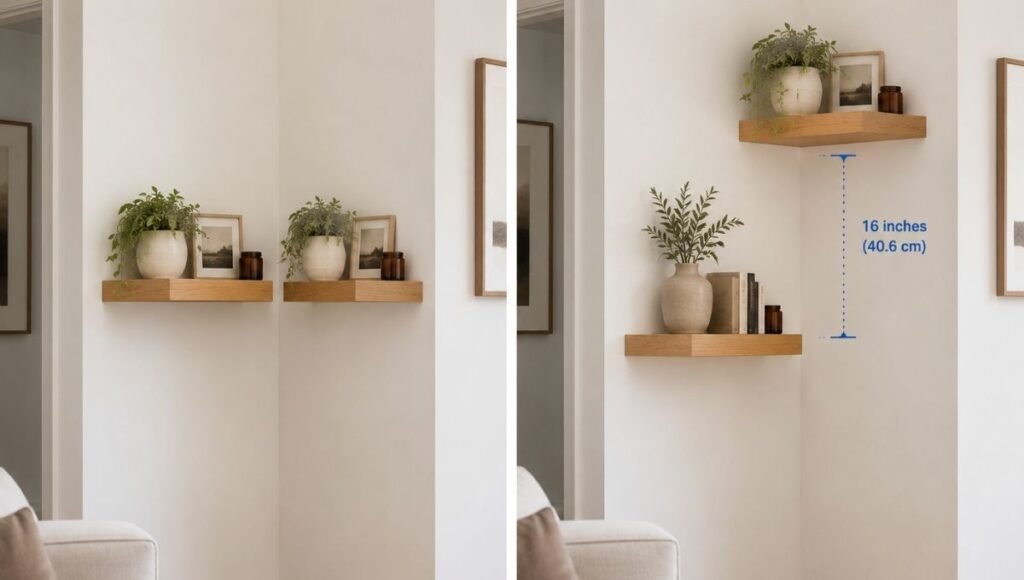
- Staggered heights outperform identical heights for stacked shelves: Two floating corner shelves at the same height look like an accident; two shelves at heights 14–18 inches apart look like a considered system
- Weight capacity matters more for corner shelves than flat shelves: Because corner shelves are often mounted into drywall rather than studs (corners don’t always align with studs), understanding the difference between stud mounting (50+ lbs) and drywall anchor mounting (15–20 lbs) determines what you can safely display
Why Corners Work Better Than Flat Walls for Shelving in Small Apartments
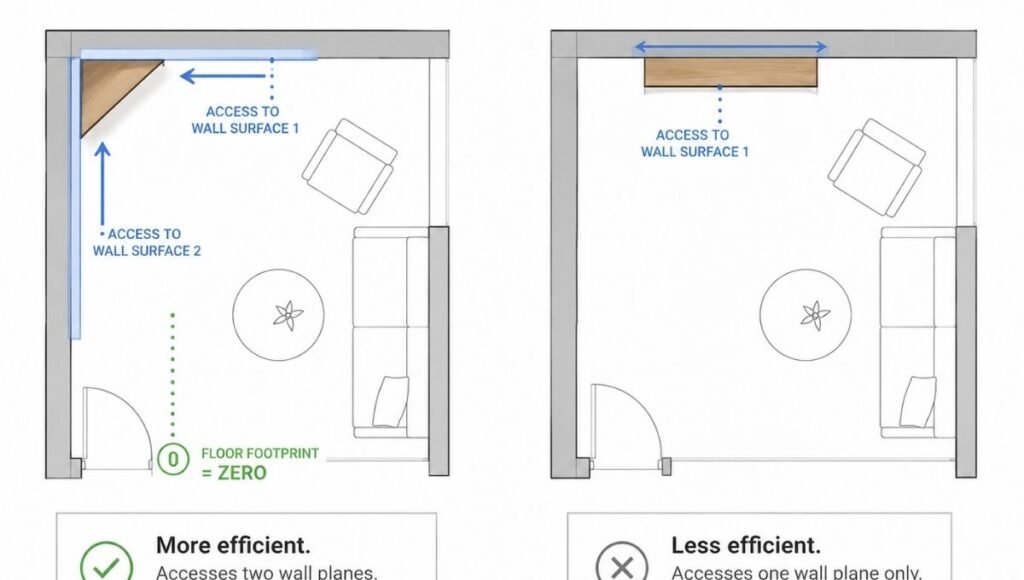
This is the argument worth making before anything else, because it explains why floating corner shelves consistently appear in small apartment renovation posts and consistently disappear from larger home interiors: scale.
In a large room, a corner shelf is a detail. In a small apartment, the corner is often the only location where a shelf doesn’t compete with furniture, walkways, windows, or doorways. Flat walls in small apartments are usually occupied — the sofa goes against one wall, the dresser against another, the TV on the third. The corner is the one location that’s genuinely available.
A floating corner shelf in a small apartment doesn’t just add storage — it adds a surface without taking anything away. No floor furniture to navigate around, no wall space that could have held a mirror or art, no clearance to maintain for drawers or doors. The corner exists in its own dimensional pocket, and a shelf there takes nothing from the room’s functionality while giving back display area, storage area, and visual interest simultaneously.
I have an editorial opinion here: the corner shelf is the most underutilized piece of storage furniture available to apartment dwellers, and it’s underutilized specifically because people underestimate how much impact a single well-placed shelf can have on a room’s sense of being designed rather than just furnished.
Floating Corner Shelf Sizes: What to Buy for Which Space
The Depth Question (More Important Than Width)
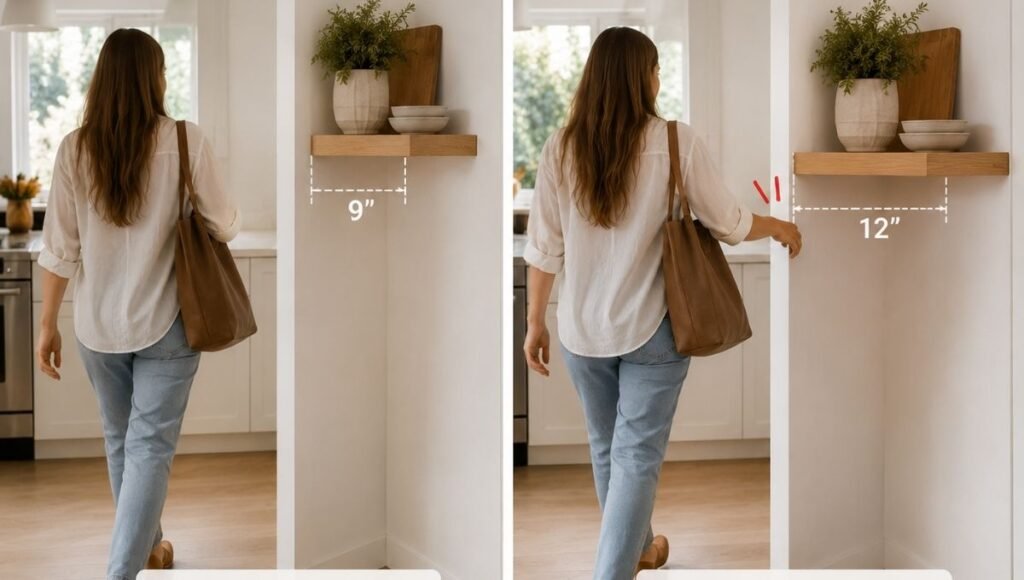
Corner shelves come in two common depth configurations: equal-depth (both legs of the shelf are the same length, typically 8–12 inches) and right-angle (two boards meeting at 90 degrees, with each leg extending 8–14 inches from the corner).
For small apartment corners where people walk past: Maximum 9 inches depth per leg. A 10-inch or deeper corner shelf in a tight space (kitchen corner, hallway corner, bathroom corner) creates an obstacle that catches elbows, bags, and hips at head height. The depth that looks proportional in a product photo is often too deep for the actual corner.
For bedroom or living room display corners where traffic is minimal: 10–12 inches works well. This depth accommodates most plants, books stood upright, and standard-sized objects without looking skinny.
The standard Woodsnap corner shelf at 12″ × 14″ is generous for display but tight for high-traffic corners. Measure the clearance from your corner to the nearest traffic path before buying any corner shelf wider than 10 inches.
Weight Capacity: Studs vs. Drywall Anchors
This is the conversation that matters before any purchase.
Mounted into wall studs: 50 lbs per shelf is achievable with quality hardware. Studs give you full confidence for plants in heavy ceramic pots, stacked books, or a small speaker.
Mounted into drywall with anchors: Maximum 15–20 lbs with good toggle anchors (Snaptoggle or similar). Sufficient for lighter displays — small plants in plastic or terracotta, a few objects, a couple of books. Not suitable for a heavy ceramic collection or a plant in a large soil-heavy pot.
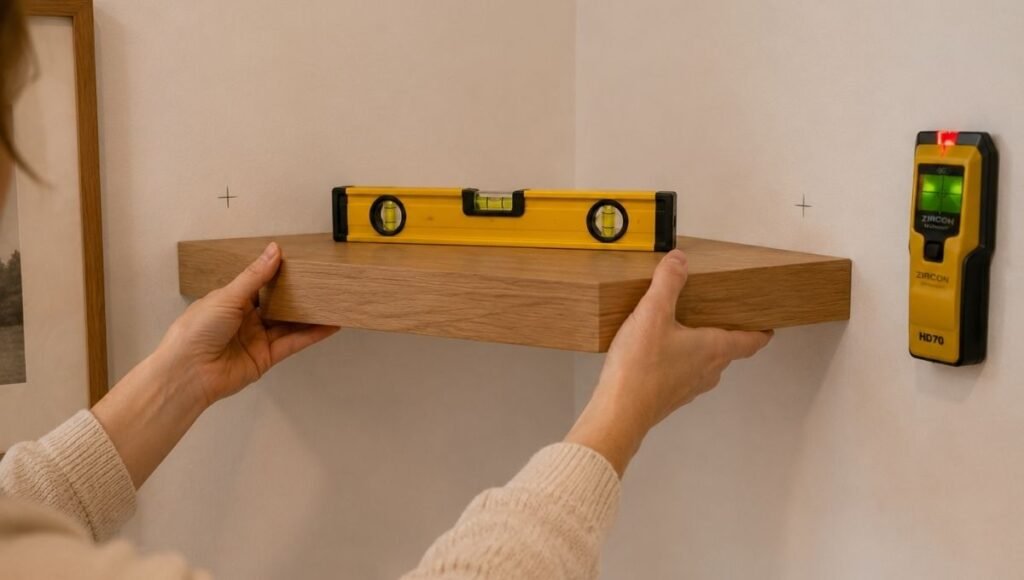
The problem with corner shelves specifically is that wall corners don’t always align with studs. Before buying, use a stud finder on both walls of your corner and check whether you can get a stud on at least one mounting side. If neither wall has a stud in the corner zone, plan for drywall anchors and limit what you display.
How High to Mount a Floating Corner Shelf: The Room-by-Room Guide
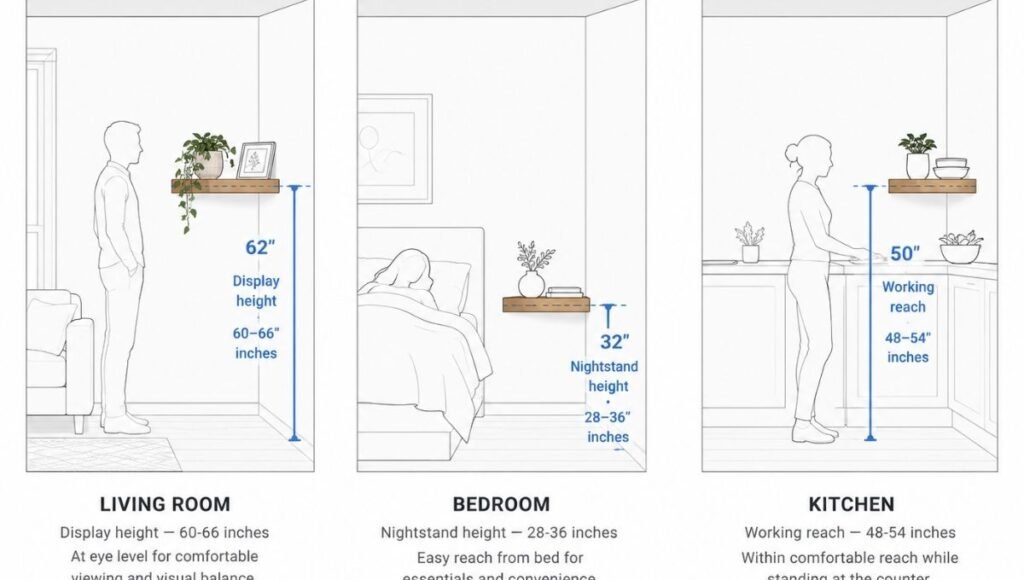
The mounting height question is the one that gets people into trouble. Too high and the shelf is inaccessible and reads as decorative-but-not-functional. Too low and it’s in the way of furniture or circulation. The answer is different by room.
Living Room Corner Shelf Height
Single display shelf: 60–66 inches from the floor. This puts the shelf surface at standing eye level, which is where displayed objects look best and where the shelf reads as a gallery-style design choice rather than utility storage.
Above a sofa or reading chair: If the corner is behind or beside a seating area, mount at 8–10 inches above the top of the furniture back (typically 42–48 inches from the floor for most sofas). This keeps the shelf in sight from seated position without being at an awkward reaching height.
Stacked shelves (two-shelf system): Mount the lower shelf at 48 inches, the upper at 64–66 inches. The 16–18-inch gap between shelves gives adequate visual breathing room and allows taller objects on the lower shelf.
Bedroom Corner Shelf Height
Beside the bed: 28–36 inches from the floor — equivalent to nightstand height. A corner shelf at this height beside the bed replaces a nightstand in tight bedrooms where there’s no space for a table. It holds a lamp, a glass of water, a phone, and a plant without the footprint of furniture.
Display shelf in bedroom corner: 58–64 inches. Slightly lower than living room display height because bedrooms are typically viewed from a seated or lying position more often than standing.
Above a desk: If a corner desk setup exists, a shelf at 18–20 inches above the desk surface (approximately 48 inches from the floor) provides accessible overhead storage without being uncomfortably close to a seated person’s head.
Kitchen Corner Shelf Height
Working height (accessible while cooking): 48–54 inches. This puts spices, oils, and frequently used items at reaching height without straining.
Display height (plants, mugs, aesthetics): 60–66 inches. Same as living room logic — above the workflow, visible, decorative.
The kitchen corner caveat: Kitchen corners are often the highest-humidity zones in an apartment. Natural wood corner shelves in kitchen corners without good ventilation can absorb moisture over time. If your kitchen has steam from cooking, choose a shelf with a sealed or painted finish rather than raw wood.
Bathroom Corner Shelf Height
Inside a shower: Most floating corner shelves are not designed for shower interior use (moisture exposure). Verify water resistance before mounting any wood shelf inside a shower enclosure.
Bathroom counter zone: 48–58 inches — accessible for reaching skincare, candles, and small storage while standing at the sink.
Above toilet: 36–48 inches above the toilet tank top, accounting for the tank height of approximately 28–30 inches from the floor. This puts the shelf at 64–78 inches total, which is accessible for most adults.
Floating Corner Shelves: Room by Room Placement Strategy
Living Room
The living room corner shelf works hardest when it anchors the room’s secondary display zone — not competing with the main wall (TV wall or art wall), but creating a considered secondary focal point in a corner that would otherwise be visually inert.
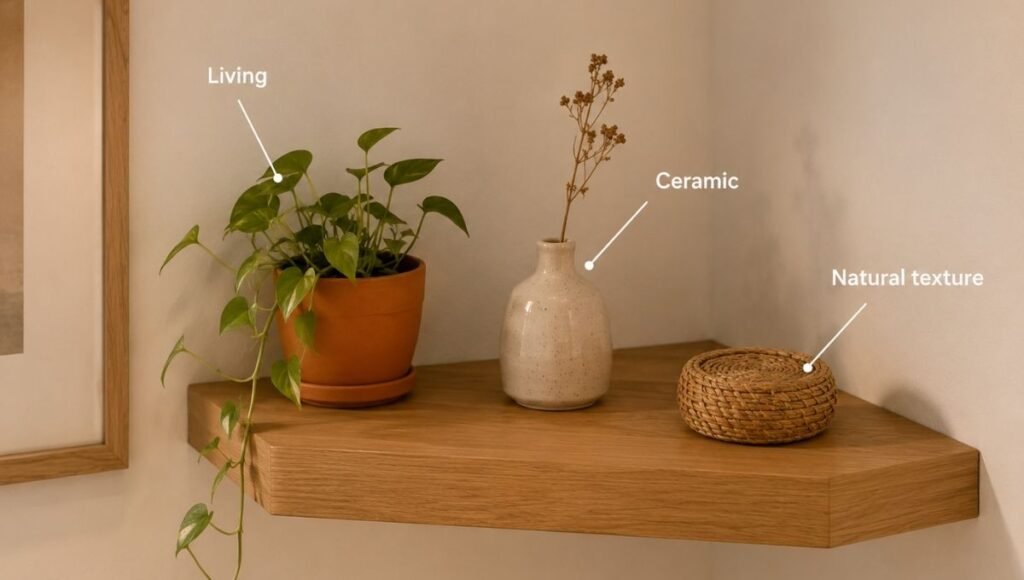
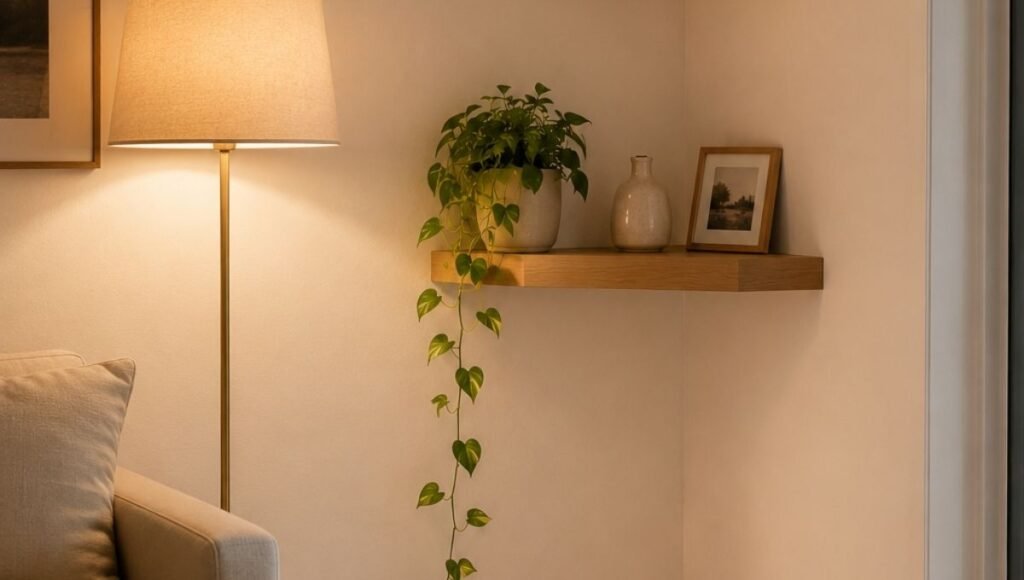
What works: A single shelf at 62 inches holding a plant with trailing vines that descend the wall, a small framed photo, and a ceramic object. The trailing plant does significant visual work — it connects the shelf to the floor visually and makes the corner feel inhabited rather than decorated.
What doesn’t work: Three shelves stacked at identical heights, each holding an unrelated collection of objects. This reads as a storage attempt rather than a design decision. If you’re using multiple shelves, stagger the heights and keep the objects on each shelf intentionally related — one shelf for plants, one for books, not each shelf holding a bit of everything.
Internal link note: For the complete living room storage picture — how corner shelves fit within a broader storage strategy — our living room storage ideas guide covers the full approach.
Bedroom
The bedroom corner shelf’s highest-value application is replacing the second nightstand. In small bedrooms where the bed is against one wall and there’s only clearance on one side, a floating corner shelf at 32 inches in the corner nearest the accessible side of the bed serves as the nightstand without the floor footprint.
Stack two at nightstand height and slightly above: the lower at 30–32 inches holds the lamp; the upper at 48–52 inches holds a book, a plant, or a small speaker. The result is a corner that does more work than a nightstand while taking zero floor space.
For the full bedroom decor and storage strategy, our small bedroom decor guide and small bedroom storage guide cover how corner shelves fit within the larger room picture.
Home Office Corner
A floating corner shelf at desk-height-plus-18-inches (approximately 48–52 inches) in a home office corner creates a document and reference zone above the desk without consuming any desk surface. This is particularly useful in the small desk setups covered in our small home office desk guide.
For a more ambitious corner office, pair a wall-mounted fold-down desk with a corner shelf above it — the desk folds flat when not in use, and the corner shelf holds the office essentials that would otherwise live on a desk that disappears.
What to Put on a Floating Corner Shelf (Curated, Not Cluttered)
The most common mistake with corner shelves isn’t the installation — it’s the styling. A corner shelf that holds too many things of similar scale looks like a relocation of clutter from another surface. The styling logic that consistently works:
The 3-material rule for single shelves: One living element (plant), one woven or natural-texture element (a small basket, a jute-bound book), one ceramic or glass element. Three materials, different from each other, tells the eye “someone made decisions here” rather than “someone put things here.”
The scale contrast rule for stacked shelves: If two or more shelves are stacked, the objects on each shelf should differ in scale — tall objects on one shelf, low objects on the next. Two shelves with identically sized objects look like rows, not composition.
Trailing plants for corner shelves specifically: A trailing pothos, string of hearts, or philodendron on the highest shelf of a corner arrangement does something wall art can’t — it provides vertical movement and connects the shelf to the floor and wall in a way that makes the corner feel inhabited. The plant grows down; the shelf anchors it at height; the corner becomes a vertical garden zone rather than a storage afterthought.
Installation: What to Know Before Drilling
Corner shelf installation is straightforward but requires two specific preparations that flat wall shelves don’t:
Step 1: Check for studs on both walls of the corner. Use a stud finder on both surfaces. Note the stud positions. If there’s a stud accessible on at least one wall within 2 inches of the corner, mount primarily to that stud.
Step 2: Ensure the corner is actually 90 degrees. Most apartment corners are 90 degrees, but older construction sometimes has slightly off-angle corners. Place a framing square (or the corner of a piece of cardboard box) against both walls. If there’s a gap, the shelf bracket will require shimming or the shelf will sit visibly angled.
Step 3: Level across both walls, not just on one axis. A shelf level on the wall-facing axis but not the room-facing axis will hold objects that slide toward the wall. Use a small level on the shelf surface itself after mounting.
Step 4: Mark both mounting points before drilling anything. Hold the shelf in position at the desired height, mark both bracket positions, verify level, then drill. Drilling first and adjusting after is how corners end up with four unnecessary holes.
If Your Corner Shelf Doesn’t Look Right: The Diagnosis
If it looks too high: Objects on the shelf are invisible from normal room positions. Lower by 6 inches and reassess. Display shelves often look correct in empty rooms and too high once furniture and eye-level context are in place.
If it looks too cluttered: Remove everything. Put back one object. Add a second. Stop at three maximum for a single shelf. Edit from sparse toward full rather than from full toward edited.
If the shelf looks small against the wall: The shelf proportion is undersized for the corner. A 7-inch deep shelf in a corner with 10-foot ceilings and large furniture reads as inadequate. Either add a second shelf above to create a composed system, or replace with a deeper shelf.
If the corner still feels empty despite the shelf: The shelf needs a trailing plant. It’s almost always the trailing plant.
FAQ: Floating Corner Shelf
How high should a floating corner shelf be mounted? For display in living rooms and bedrooms: 60–66 inches from the floor (standing eye level). Beside a bed as a nightstand replacement: 28–36 inches. Above a desk: 48–52 inches. In a kitchen at working reach: 48–54 inches. Mount at the height where the objects you’ll display will be naturally visible from the position you most often occupy in that room.
How much weight can a floating corner shelf hold? When mounted into wall studs: 50 lbs or more with quality mounting hardware. When mounted into drywall with toggle anchors: 15–20 lbs maximum. Corner positions don’t always align with studs — check both walls of your corner with a stud finder before purchase to understand your weight capacity.
What size floating corner shelf for a small apartment? For high-traffic corners (kitchen, hallway): maximum 9 inches depth per leg to avoid creating an obstacle. For display corners in bedrooms and living rooms with minimal traffic: 10–12 inches per leg. Deeper shelves accommodate more but create elbow-catching hazards in tight corners.
Can you put plants on a floating corner shelf? Yes — corner shelves are excellent for plants, particularly trailing varieties (pothos, string of hearts, philodendron) that grow down from height. Ensure the shelf can support the combined weight of pot, soil, and plant when wet, and use a drip tray to protect the wall below. Check that the corner receives adequate indirect light for the plant species.
How do you style a floating corner shelf? Three-material rule: one living element (plant), one natural-texture element (basket, wood object), one ceramic or glass element. Avoid grouping objects of identical scale. For stacked shelves, vary the object heights between levels. The trailing plant is the most effective single addition to make a corner shelf read as designed rather than stored.
The Bottom Line
The floating corner shelf is the highest-efficiency storage and display addition available to a small apartment — it uses otherwise dead architectural space, takes no floor footprint, and with one or two shelves can transform a corner from the room’s most visually incoherent spot to its most intentional.
Get the depth right (under 10 inches for tight corners), mount at the right height for the room and your most common viewing position, and style with the 3-material rule. The corner that’s been a problem to solve becomes the corner you show people when they visit.
For the complete small apartment storage strategy — how corner shelves fit alongside media consoles, entryway benches, and under-bed storage — our living room storage ideas guide covers the full picture. And for the bedroom-specific storage decisions, including nightstand alternatives for very tight bedrooms, our small bedroom storage guide has the full breakdown.
References
- American Society of Interior Designers (ASID): Residential ergonomic guidelines — shelf mounting heights for residential display and storage, minimum clearance standards for wall-mounted shelving in residential interiors
- Stamps, A. E. (2010). Effects of permeability on perceived enclosure and spaciousness. Environment and Behavior, 42(6), 864–886. (Research on visual perception of space and how vertical storage affects perceived spatial openness in small residential interiors)
Published on Grainv.com | Category: Storage Furniture | Related: Living Room Storage Ideas, Small Bedroom Storage Ideas, Small Home Office Desk, Small Bedroom Decor