
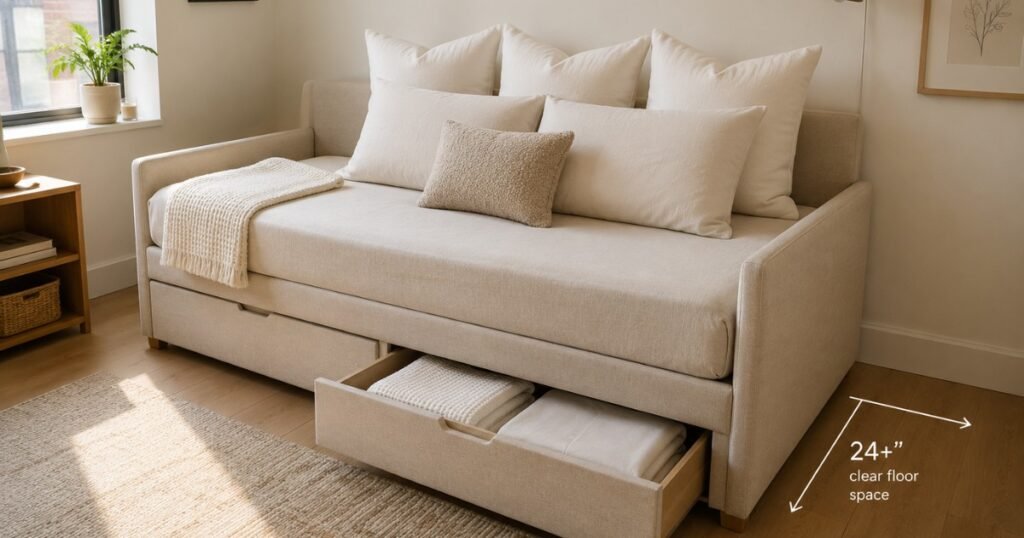
It can be a place to sleep at night, a comfortable spot to relax during the day, and a hidden storage solution for the items you still need but don’t want on display.
But once the daybed is actually in your space, the small details start to matter. The difference between a storage daybed you love and one you regret usually comes down to a few inches.
Maybe the drawers hit the edge of your rug. Maybe there isn’t enough space between the bed and your dresser to fully open them. Or maybe the daybed looked like a cozy sofa online but still feels like a bed sitting in the middle of your living room.
Choosing the right daybed with storage is less about finding the biggest drawers or the most features. It’s about understanding how that piece will actually fit into your daily routine.
This guide walks through the measurements, storage types, and small details worth checking before bringing one home.
Key Takeaways
- Twin-size daybeds run 78–80 inches long and 42–44 inches wide — the frame itself is often wider than the mattress by several inches, which catches buyers off guard when measuring
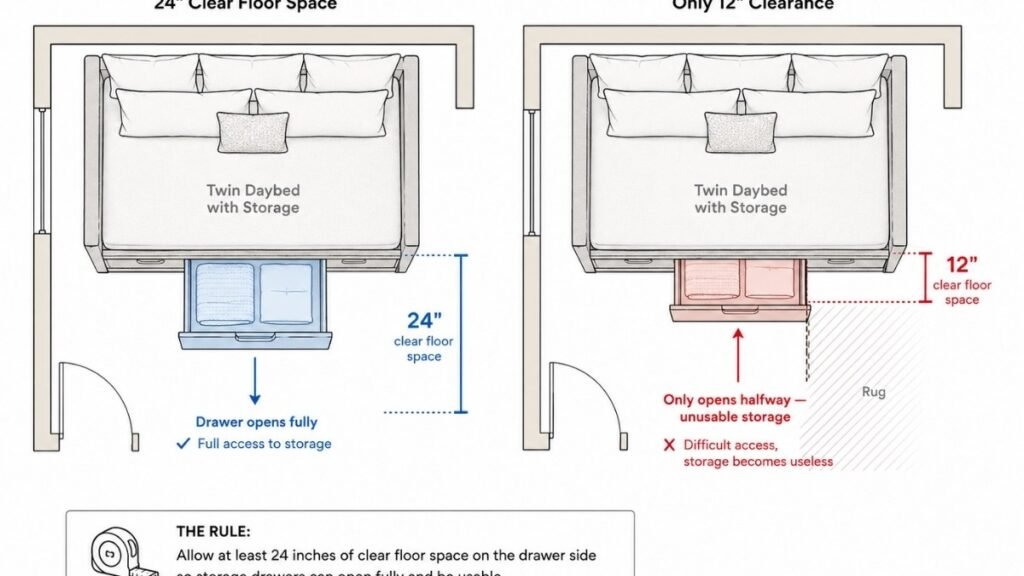
- Drawer clearance is the most overlooked measurement: you need at least 24 inches of open floor space on the drawer side so drawers can pull out fully — a daybed drawer that can only open halfway is functionally useless
- Seat height matters as much as storage capacity: for a daybed doing double duty as sofa and bed, 18–20 inches finished height (top of mattress to floor) is the sweet spot — close enough to standard sofa seat height to feel natural
- Three storage types, three different use cases: drawers for daily access (clothes, linens), trundle for occasional guests sleeping two, lift-up for maximum hidden storage you access less often
- The biggest daybed styling failure isn’t comfort — it’s the daytime look: a daybed that looks like an unmade bed at 2pm defeats the whole purpose of choosing this piece over a regular bed
Before Buying a Daybed with Storage, Measure These 3 Things First
I’ll be direct: most people only measure the bed frame, then forget the extra space needed to actually use the storage. These three measurements need to happen before you look at a single product listing.
Available Floor Space vs. Actual Daybed Footprint
Standard twin daybeds measure 78–80 inches long and 42–44 inches wide. That width surprises people because a twin mattress is only 38 inches wide — but the frame adds 2–3 inches on each side, sometimes more with arms and backrest.
Here’s the table that matters before you shop:
| Size | Mattress | Frame (typical) | Wall space needed |
|---|---|---|---|
| Twin | 38″ × 75″ | 42–44″ × 78–80″ | 45″ width minimum |
| Full | 54″ × 75″ | 58–60″ × 78–80″ | 62″ width minimum |
Mark those dimensions on your floor with painter’s tape before buying anything. Then stand in the room and check whether the space still feels livable with that footprint occupied. Product photos are almost always taken in generous rooms. Your apartment may not have the same forgiving geometry.
Drawer Clearance: The Detail Most Buyers Forget
This is the one that causes the most post-purchase regret, and it rarely appears in product descriptions.
A daybed with storage drawers needs clear floor space on the drawer side — the side where the drawers pull out, usually the front-facing side or one of the long sides. <cite index=”27-1″>You need at least 24 inches of open floor so the drawers can pull out fully.</cite> A daybed with drawers that can only open 12 inches because there’s a rug edge or a wall in the way is a daybed with half-functional storage.
Here’s what that looks like in practice: say your bedroom has 20 inches of clearance between the daybed’s drawer side and the nearest wall or furniture piece. You bought a daybed with 18-inch drawers. Those drawers will open — but only partway. You’ll be reaching in at an angle to get anything out. After about two weeks of this, you’ll stop using the drawers entirely and start piling things on top of the daybed instead.
Before buying, measure the clearance on the side where the drawers will face. You need a minimum of 24 inches. If that space doesn’t exist in your room, either reposition the bed so the drawers face a more open direction, or choose a lift-up storage model instead.
Mattress Height and Sitting Comfort
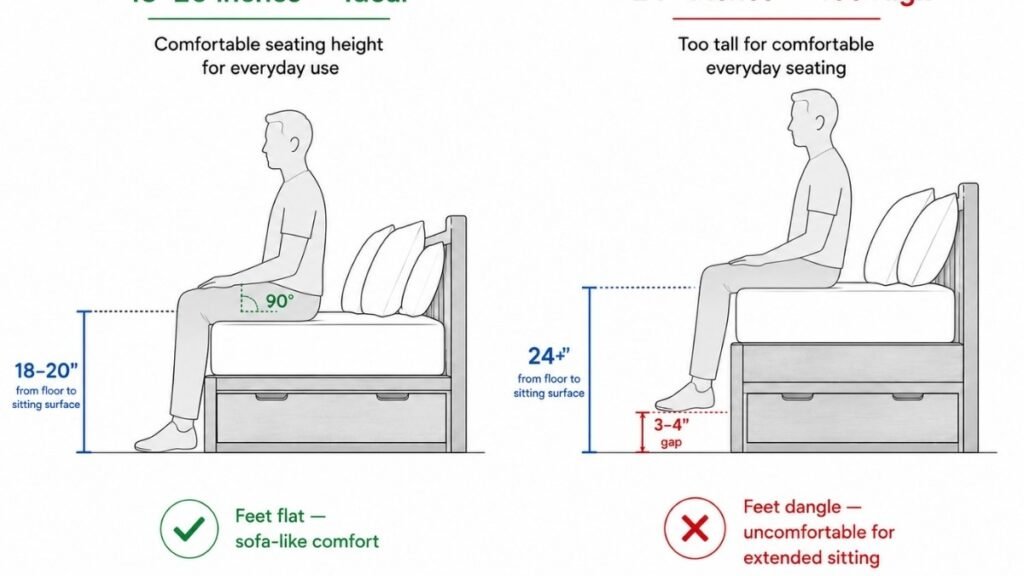
The finished height of a daybed — top of mattress to floor — determines whether it functions as a piece of seating or just a bed you sit on occasionally.
<cite index=”23-1″>Standard finished height (top of mattress to floor) runs from 17 to 24 inches. For a daybed doing double duty as a sofa and a bed, 18–20 inches tends to work best — close enough to standard sofa seat height that it feels natural.</cite>
The calculation: frame height + mattress thickness = finished height. A frame with a 12-inch platform height plus an 8-inch mattress = 20 inches finished. That’s ideal. A frame with a 10-inch platform height plus a 12-inch thick mattress = 22 inches — already starting to feel high for comfortable seated conversation.
Two things to check before buying: the frame’s platform height (how far the mattress support surface is from the floor) and the recommended maximum mattress thickness. Most storage daybeds recommend 6–8 inch mattresses specifically because thicker mattresses push the finished height too high for comfortable seated use.
Types of Daybeds with Storage (And Who Should Choose Each)
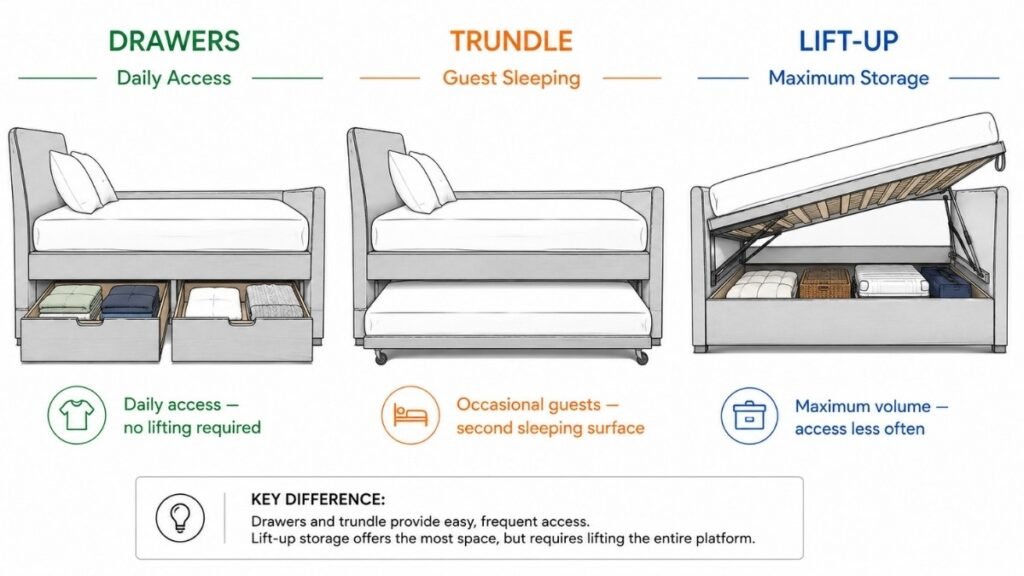
Daybed with Storage Drawers
The most common type. Drawers built into the frame pull out from the front, side, or both, providing divided storage accessed independently of the mattress.
Who it’s for: People who need to access storage regularly — daily or weekly. Clothes, extra bedding, books, anything you actually reach for. The drawer access is faster than lift-up and doesn’t require moving or lifting anything.
The honest trade-off: Drawers require that 24-inch clearance we covered above. In genuinely tight rooms, this is a deal-breaker. If your room is 10 feet wide and the daybed needs to sit centered against one wall with 2–3 feet of clearance on the access side, you may not have the 24 inches the drawers need on the other side.
If you access storage every morning, drawers are almost always the easier choice over lift-up designs. The convenience difference over 365 mornings is significant.
Daybed with Storage and Trundle
A trundle is a second sleeping surface that rolls out from underneath the daybed on casters, either at floor level or with a mechanism that lifts it to the same height as the main frame.
Who it’s for: Guest rooms and spaces that occasionally need to sleep two people. If you have overnight visitors more than a few times a year but no dedicated guest room, a trundle daybed solves the problem without requiring you to own a separate bed.
This is the type that answers the question “can a storage daybed sleep two people?” — yes, if it has a trundle. The main mattress sleeps one; the trundle sleeps the second guest at floor level or raised height.
<cite index=”23-1″>If you need to sleep two people occasionally, get the trundle. If you need storage and only ever sleep one guest, the day bed with drawers is the better pick.</cite> These two purposes sound similar but require different products.
Note on floor clearance for trundles: the trundle needs 7–8 inches of clearance from the floor to the bottom of the frame to roll out without scraping. Measure before buying.
Lift-Up Storage Daybeds
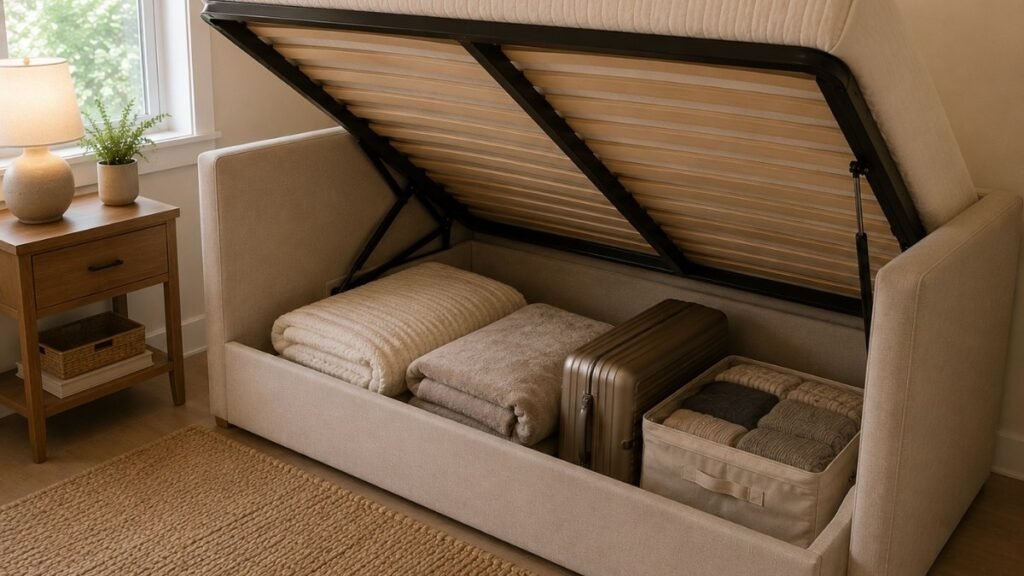
Instead of drawers or a trundle, lift-up daybeds have a hydraulic mechanism that raises the entire mattress platform, revealing a large open storage cavity underneath. This maximizes storage volume — you can store bulky items like suitcases, extra duvets, or seasonal clothing that wouldn’t fit in individual drawers.
Who it’s for: Tiny apartments where maximum hidden storage is the priority and the items stored are accessed infrequently — seasonal gear, extra bedding, luggage.
The honest trade-off: Lift-up access is inconvenient for daily use. You need to lift the mattress (and whatever bedding is on it) each time you access the storage. If you’re reaching in there every morning for clothes, this gets old quickly. Lift-up is best for things you access monthly or seasonally, not daily.
Best Daybed with Storage Ideas by Room Type
Best Storage Daybed for Studio Apartments
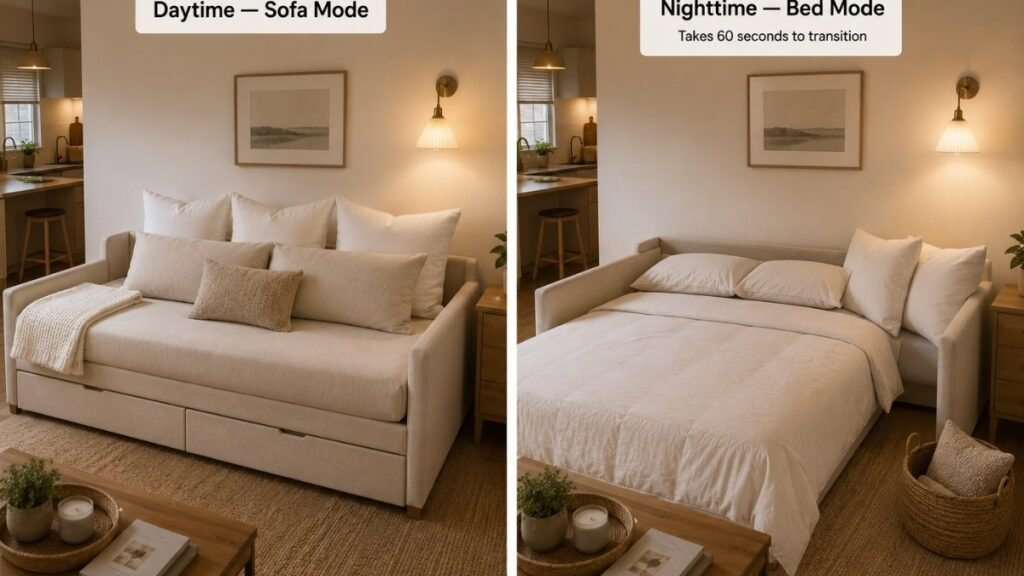
The studio apartment daybed is doing the most jobs simultaneously: it’s the primary bed, the primary seating, and the primary storage surface in a room where there may not be space for a separate sofa, dresser, or dedicated guest setup.
For this use case, the day-to-night conversion matters more than any other factor. That means:
- A backrest height of 20–24 inches that creates a genuine sofa back when you’re sitting against it (not just a low rail that looks fine in photos but provides no actual support)
- Arms on both short sides that complete the sofa silhouette
- Storage drawers that work without requiring furniture rearrangement to access
- A mattress 6–8 inches thick so the finished height stays in the 18–20 inch sofa-height range
The pillow arrangement is what makes or breaks the daytime look in a studio. During the day: 2–3 long rectangular euro pillows against the back, 2 standard sleeping pillows in front of those, and 1–2 accent pillows in front. This arrangement looks deliberate and sofa-like. At night: move the accent pillows to a basket or floor, pull the euro pillows forward, and you have a made bed in under 60 seconds.
Best Daybed with Storage for Small Bedrooms
In a small bedroom, a storage daybed replaces two pieces of furniture: the bed and the dresser. This is the calculation that makes it worth considering over a standard platform bed, even if you’re not interested in the sofa function at all.
Daybed vs. Standard Bed for a small bedroom:
| Feature | Storage Daybed | Standard Bed |
|---|---|---|
| Seating function | ✓ | ✗ |
| Hidden storage | ✓ drawers or lift-up | Depends on frame |
| Guest sleeping | ✓ with trundle | ✗ |
| Small room friendly | ✓ twin footprint | Medium (full/queen) |
| Daily sleeping comfort | ✓ | ✓ |
The twin footprint is the main practical argument for small bedrooms. A twin daybed against a wall opens up the rest of the room in a way a queen bed can’t. If you’ve been sleeping on a queen because that’s just what adults have and you frequently wish your room felt bigger, a twin daybed with storage is worth reconsidering.
Best Storage Daybed for Guest Rooms
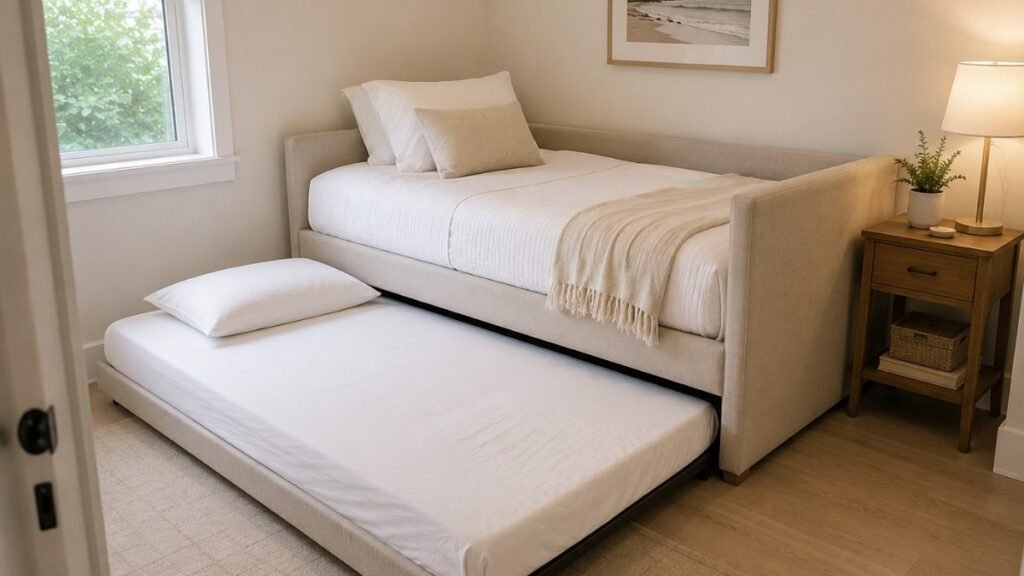
The guest room daybed is used perhaps 20–30 nights a year. This changes the priority order: storage convenience and daily aesthetics matter more than sleeping comfort, because the room-as-home-office or room-as-study is the primary use case 90% of the time.
For a guest-room daybed, I’d recommend: a trundle for actual guest sleeping (the main surface is more comfortable than floor-level trundle sleeping for most adults), drawers for storing the guest room essentials (extra towels, pillows, linens), and an upholstered frame that reads as furniture rather than just a bed. The guest room daybed should look like a sofa that happens to become a bed — not a bed that you’ve put in the guest room.
Best Daybed with Storage for Kids or Teen Rooms
Kids’ and teen rooms are where daybeds with trundles are especially practical. The trundle provides sleepover capacity without any additional floor furniture. Drawers handle the inevitable overflow of clothes, games, or whatever-it-is-teens-accumulate.
For younger children: choose a frame with solid side rails and no sharp corners on the arms. The daybed surface is the sitting surface and often a jumping surface — structural durability matters more than aesthetics.
For teens: the daybed that looks most like a low sofa is typically preferred. Higher backrest, arms that don’t look like a baby crib, fabric upholstery in a color they chose, and a good quality mattress they’ll actually want to sleep on.
Common Mistakes When Choosing a Storage Daybed
Choosing Storage Size Without Checking Drawer Depth
The measurements that matter for daybed drawers are depth and height, not just width. A drawer 36 inches wide sounds generous until you discover it’s only 4 inches deep — enough for a layer of folded t-shirts and nothing else.
Before buying, look for: drawer depth (minimum 14 inches for useful storage), drawer height (minimum 8 inches to accommodate folded clothing or standard pillow sizes), and drawer construction (full-extension slides so you can actually reach the back, not partial-extension slides that stop at 70% open).
Forgetting Rug and Nightstand Placement
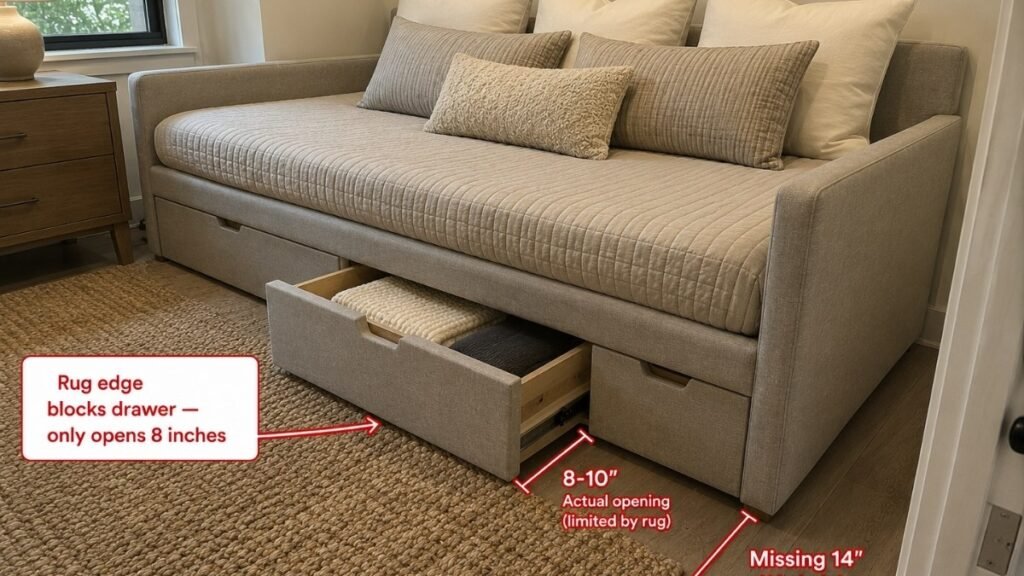
The daybed doesn’t exist in isolation. In a small bedroom, the rug needs to extend at least 18 inches beyond the daybed’s accessible sides for the floor to feel anchored — which means the rug’s edge may be exactly where you needed the drawer clearance. These two elements conflict constantly in small rooms.
Plan rug placement and drawer clearance simultaneously, not sequentially. A rug that runs under the daybed on the drawer side and prevents the drawers from opening is a common and frustrating outcome of buying the rug and daybed without measuring both at once.
The nightstand situation is similar. A standard nightstand beside a twin daybed takes the same clearance the drawers need on that side. Consider a wall-mounted floating shelf or a wall sconce instead — they eliminate the nightstand footprint and the clearance conflict.
Buying Based Only on Photos
Product photos for daybeds are almost universally taken in large, well-lit rooms with high ceilings and generous clearance on all sides. The daybed looks appropriately proportioned because the room is large enough to accommodate it with room to spare.
Your studio apartment or small bedroom has different geometry. The daybed that looked refined and sofa-like in the product photo may look like it fills the entire room when placed against your actual wall. The storage drawers that looked accessible in the lifestyle shot may be blocked by the edge of your existing wardrobe.
The only reliable way to evaluate fit before buying: mark the footprint on your floor with painter’s tape, including the 24-inch drawer clearance zone, and live with it for a day. If the tape makes the room feel impossible to navigate, the daybed will too.
How to Style a Daybed So It Looks Like a Sofa
The biggest daybed failure isn’t sleeping comfort — it’s daytime aesthetics. A daybed that looks like an unmade bed at 2pm defeats the purpose entirely.
Pillow Layering Formula
The arrangement that consistently works: three layers, front to back.
Back layer (against the backrest): 2–3 Euro pillows (26×26 inches) standing upright. These create the visual height that makes a daybed look sofa-backed rather than mattress-laid. Use pillow covers in a solid neutral or subtle pattern — these are the frame of the composition.
Middle layer: 2 standard sleeping pillows (the actual sleeping pillows) in coordinating cases, placed in front of the euro pillows. These are functional but need to look deliberate.
Front layer: 1–2 smaller accent pillows (18×18 or lumbar shape) in a contrasting texture or pattern. One is usually enough in a small space — two is the maximum before it starts looking like a pillow shop.
At night: remove the front accent pillows to a basket. Move the euro pillows to the side. Done.
Choosing Colors for Small Rooms
A daybed upholstered in a medium warm neutral — linen white, warm gray, oatmeal, or warm beige — reads as furniture rather than bedding. These colors work with the room rather than announcing themselves.
Avoid: bedding patterns on the daybed cover (quilts and duvet covers read as bed, not sofa), cold blue-gray or stark white upholstery (reads clinical rather than furniture), and dark upholstery in small rooms (absorbs light and makes the piece feel heavier than its dimensions).
Keeping Storage Hidden and Minimal
The daybed’s storage is invisible when done well. Drawer fronts that match the frame finish look intentional. Visible bins or boxes stacked beside the daybed because the drawers are full read as overflow, not storage.
If you find yourself regularly piling things next to the daybed because the drawers are at capacity, the storage system is wrong for your actual volume of belongings — not a sign that you need more things. Edit what goes in the drawers; what’s not worth storing there isn’t worth keeping at all.
Is a Daybed with Storage Worth It?
Here’s the honest summary by use case:
Daily sleeping in a studio or small bedroom: Yes, worth it — with the condition that the mattress is genuinely good quality (not the mattress included with most budget daybeds, which are typically thin and unsupportive). Invest in the mattress as a separate purchase. The frame being a daybed rather than a standard bed is neutral for sleeping comfort; the mattress is everything.
Guest room that doubles as a home office: Yes, worth it — especially with a trundle for occasional guest sleeping. The daybed format keeps the room functional as a work or study space 90% of the time.
Small apartment where you want seating and sleeping from one piece: Yes, but only if the backrest and arm heights create genuine seating. A low-backed daybed with minimal arms provides sleeping but mediocre seated comfort. Check the backrest height before buying — it should be at least 20 inches above the mattress surface to provide real back support.
Investment value: A quality storage daybed at $600–$1,200 replaces a bed frame ($200–$400), a dresser ($300–$600), and potentially a sofa ($500–$1,500) from a single footprint. The math works. The condition is that “quality” does real work in that sentence — the budget end of this category cuts corners on drawer construction, frame stability, and mattress quality that affect daily usability significantly.
At Grainv, we believe small homes don’t need more furniture — they need smarter furniture decisions. A daybed with storage is one of the smarter ones, when matched to the right room and the right use pattern.
FAQ: Daybed with Storage
Are daybeds with storage comfortable for everyday sleeping? Yes, if the mattress is right. Most daybeds ship with a thin mattress or no mattress — buying a quality 6–8 inch memory foam or latex mattress separately is the most important upgrade you can make. The frame supports daily sleeping fine; the included mattress often doesn’t.
How much space do you need around a daybed with drawers? At minimum, 24 inches of clear floor space on the drawer side so drawers can pull out fully. If a rug, wall, or other furniture restricts that to less than 18 inches, the drawers will only partially open. Plan drawer clearance and rug placement simultaneously, not separately.
Is a daybed better than a regular bed for a small room? For rooms under 120 square feet where you want storage without a separate dresser: often yes. A twin daybed with storage drawers replaces the bed and the dresser from a smaller combined footprint than both pieces separately. For primary sleeping comfort in larger rooms, a platform bed with storage drawers is usually more comfortable for regular sleeping.
What size mattress fits most storage daybeds? Most storage daybeds are built for a standard twin mattress (38×75 inches). Full-size daybeds (54×75) are available but less common. Confirm the platform dimensions before buying a mattress — some frames have interior dimensions slightly smaller than standard mattress sizes, requiring a specific mattress.
Can two adults sleep on a daybed with storage? On the main surface: no, a twin is too narrow for two adults. With a trundle: yes — one adult on the main twin surface, one adult on the trundle. The trundle provides a second twin-size sleeping surface. If two adults regularly need to share the sleeping space, a full-size daybed or a sofa bed is a more comfortable solution.
Are storage drawers or trundle daybeds better? Different purposes. Drawers are better for daily storage access — clothes, linens, anything you reach for regularly. Trundles are better for occasional guest sleeping — the trundle provides a second sleeping surface that stores invisibly when not in use. If you need both storage and guest sleeping, some models combine both features.
How do you make a daybed look less like a bed? Three-layer pillow arrangement: Euro pillows against the back, standard pillows in front, one accent pillow in front of those. Consistent upholstery — the frame, mattress cover, and pillow covers should be in the same color family. A coverlet or woven blanket rather than a duvet (duvets read as bedding; coverlets read as upholstery). The goal is to make the horizontal surface look like a sofa cushion, not a made bed.
What should you store under a daybed? Drawers: folded clothes, extra bedding, seasonal items, books. Lift-up: luggage, bulky winter items, anything accessed monthly rather than daily. Trundle (when not in use as a guest bed): pillows, folded blankets. The general rule: store things you actually use regularly in drawers, and reserve lift-up storage for anything you access seasonally.
🏡 Grainv Notes: How We Think About Small Spaces
A better small home is rarely about adding more furniture.
It comes from choosing pieces that fit your space, your habits, and the way you actually live every day.
For this guide, we focused on:
📏 Real-Life Measurements
Room size, furniture dimensions, drawer clearance, and everyday usability — not just product photos.
🛋 Smarter Furniture Choices
Finding multi-functional pieces that combine comfort, storage, and flexibility without wasting space.
🧺 Practical Storage Habits
Choosing storage solutions that stay useful after months of real daily use.
Small-space living is not about having less.
It is about making every piece work better.
Final Thoughts
If you sleep in it every night, comfort is the priority and the mattress matters more than anything else. If it’s a guest room piece, the trundle capacity and daytime aesthetics matter more than daily drawer access. If it’s the main seating and sleeping surface in a studio, the backrest height and pillow formula matter more than storage volume.
Measure the room before the furniture. Check the drawer clearance before checking the color. Choose the storage type before choosing the style. And then, once the practical constraints are met — choose the piece that actually looks like something you want to live with.
For the murphy bed option — the wall-mounted alternative when even a daybed’s footprint is too large — our murphy bed with sofa guide covers the comparison in detail. And for platform beds with storage drawers as an alternative primary sleeping solution, our platform bed with drawers guide covers the drawer capacity and sizing math for bedroom-only use.
Small spaces do not need more furniture — they need better decisions.
At Grainv, we focus on practical furniture choices that make everyday living easier: smarter storage, flexible layouts, and pieces that work harder without making your home feel crowded.
A storage daybed is just one part of building a more efficient home.