
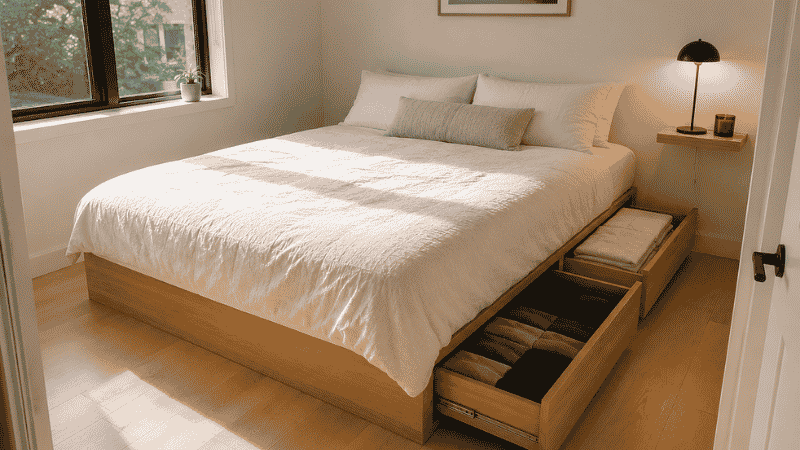
The dresser in most small bedrooms is doing an important job — but it’s doing that job at an enormous cost. A standard 6-drawer dresser sits 18–20 inches deep, 36–42 inches wide, and consumes somewhere between 4.5 and 5.8 square feet of floor space. That’s more floor space than a small loveseat. And unlike a loveseat, a dresser can’t be repositioned for a different function, doesn’t create a seating area, and contributes nothing to the room’s livability beyond the storage inside it.
A platform bed with drawers changes this calculation entirely. The storage moves under the bed — a space that already exists, already occupies that footprint, and was previously contributing nothing. The dresser’s job gets done without the dresser’s floor cost.
This guide is for people considering that switch: what to know before buying a platform bed with drawers, how to match the right configuration to your room and storage needs, what separates a bed you’ll use happily for ten years from one you’ll regret within six months, and whether eliminating your dresser entirely is actually realistic. By the end, you’ll have a clear answer for your specific situation.
Key Takeaways
- A queen platform bed with 4 drawers replaces approximately 70–80% of a standard 6-drawer dresser’s storage volume — enough to eliminate the dresser entirely for most single-person households
- Drawer access clearance is the most overlooked spec: Side-opening drawers on a queen bed need at least 24 inches of clear space on that side — measure before buying, not after delivery
- Platform height matters for comfort: The ideal seated height on a bed is 18–19 inches from floor to mattress top; most platform beds with drawers sit at 15–17 inches from floor to frame, plus your mattress thickness
- Full size beds with drawers work in rooms as small as 10 × 10 feet: A full/double platform bed with drawers (54 × 75 inches frame) leaves enough clearance in most small bedrooms without the room feeling furniture-locked
- The storage math: A standard drawer on a queen platform bed measures approximately 29W × 18D × 6H inches — roughly equivalent to 1.5 dresser drawers per storage compartment
Platform Bed with Drawers vs. Regular Platform Bed: What’s Actually Different
Before getting into selection criteria, it’s worth being precise about what a platform bed with drawers is and isn’t — because the category includes some configurations that work very differently from others.
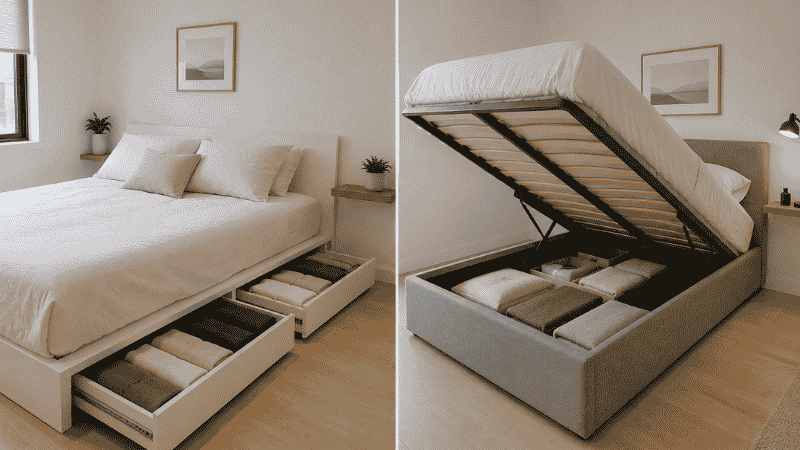
Standard platform bed with drawers: A low-profile bed frame with built-in drawer units on one or both sides. The drawers open outward from the side of the bed and are typically 6–8 inches deep. The bed sits directly on slats — no box spring required, which is part of why the profile is lower than traditional bed frames.
Hydraulic lift storage bed: The mattress and frame lift as one unit on gas pistons (like a car hood), revealing a large open storage area underneath. More storage volume than drawer models, but you need to lift the entire mattress to access anything — not ideal for daily-use items.
Upholstered platform bed with side drawers: Same drawer function as the standard version, but the frame is wrapped in fabric (linen, velvet, boucle). Warmer aesthetic, slightly softer edge for small rooms; slightly more difficult to clean around.
Ottoman storage bed: Similar to hydraulic lift but with a push-button mechanism that lifts the mattress. Less effort than full hydraulic; similar access limitations.
For most small bedroom situations — where you want to store daily-use clothing and linens — the standard platform bed with side drawers is the right choice. The others work better for seasonal or infrequent-access storage.
How Much Storage Do Platform Bed Drawers Actually Hold?
This is the question most product pages don’t answer, and it’s the one that matters most when you’re deciding whether to eliminate a dresser.
Drawer Dimensions and Capacity
The most common drawer configuration on a queen platform bed is 4 drawers (2 per side). Standard dimensions per drawer: approximately 28–32 inches wide × 16–20 inches deep × 6–8 inches tall.
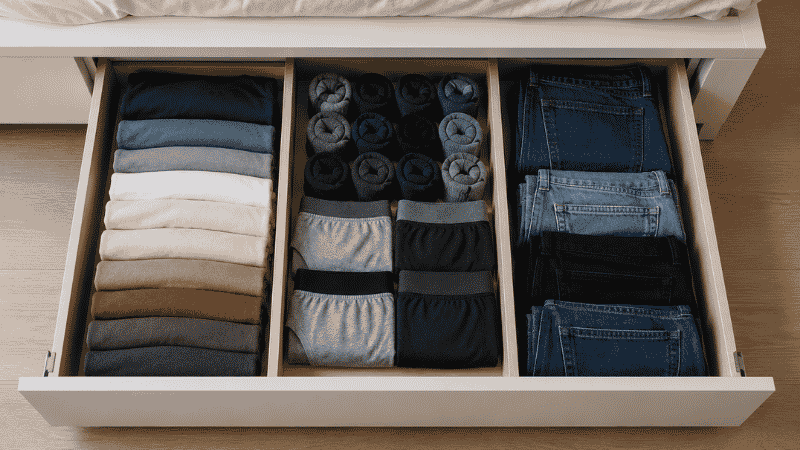
What fits in one drawer at those dimensions:
- Folded t-shirts: 8–10 shirts, stacked flat or rolled vertically (KonMari method allows more)
- Folded underwear/socks: approximately 20–25 pairs, folded and sorted
- Folded jeans: 3–4 pairs flat; 5–6 pairs rolled
- Folded sweaters: 2–3 depending on thickness
- Bedding: one full fitted sheet set (sheet + pillowcase) per drawer, folded flat
4-drawer total capacity: Roughly equivalent to a 5-drawer dresser in volume, with shallower individual compartments. The trade-off is depth — dresser drawers typically run 20–24 inches deep; platform bed drawers run 16–20 inches. This means fewer layers of stacking, which is actually better for organization (you can see everything in the drawer at once) but requires more ruthless folding habits.
6-drawer configurations: Some queen platform beds include 3 drawers per side. These are significantly more storage — comparable to a 7–8 drawer chest — and typically found in beds with slightly higher profiles (18–20 inches from floor to mattress platform).
Does a Platform Bed with Drawers Replace a Dresser?
For a single person with a moderate wardrobe: yes, almost certainly. 4 drawers handle the folded clothing categories (underwear, socks, t-shirts, gym clothes, one or two pairs of jeans) while the closet handles hanging items and the remaining drawer holds miscellaneous items.
For a couple sharing the bed: usually not fully. 4 drawers split between two people gives each person 2 drawers — enough for basics but not a complete wardrobe. Most couples with a queen storage bed keep a slim supplemental dresser (maximum 36 × 16 inches) for overflow.
For items that don’t belong in drawers: bedding sets, extra pillows, thick sweaters, winter accessories — these are better handled by under-bed rolling bins (if the bed has clearance beneath the drawer units) or the closet’s top shelf.
What to Look for When Buying a Platform Bed with Drawers
Drawer Slide Quality: The Non-Negotiable Spec
This is the single most important quality indicator in a platform bed with drawers, and it’s the hardest to assess from a product photo. Drawer slides determine whether opening the drawer every morning feels effortless or requires both hands and mild frustration.
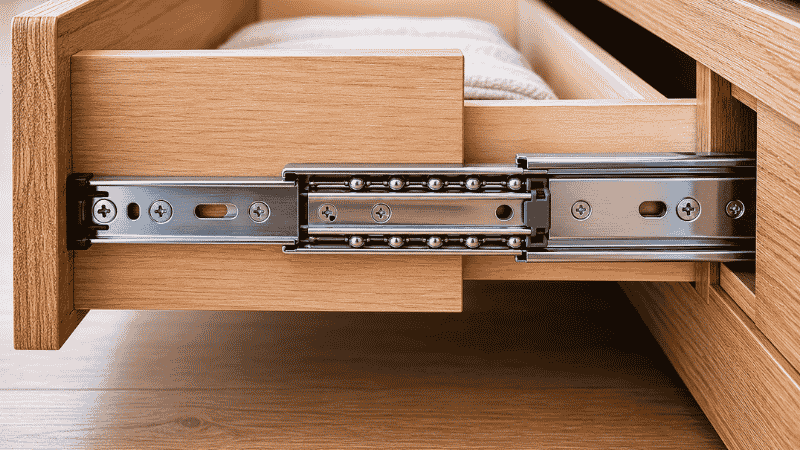
Full-extension ball-bearing slides: The gold standard. The drawer opens completely — 100% of the drawer depth is accessible — and glides smoothly in and out. Look for this in any bed you plan to open daily.
Partial-extension slides: The drawer opens 75–80% of its depth. The back of the drawer is inaccessible without removing items in front. Fine for seasonal storage; not ideal for daily clothing access.
No slides (wooden runners): The drawer sits on wooden grooves and requires manual lifting-and-pulling to open. These wear over time and become stiff. Avoid for daily use.
Soft-close mechanism: The drawer slows automatically in the last two inches before closing, preventing slamming. Not a necessity, but worth paying for on a bed you’ll use daily for years.
Drawer Access Direction: Measure Before You Order
Platform beds with drawers come in two access configurations, and choosing the wrong one for your room creates a problem you’ll live with for years.
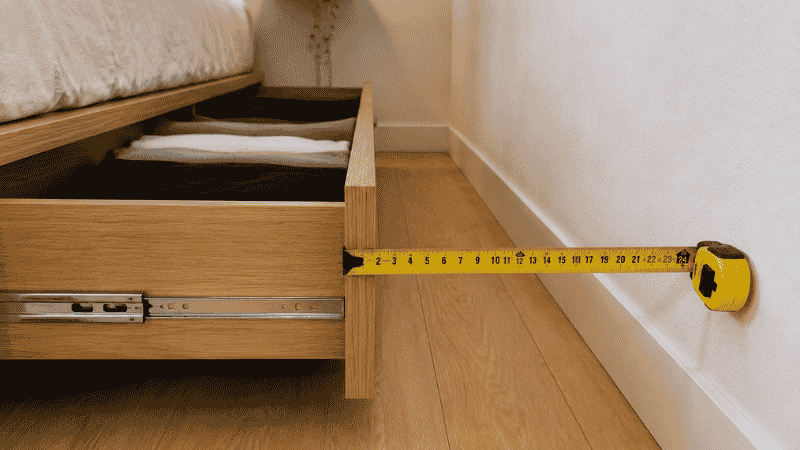
Side-opening drawers (most common): Drawers open from the left or right side of the bed. You need at least 20 inches of clear space on the drawer side — 24 inches is comfortable — to open the drawer fully and access the contents. In a room where one side of the bed is against a wall, side drawers on that side are inaccessible.
Foot-end drawers: Drawers open from the foot of the bed. Useful when both sides of the bed are against walls or constrained by furniture. Requires approximately 28–32 inches of clear space at the foot of the bed. Less convenient for daily use because you’re always walking to the end of the bed.
Before ordering: Stand in your bedroom and measure the available clearance on each side of where the bed will sit. If one side has less than 20 inches, you need either foot-end drawers or a bed with drawers only on the accessible side.
Frame Material and Durability
Solid wood (pine, rubberwood, oak): Heaviest, most durable, most expensive. Drawer boxes made from solid wood hold their shape over years of use. Best choice if you want the bed to last 10+ years.
Engineered wood / MDF: Lighter, more affordable, more susceptible to moisture damage. Perfectly adequate for most bedrooms, but avoid in rooms with humidity issues (basements, rooms without AC in humid climates). Look for thickness — a 15mm MDF panel is meaningfully less durable than an 18mm panel.
Metal frame with wood drawer boxes: A common and practical combination. The metal frame provides structural stability; the wooden drawer boxes provide storage function. Often found in mid-range beds ($300–$600).
Mattress Compatibility
Platform beds do not require a box spring — the slat system provides support directly. However, mattress thickness affects the final seat height:
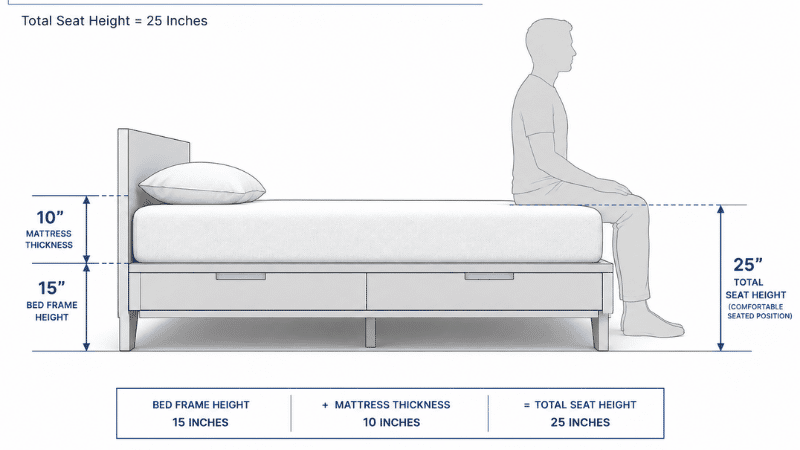
- Standard platform bed frame sits 14–16 inches from floor to mattress platform
- Add a 10-inch mattress → total seat height: 24–26 inches (slightly high for shorter adults)
- Add a 12-inch mattress → total seat height: 26–28 inches (comfortable for most adults)
- Add an 8-inch mattress → total seat height: 22–24 inches (lower end, comfortable for most)
The ideal seated bed height for most adults is 24–26 inches from floor to mattress top. If you’re buying a new mattress alongside the bed, factor in the combined height.
Important: Most platform beds specify a maximum mattress thickness of 10–12 inches. A mattress thicker than specified may prevent the drawer from opening properly (the mattress overhang can block the drawer handle). Check this spec carefully if you’re keeping an existing thick mattress.
Full Size Bed with Drawers: The Right Choice for Very Small Bedrooms
A queen mattress is 60 × 80 inches. A full/double mattress is 54 × 75 inches. That 6-inch width difference seems small, but in a small bedroom it’s significant — and in rooms under 10 × 11 feet, it’s often the difference between a functional layout and one where you’re constantly sidling past furniture.
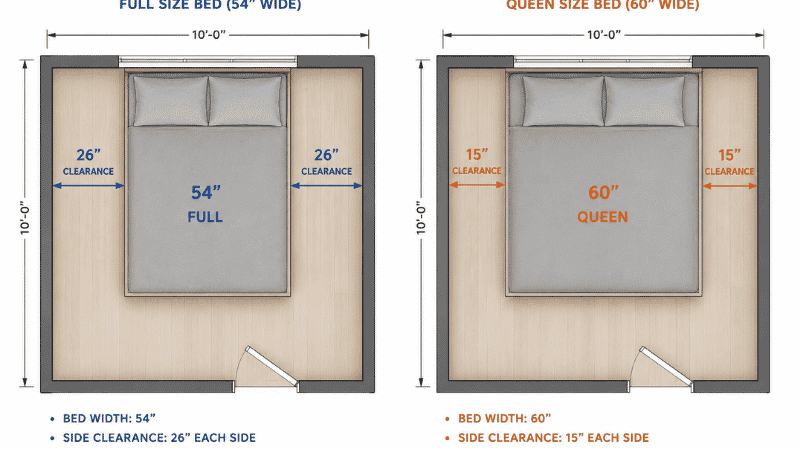
A full size bed with drawers in a 10 × 10 room leaves:
- 26 inches on one side of the bed (if centered, 26 inches on each side = 52 inches total minus 54-inch bed width in a 10-foot / 120-inch wide room)
- Enough for a floating nightstand on each side and a clear walking path
The same room with a queen bed leaves:
- 30 inches total split between both sides — about 15 inches each, which is too narrow for comfortable daily use
For single occupants in studios or very small one-bedrooms, a full size bed with drawers is often the most functionally correct choice even if the person could “fit” a queen. The storage drawers on a full bed are proportionally sized and typically provide 3–4 drawers — adequate for a single-person wardrobe when combined with closet storage.
The storage math for a full platform bed: 3–4 drawers × approximately 24W × 16D × 6H inches per drawer = enough capacity for the folded clothing categories of one person’s wardrobe.
Queen Storage Bed: When It’s the Right Choice
A queen storage bed makes sense when:
- The bedroom is at least 10 × 12 feet (allowing 24+ inches of clearance on the primary access side)
- Two people are sharing the bed (though 4 drawers between two people means 2 each — consider a 6-drawer queen if maximum storage is the goal)
- You’re replacing both the bed and dresser simultaneously and want to maximize the storage consolidation
- Style is a priority — queen storage beds have a wider range of aesthetic options than full-size equivalents
Queen storage bed size math: In a 10 × 12 room (120 × 144 inches), a queen bed (60 × 80 inches) leaves 30 inches of width on each side and 64 inches at the foot. With 24-inch clearance needed for drawer access, you have enough on each side — barely. In a 10 × 10 room, the same bed leaves only 15 inches per side — not enough for comfortable drawer access.
Platform Bed with Drawers: Style Options That Work in Small Bedrooms
Small bedrooms benefit from furniture that reads as visually light. The following platform bed styles consistently perform best in rooms under 120 square feet:
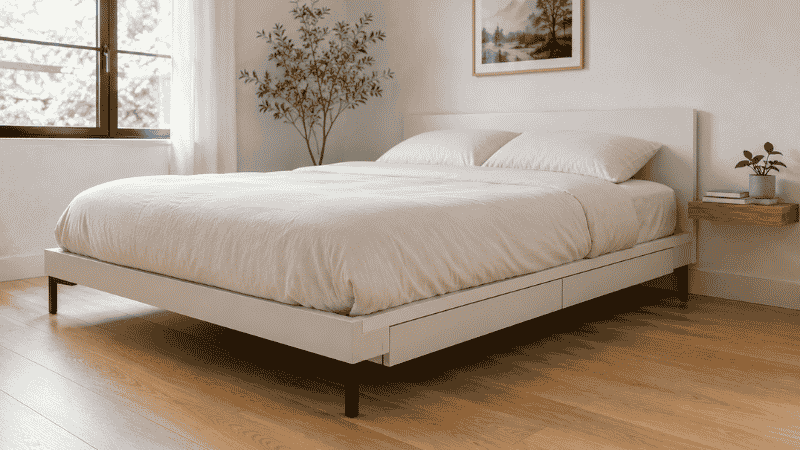
Low-profile with visible legs: A platform bed that sits on slim metal or wooden legs (showing 4–6 inches of floor beneath the frame) reads as lighter and less massive than a bed that sits flush to the floor. The visible floor space makes the room feel larger. Look for beds where the drawer unit is recessed slightly rather than flush with the floor.
Upholstered in neutral fabric: Linen-effect, gray, cream, or sage green upholstered frames soften the visual weight of the storage unit beneath the mattress. Avoid dark solid wood frames in rooms under 100 square feet — they can make the room feel furniture-heavy.
No headboard or low headboard: In rooms where the bed sits against a wall, a high headboard pushes storage space up into the visual field. A low headboard (under 36 inches) or no headboard keeps the visual center of gravity low and makes ceilings feel higher.
Clean-line drawer fronts: Drawers with simple linear hardware or push-to-open mechanisms (no visible handles) blend into the bed’s silhouette rather than announcing themselves as storage infrastructure. This matters aesthetically in rooms where the bed is the primary visual element.
What to Do If the Drawers Feel Stiff or Won’t Open Smoothly
This is the most common complaint with budget platform bed drawers, and it’s usually fixable without replacement.
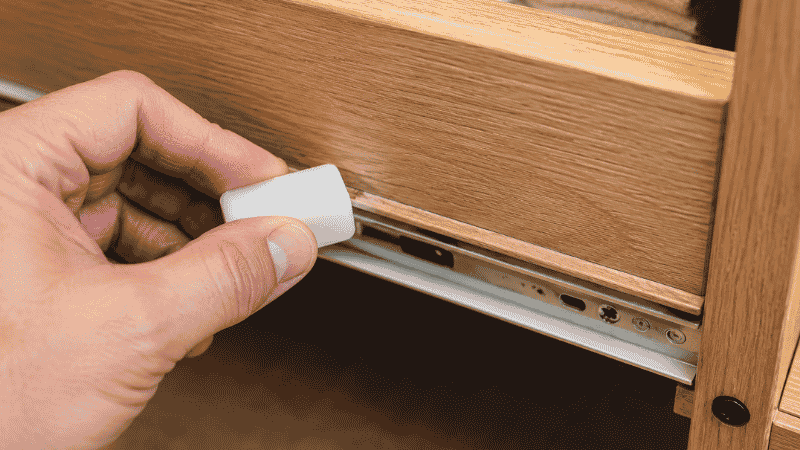
Wax the slides: A standard candle or block of beeswax rubbed along the wooden runner surfaces dramatically reduces friction. Takes two minutes; lasts several months.
Check for misalignment: If the drawer is stiff in one corner, the slide may be slightly off-track. Remove the drawer completely, check for debris in the track, and reseat it. Most drawer boxes on platform beds are simply lifted out and replaced without tools.
Reduce load weight: Overloaded drawers drag against their tracks. Each drawer has a weight limit (typically 30–50 lbs depending on the slide quality). If you’re storing heavy items (shoes, books, electronics), redistribute to lighter categories and move heavy items elsewhere.
Replace the slides: If the bed has wooden runners rather than ball-bearing slides, upgrading the slides is often possible and costs $15–30 per pair. This is worth doing if the bed is otherwise solid — it transforms the daily experience of using the storage.
If You Only Have 10 Minutes: The Quick Storage Bed Assessment
Before committing to a platform bed with drawers, answer these four questions with your tape measure:
- Side clearance: Measure the space on both sides of where the bed will sit. Is at least one side ≥24 inches? If not, you need foot-end drawers or a bed with single-side drawer placement.
- Foot clearance: Measure from the planned foot of the bed to the nearest obstruction (wall, dresser, door). Do you have at least 30 inches? If you need foot-end drawers, you need this clearance.
- Mattress thickness: If you’re keeping your current mattress, measure its height. Add it to the bed frame’s platform height. Is the total ≥22 inches? Lower than that may feel uncomfortably close to the floor for getting in and out.
- What the drawers need to hold: Write down the clothing categories you’d store in the bed (underwear, t-shirts, gym clothes, etc.). Count the items. Does the drawer capacity (4 × 29W × 18D × 6H inches for a typical queen) actually hold what you need it to hold, or do you need a supplemental solution?
FAQ: Platform Beds with Drawers
Does a platform bed with drawers need a box spring? No — platform beds are designed to support the mattress directly on slats. Adding a box spring raises the bed height significantly and may prevent drawers from opening (if the box spring extends beyond the frame’s edge). Use the mattress directly on the slats.
How much weight can platform bed drawers hold? Depends on the slide quality. Basic wooden-runner drawers: 20–30 lbs per drawer. Ball-bearing slide drawers: 35–60 lbs per drawer. Full-extension heavy-duty slides (found in premium beds): up to 100 lbs per drawer. Check the spec sheet — manufacturers who don’t publish this number usually have basic slides.
Can I use a platform bed with drawers in a rental apartment? Yes — platform beds require no wall anchoring or structural modification. They’re fully freestanding and renter-friendly. The only consideration is getting the bed into the apartment: large queen frames often ship in multiple boxes but still require maneuvering through doorways and hallways. Measure your doorway (standard interior doors are 32–36 inches wide) before ordering.
What’s the best platform bed with drawers for a small bedroom? For rooms under 10 × 11 feet: a full size bed with drawers, maximum 54 × 75-inch footprint. For rooms 10 × 12 feet and above: a queen platform bed with 4 drawers, side-opening on the primary access side. In both cases, prioritize ball-bearing drawer slides over price — you’ll open these drawers thousands of times.
How do platform beds with drawers compare to beds with hydraulic lift storage? Drawer beds: better for daily-access items (clothing, linens you use regularly); easier to organize; no need to lift the mattress. Hydraulic lift beds: more total storage volume; better for seasonal or infrequent-access items; the open storage area is harder to organize without bins and dividers. For a small bedroom where the storage replaces a dresser, drawers win. For storing seasonal items you access quarterly, hydraulic lift wins.
Can I attach a headboard to a platform bed with drawers? Most platform beds include pre-drilled attachment points for optional headboards. Check whether the bed you’re considering accepts a headboard separately — some have integrated headboards, some have none, and some are compatible with standard attachment brackets. In a small bedroom, a slim upholstered headboard (under 36 inches tall) is the most visual-space-efficient option.
What mattress thickness works with a platform bed with drawers? Most platform beds specify a maximum mattress thickness of 10–12 inches. Beyond this, the mattress overhangs the frame and may block the drawer handle or prevent full drawer opening. Check the spec before purchasing a thick memory foam or hybrid mattress alongside a storage bed.
The Bottom Line
A platform bed with drawers is the most space-efficient furniture swap available for a small bedroom — not because it adds storage, but because it relocates storage that already needs to exist into space that already exists. The dresser goes away. The floor comes back.
The decision is almost always worth making. The caveats are around execution: matching drawer access direction to your room’s clearances, choosing drawer slide quality that works for daily use, and being realistic about whether 4 drawers fully replace your dresser or require a slim supplemental piece.
Get the clearance measurements right before ordering. Everything else can be adjusted.
Once you’ve sorted the bed, the next question is how to arrange everything around it. Our small bedroom layout guide covers five arrangement formulas with exact clearance measurements. And for the complete bedroom storage picture — what goes in the bed drawers, what goes in the closet, what goes under the bed — our small bedroom storage guide has the full breakdown.
References
- National Sleep Foundation (2023): Mattress height and sleep ergonomics — recommendations for bed height and spinal alignment during ingress and egress
- American Society of Interior Designers (ASID): Residential space planning guidelines — minimum clearance standards for bedroom furniture, including 24-inch recommended clearance on the primary bed access side
- Consumer Reports Furniture Testing Lab (2024): Drawer slide durability testing — ball-bearing vs. wooden-runner performance over simulated 5-year use cycles
Published on Grainv.com | Category: Bedroom · Storage Furniture | Related: Small Bedroom Layout, Small Bedroom Storage Ideas, How to Organize a Small Apartment