
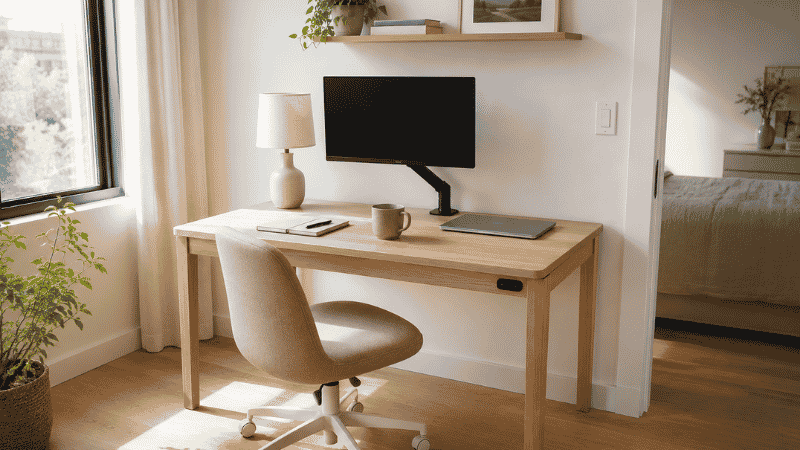
There’s a specific kind of tired that comes from working at your kitchen table for too long. Not the good tired — the kind where you feel accomplished. The other kind. The kind where your lower back aches in a way it didn’t use to, where you find yourself checking Slack at 10pm because the line between “at work” and “at home” has dissolved so completely that you can’t find it anymore.
The problem isn’t your discipline. It’s your desk — or the absence of one. A kitchen table is 30 inches tall, designed for eating, not for eight hours of focused work. A bed is approximately the worst possible surface for anything requiring sustained concentration. And a couch, for all its comfort, trains your brain to associate that spot with passive rest rather than active thinking.
A small home office desk in the right configuration doesn’t just give you somewhere to put your laptop. It creates a boundary — a physical signal to your brain that says this is where work happens, which is the prerequisite for also being able to signal and now it’s over. In a small apartment where the bedroom is also the office and the living room is also the dining room, that boundary matters more than it would in a dedicated home office with a door you can close.
This guide is about finding the right desk for your specific space — and setting it up so that work actually ends when you close the laptop.
Key Takeaways
- Desk depth matters more than desk width: A desk 24 inches deep allows proper monitor positioning (20–28 inches from your eyes to the screen); a desk at the standard IKEA MICKE depth of 19.5 inches forces you to crane forward or hunch back — both bad over eight hours
- The 48-inch sweet spot: For most single-person small apartment setups, a desk 48 inches (4 feet) wide provides enough surface for dual monitor or monitor plus laptop without feeling like a piece of institutional furniture in a small room
- Depth clearance at the desk: Your knees need at least 24 inches of vertical clearance beneath the desktop; many slim apartment desks underestimate this and the chair ends up sitting awkwardly far out
- Sleep research is not subtle on this: The American Academy of Sleep Medicine explicitly states that using a bedroom for non-sleep activities — including work — is associated with significantly worse sleep quality and onset time. If your desk is in your bedroom, how you configure it matters for your health, not just your aesthetics
- The fold-away option is underrated: A wall-mounted fold-down desk at 28–30 inches height takes zero floor space when closed and creates a legitimate work zone when open — the most space-honest solution for apartments where there genuinely isn’t room for a permanent desk footprint
Before the Desk: The Three Questions That Determine Everything
Here’s the thing nobody asks when you’re browsing desk options: where are you actually going to put this? Not in the abstract “I have a home office” sense. Concretely. Which wall, in which room, and how does it relate to the window?
Answer these before buying anything.
Where in the apartment will the desk go?
Three scenarios exist for most small apartment dwellers:
Desk in the bedroom: The most common setup. Also the one most likely to mess with your sleep if you don’t configure it carefully. A desk in the bedroom should ideally be positioned so the work surface isn’t visible from the bed — behind a bookcase, angled toward a different wall, or covered with a fabric panel at the end of the workday. If that’s genuinely impossible, a fold-down desk that collapses flat against the wall is your best option.
Desk in the living room: Requires a desk that looks like furniture, not an office supply. Open shelving and visible cable chaos reads as “I live in my workspace” rather than “I have a dedicated work zone.” A desk with closed storage below and a clean top surface, positioned against a wall that’s not the TV wall, works.
Desk in a defined corner or alcove: The best scenario. Even in a studio, a corner can become a defined work zone with the right desk configuration. A corner desk or a standard desk positioned at a right angle to the wall creates visual separation between the work area and the rest of the room.
What direction does the light come from?
Natural light is great for daytime work. Natural light directly on your screen creates glare that turns a productive afternoon into an eyestrain session. The ideal desk position: light comes from the side (left or right), not from behind the screen or directly into your face. If your only available wall faces a window, get a monitor with anti-glare coating and position the screen at a 45-degree angle to the window rather than parallel to it.
What do you actually use the desk for?
This changes the size equation significantly. A laptop-only setup needs a 30–36-inch wide desk. A laptop plus external monitor needs 48 inches. A dual monitor setup needs 56–60 inches. A setup that also includes drawing, physical paperwork, or creative materials needs additional surface or a desk with a side return. Know your setup before buying the desk.
Small Home Office Desk Dimensions: The Numbers That Actually Matter
Depth: The Spec Nobody Checks
This is my biggest frustration with most desk buying guides — they lead with width and barely mention depth. In a small apartment, desk depth determines both ergonomic comfort and how intrusive the desk feels in the room.
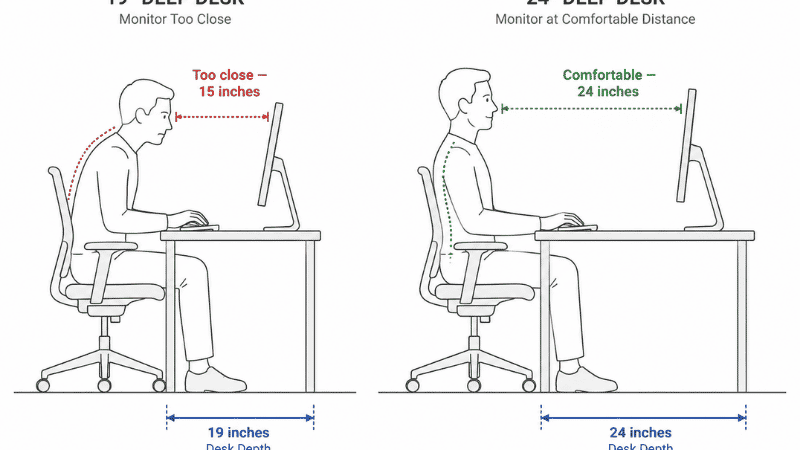
The ergonomic minimum: For a desk with a monitor, the screen should be 20–28 inches from your eyes. If you’re sitting 15 inches from the desk front (typical seated position), the monitor needs to be pushed 5–13 inches back from the desk edge. That means your desk needs to be at least 20 inches deep to place the monitor at minimum safe distance — and ideally 24 inches to place it at a comfortable 24-inch viewing distance.
Most IKEA MICKE desks are 19.5 inches deep. That’s 0.5 inches short of the ergonomic minimum for monitor placement, which means most people using a MICKE with an external monitor either have the screen too close or lean back awkwardly. This isn’t a catastrophe — many people use them perfectly fine — but it explains why 20-inch-deep desks often feel cramped even when they look fine in the product photo.
The recommendation: For any setup involving an external monitor, look for 24 inches minimum depth. For laptop-only setups where the screen is at eye level (laptop stand + external keyboard), 20 inches is adequate. For setups where the laptop sits flat on the desk surface, 24 inches prevents the awkward hunch.
Width: Matching the Work
The width question is simpler but has its own nuances.
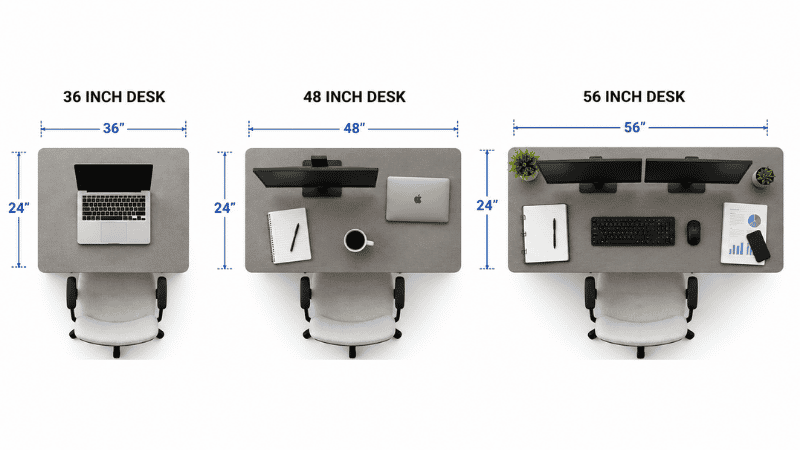
36 inches (3 feet): Laptop only, minimalist setup. Can feel tight but works fine for focused writing or single-window work.
48 inches (4 feet): The sweet spot for most apartment home office setups. Laptop plus monitor, or a single large monitor setup, with room for a notebook and coffee without feeling crowded. Visually reads as a desk, not a table.
56–60 inches (4.5–5 feet): Dual monitor, or any setup requiring peripheral surface for reference materials. Starting to feel significant in a room — works well when the desk occupies a full wall, looks out of proportion in a small corner.
Over 60 inches: You’re essentially buying a piece of office furniture, not a home desk. Fine if it fits and you genuinely need the surface. Just be honest with yourself about the room.
Height: The Standard That Isn’t Always Standard
Standard desk height is 28–30 inches. Most people at average height are reasonably comfortable at this range with a properly adjusted chair. But “average” is doing a lot of work there.
If you’re under 5’4″: a desk at 28 inches with a chair adjusted to match is likely comfortable. A 30-inch desk with the same setup may have you with your shoulders raised slightly.
If you’re over 6’2″: a standard 29–30-inch desk may have you hunched. Adjustable-height desks (those with manual cranks or electric motors) solve this definitively but add cost and weight.
For most people renting a small apartment: a fixed-height desk at 29–30 inches with a good adjustable chair covers the ergonomic need without the complexity or cost of a standing desk.
On standing desks in small apartments: I have an opinion here. Standing desks are genuinely useful for people who stand regularly throughout the day. Most apartment-based remote workers stand their desk at 47 inches, sit-stand it twice in the first week, and then leave it at sitting height indefinitely. If that’s you, a fixed desk is fine and it’ll be lighter, cheaper, and less visually obtrusive. Buy the standing desk only if you’ve already used one at a coworking space and actually stood.
The Best Small Home Office Desk Configurations by Apartment Type
The Bedroom Desk Setup
The rule I keep coming back to: if the desk is in your bedroom, make it possible for the desk to “disappear” visually when the workday ends.
This doesn’t require a fold-down desk (though those are the cleanest solution). It can mean:
- A desk chair that tucks completely under when not in use, eliminating the “occupied chair = working” visual signal
- A monitor that tilts down or a laptop that closes, turning the desk surface into something that looks like a sideboard or console table
- A fabric panel, sliding curtain, or bookcase positioned between the desk and the bed line of sight
- A desk lamp that’s unplugged at the end of the day — the darkness of the desk area signals “closed”
The sleep research on this is worth taking seriously. Research published in the Journal of Clinical Sleep Medicine (2015) found that using a bedroom for work is associated with significantly longer sleep onset times and lower overall sleep quality ratings. That’s not a scare tactic — it’s a practical constraint that desk configuration can partially address.
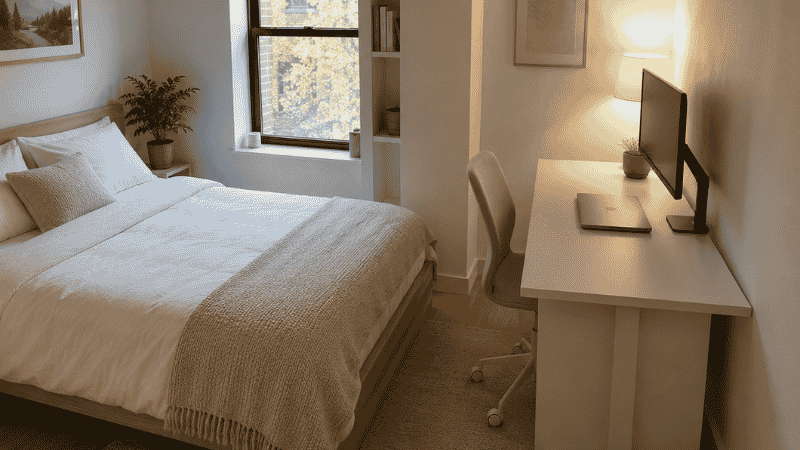
Desk type for bedrooms: Wall-mounted fold-down (best, zero floor space when closed), slim console-style desk with closed base (no visible clutter), or a corner desk positioned at the wall furthest from the bed.
The Living Room Desk Setup
If the desk is in the living room, it needs to earn its place aesthetically. A black metal frame desk with visible cable management looks fine in a dedicated office. In a living room, it looks like you forgot to unpack.
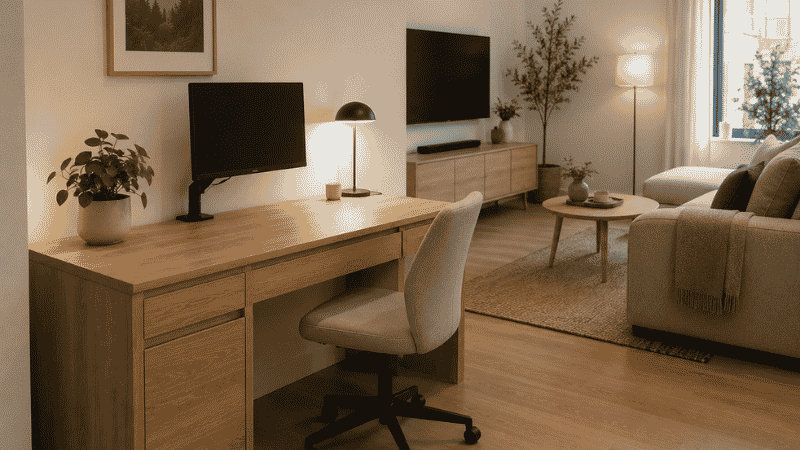
What works in living rooms:
A desk that looks like furniture — light wood or warm painted finish, clean top surface with closed storage below. Think secretary desk, or a console table at desk height with a drawer unit tucked below.
Position: against the wall perpendicular to the TV wall, so the desk view and the couch view are in different directions. This helps the living room feel like two zones (work and living) rather than one chaotic multipurpose space.
Cable management is not optional in a living room desk setup. An exposed USB hub and three trailing cables reads as “home office” rather than “intentional design.” Surface cable clips, a cable box, and one consolidated power strip behind or under the desk are the minimum.
The Corner or Alcove Setup
If your apartment has a corner — even a shallow one — or an alcove, it’s the best location for a desk in a small apartment. Corners create natural visual containment, and a desk that occupies a corner removes it from the flow of the rest of the room.
The 90-degree option: Two standard desks or a modular L-shaped configuration. If the corner gap is under 8 feet in either direction, keep each desk section under 48 inches wide. A desk section that runs more than 2/3 of the wall length in a small room starts to dominate.
The floating shelf desk: For corners under 6 feet in any direction, a wall-mounted shelf at desk height (28–30 inches) with a chair positioned in front creates a corner work zone from approximately 4 square feet of wall space. No floor furniture required except the chair.
The Fold-Down Desk: Honest Assessment
The fold-down wall desk is mentioned in nearly every small space guide, and frequently dismissed as too small or inconvenient. I think this is mostly wrong.
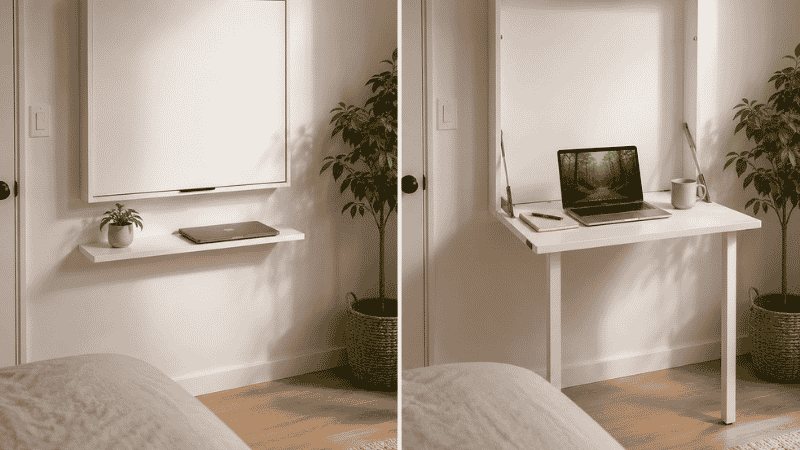
A quality fold-down desk at 24–30 inches wide and 20–24 inches deep when open provides a genuine working surface for focused single-screen work. It’s not comfortable for a full dual-monitor setup, but for a laptop plus notebook, it’s more than adequate. And when it closes — which takes 30 seconds — it becomes 3–4 inches of flat wall. In a bedroom where you’re trying to create psychological separation between sleep and work, this is worth more than any desk-styling trick.
What makes a fold-down desk work well:
- Depth of at least 20 inches when open (anything shallower feels like a kitchen shelf, not a desk)
- Leg support that locks in place (not wobbling on a chain)
- A small shelf or surface below at standing height — for laptop charging, a plant, or a glass while standing — that functions even when the desk is closed
- Positioned beside a power outlet so the charging cable doesn’t cross the room
What makes one fail:
- Too small (under 18 inches deep), which means your wrists hang off the edge
- Cheap hinge mechanism that requires bracing with one hand while setting up
- No nearby storage for the keyboard and mouse, which have to live somewhere when the desk is closed
Cable Management: The Step That Separates a Desk from an Office Setup
This is, consistently, the most underestimated finishing step in a home desk setup. A carefully chosen desk with a monitor, lamp, and coffee looks like an intentional workspace. The same desk with three trailing USB cables, a power strip on the floor, and a charging brick dangling mid-air looks like a hotel room desk.
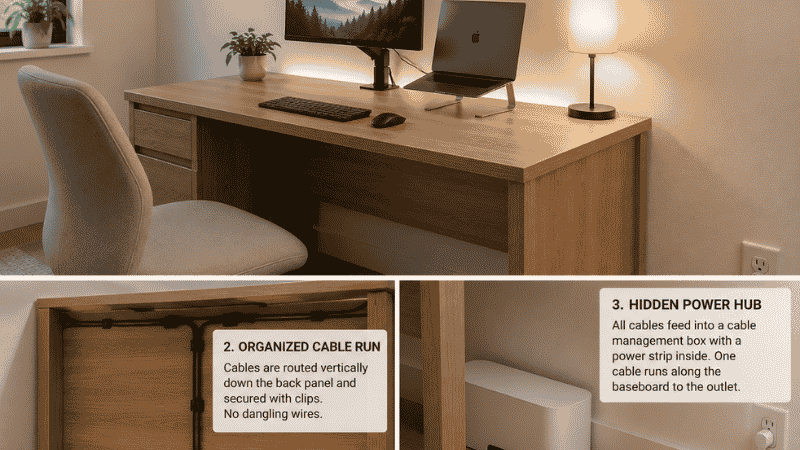
Three-tier approach:
At the desk surface: One monitor, one laptop stand, one keyboard and mouse. No loose cables on the surface. Cables from the monitor and laptop run vertically down the back of the desk, not horizontally across the top.
Behind the desk: A small cable box (a box with a lid that holds the power strip) sits on the floor or attaches to the underside of the desk. All cables from the surface route into this box. One cable exits the box and goes to the wall outlet. From the outside, there’s one cable running to the wall.
To the wall: A cable clip path along the baseboard or a cable raceway painted to match the wall. This eliminates the ground-level cable that reads as “temporary installation” regardless of how nice the desk is.
If You Can Only Do One Thing in the Next 10 Minutes
If you don’t have a dedicated work surface yet and you’re reading this at your kitchen table: measure the available wall space in your bedroom or living room and write down the width and depth. That number determines your desk options before anything else. If you have 48 inches of wall and 22 inches of depth available, you have a very specific set of options — and browsing desks before knowing this number means you’re shopping by aesthetics rather than by what will actually work.
The measurement takes 60 seconds. It’s the single action that will make every subsequent decision faster.
When the Desk Setup Isn’t Working
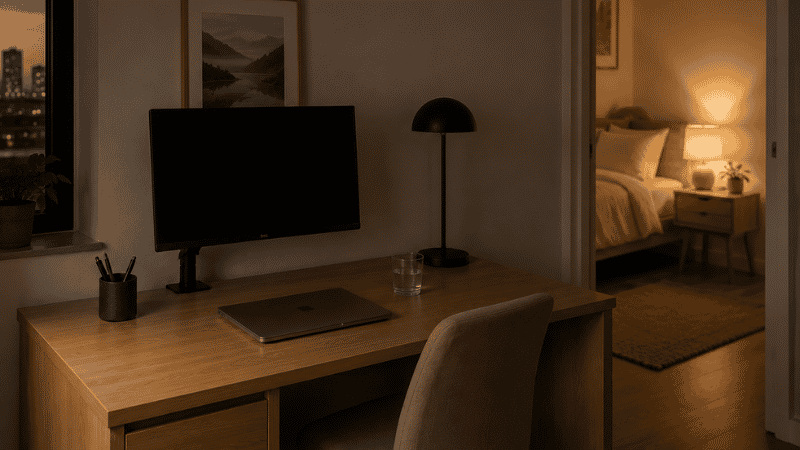
If you can’t concentrate at your home desk: The environment is doing more work than the desk itself. Check: are there other visual tasks competing for attention from the desk? (TV in sightline, unmade bed visible.) Is the lighting comfortable? (Overhead lighting directly above a screen creates glare; a desk lamp from the side is better.) Is the chair actually at the right height for this desk?
If your back hurts after working at the desk: The chair-desk height relationship is almost certainly wrong. Sit in your chair and adjust the height until your elbows are at desk height and your forearms are roughly parallel to the floor. Then measure from the floor to your elbow — that’s your ideal desk height. If the desk is significantly different, either the chair needs adjustment or the desk is the wrong height for your body.
If you’re working at the desk after hours: The desk hasn’t been made to feel “closed.” Try one of the behavioral triggers — closing the laptop lid, turning off the desk lamp, closing a curtain if applicable — as an end-of-work ritual. The ritual signals to your nervous system that the workday is over. It sounds surprisingly simple. It works.
FAQ: Small Home Office Desk
What size desk do I need for a small home office? For laptop-only use: 36 inches wide, 20 inches deep minimum. For laptop plus external monitor: 48 inches wide, 24 inches deep minimum. For dual monitors or side-by-side large monitor setups: 56–60 inches wide, 24 inches deep. The depth dimension matters as much as the width for ergonomic monitor placement — don’t skip it.
What is the best desk for a small bedroom? A wall-mounted fold-down desk (zero floor footprint when closed) is the most space-efficient for bedrooms where visual separation between work and sleep is a priority. For a permanent desk, a console-style desk with a clean back surface and closed storage below reads as furniture rather than office equipment and blends into the bedroom environment. Avoid desks with visible shelving, open cable trays, or bookcase attachments in bedroom settings.
Can I use a dining table as a home office desk? Temporarily, yes. Long-term, no — and not primarily because of ergonomics. The real issue is that a dining table used for work never fully becomes a workspace, and never fully becomes a dining table. The psychological ambiguity of a multi-use surface without designated purpose undermines both functions. A dedicated desk surface, even a small one, is worth the floor space for full-time remote workers.
What is a good small desk depth for home office use? Minimum 20 inches for laptop-only setups; 24 inches for any setup involving an external monitor. The standard IKEA MICKE desk at 19.5 inches depth is marginally short for monitor use — functional, but not optimal. If you’re buying a desk specifically for remote work with a monitor, prioritize 24-inch depth even at the cost of some width.
How do I set up a home office in a small apartment bedroom? Position the desk against the wall furthest from the bed, or at an angle where the desk surface isn’t in direct sightline from the bed. Use closed storage rather than open shelving to prevent the visual accumulation of work materials. Close the laptop and turn off the desk lamp at day’s end — these physical actions signal the end of the workday. If space is extremely tight, consider a fold-down wall desk that visually disappears when not in use.
Is a standing desk worth it for a small apartment? Only if you’ll consistently use the standing function. Most standing desks in small apartments are used at sitting height after the first week. If that’s likely your pattern, a fixed-height desk is lighter, smaller, and cheaper — which are real advantages in a small space. If you’ve actually used a standing desk regularly and want to continue, the space and cost trade-off is worth it. Be honest with yourself about which category you’re in.
The Bottom Line
A small home office desk isn’t a productivity hack. It’s a physical boundary — between working and not working, between the part of your home that’s for output and the part that’s for rest. In a small apartment where those zones overlap by necessity, the desk’s configuration matters more than its style.
Get the depth right (24 inches for monitor use). Get the width right for your specific setup. Position it so that when you close the laptop, it can disappear — visually, behaviorally, psychologically. The desk is the infrastructure. What happens on it is up to you.
A desk doesn’t exist in isolation — it needs to work with the room’s layout and the other furniture around it. Our studio apartment layout guide covers zone-definition strategies that include dedicated work areas. And if you’re working from a space that’s also a bedroom, our small bedroom storage guide covers how to keep work and sleep zones as separate as possible.
References
- Cajochen, C., & Dijk, D. J. (2015). Bedroom environment and sleep quality. Journal of Clinical Sleep Medicine, including studies on workspace overlap with sleep environment and sleep onset latency
- American Academy of Sleep Medicine (AASM): Sleep hygiene behavioral guidelines — recommendation to restrict the bed and bedroom to sleep and intimacy; work activities in the bedroom associated with conditioned arousal and sleep disruption
- NIOSH (National Institute for Occupational Safety and Health): Home office ergonomics guidelines — recommended monitor distance (20–28 inches from eyes), desk height calculation from elbow-to-floor measurement, minimum knee clearance under desk (24 inches minimum)
Published on Grainv.com | Category: Apartment Layout · Multifunctional Furniture | Related: Studio Apartment Layout Ideas, Small Bedroom Storage Ideas, Loft Bed with Desk, Small Apartment Furniture