
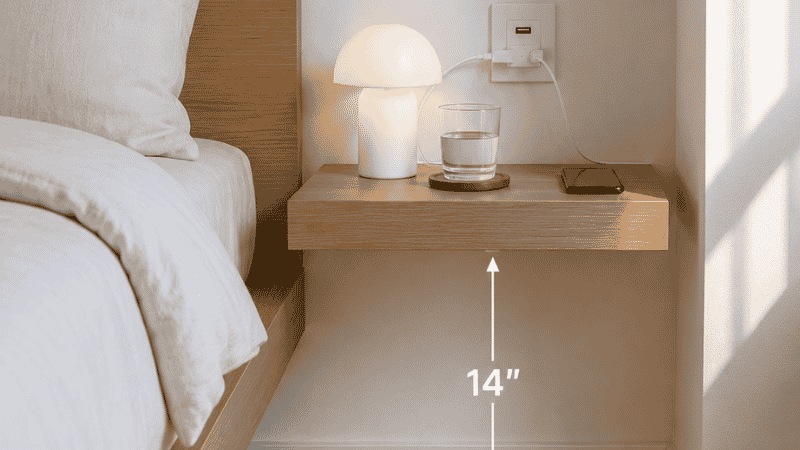
The gap between your bed and the wall is one of the most constrained spaces in a small bedroom — and one of the most used. You reach for your phone in the dark. You set down a glass of water before sleeping. You need somewhere to put reading glasses, a book, and a lamp without any of it ending up on the floor or on the bed with you.
The standard nightstand assumes you have 18–22 inches of clear space beside the bed. Most small bedrooms don’t. In a 10-foot-wide room with a queen bed, the clearance on each side runs 15–18 inches — barely enough for a traditional nightstand before the walkway disappears. In rooms where one side of the bed is against a wall, the issue doesn’t exist on that side but becomes critical on the accessible side.
This guide covers the right small bedside table for every gap width — from 6-inch gaps where only a wall-mounted shelf works, to 18-inch gaps where a proper two-drawer nightstand fits comfortably. It includes the height formula that determines whether you’ll be reaching down or reaching across comfortably, and the zero-floor-space alternatives that solve the problem entirely when floor clearance is the constraint.
Key Takeaways
- The height rule: Your bedside table surface should be within 2 inches of your mattress top height — typically 24–28 inches from the floor for a platform bed setup, 26–30 inches for a traditional bed frame with box spring
- The width threshold: Under 10 inches of clear space beside the bed — only wall-mounted options work; 10–16 inches — slim table or floating shelf; 16–22 inches — standard nightstand; over 22 inches — full nightstand with drawers or a small dresser
- A floating shelf nightstand eliminates the floor footprint entirely: A shelf mounted at the correct height holds everything a traditional nightstand holds — lamp, phone, glass, book — while consuming zero floor space beside the bed
- The 3-item surface rule: A bedside surface that holds more than 3 categories of items becomes a clutter zone by the end of the first week — lamp, one drink vessel, and one book/phone is the functional maximum for a maintained surface
- The cord problem is real: Any bedside setup requires solving the charging cable — a bedside table without a solution for phone charging will result in cables across the bed or dangling from the wall within two weeks
The Three Numbers: Height, Width, and Depth
Before choosing a style or configuration, establish these three measurements. They determine which options are physically possible in your space.
Height: The Reach Comfort Formula
The most important and most ignored bedside table specification. A bedside table that’s too low forces you to lean down; one that’s too high means your arm hangs awkwardly reaching for a glass in the dark.
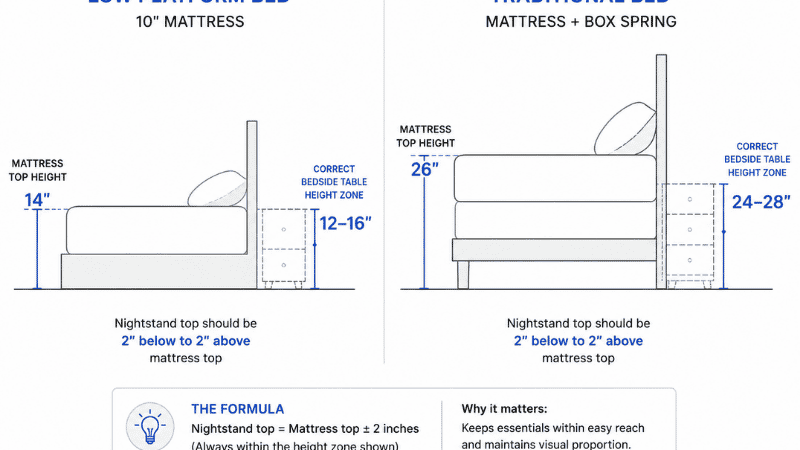
The formula: Bedside table surface height = mattress top height ± 2 inches
To find your mattress top height, sit on the bed and measure from the floor to the top of the mattress (not the top of the fitted sheet). This number varies significantly:
- Platform bed with 10-inch mattress: 10 + 4-inch platform = 14 inches — needs a bedside table at 12–16 inches (very low; a floating shelf at the correct height is often better)
- Platform bed with 12-inch mattress: 12 + 4 = 16 inches — bedside table at 14–18 inches
- Standard bed frame with 10-inch mattress + box spring: approximately 26 inches — bedside table at 24–28 inches (most standard nightstands in this range)
- Tall bed frame with thick mattress: 28–30 inches — bedside table at 26–32 inches
The practical implication: If your platform bed with a 10-inch mattress puts the mattress top at 14 inches, a standard 28-inch-tall IKEA nightstand sits 14 inches above the mattress surface. Reaching for a glass on that nightstand requires a full arm extension upward — uncomfortable and likely to cause spills. This is a very common mismatch that nobody notices in the showroom.
Check before buying: Measure your mattress top height. Add 2 inches. That’s the maximum comfortable bedside table height. Subtract 2 inches for the minimum. Most of your options need to land in this 4-inch band.
Width: What Fits in Your Specific Gap
Measure the clear space between the edge of your mattress and the nearest wall, door swing zone, or piece of furniture. This is your maximum bedside table width (for depth) — anything deeper than this gap either doesn’t fit or blocks the walkway.
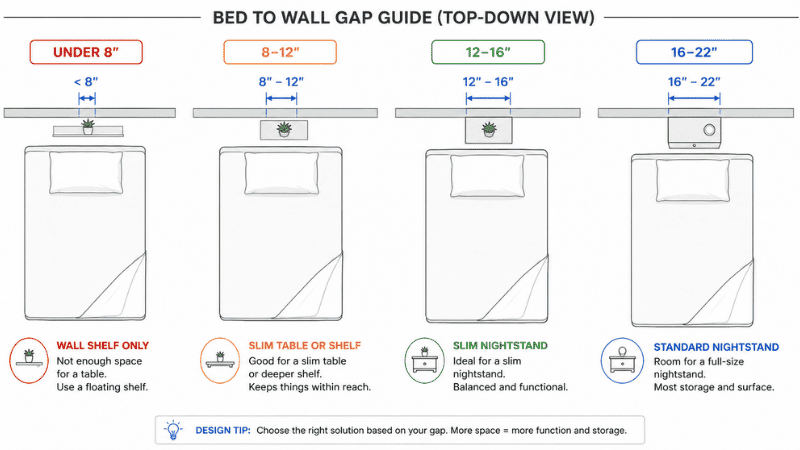
Gap width to option mapping:
Under 8 inches: A traditional bedside table cannot fit. Wall-mounted shelf or wall-mounted mini ledge only. Consider also: a C-shaped table that slides under the bed edge — its vertical support sits outside the gap.
8–12 inches: Slim nightstand or floating shelf. Look for tables with a maximum depth of 10–11 inches. Most standard nightstands are 16–18 inches deep and won’t fit. Small stool-style tables can work if they’re depth-appropriate.
12–16 inches: The mid-range gap. Slim nightstands (12–15 inches deep) work, as do floating shelves. This range accommodates a small table with one drawer.
16–22 inches: Standard nightstand range. Most conventional two-drawer nightstands (typically 16–22 inches deep) fit comfortably. This is the gap most small bedrooms have on the primary access side.
Over 22 inches: Standard nightstand or a small dresser serving as a nightstand (the dresser-as-nightstand approach covered in our narrow dresser guide).
Depth: Don’t Confuse Table Depth with Gap Width
An important clarification: the table’s depth (front-to-back measurement) needs to fit within your gap width, but the table’s width (left-to-right measurement) runs parallel to the bed and doesn’t need to match the gap. Most bedside tables are 16–20 inches wide; this dimension is about visual proportion relative to the bed, not about fitting in the gap.
Visual proportion for bedside tables: A bedside table looks proportionally correct when its width is approximately 50–70% of the mattress height (the mattress’s short dimension when viewed from the side). For a standard mattress at 10 inches tall plus platform at 4 inches = 14 inches — a bedside table 8–10 inches wide reads proportionally correct. For a mattress-plus-headboard combination that totals 36 inches — a bedside table 18–24 inches wide reads correctly.
5 Small Bedside Table Options by Gap Width
Option 1: Floating Shelf Nightstand (Best for Gaps Under 12 Inches)
A wall-mounted floating shelf positioned at the correct bedside height — mattress top ± 2 inches — serves every function of a traditional nightstand while consuming exactly zero floor space beside the bed. The floor gap beside the bed remains completely clear, which makes the bedroom feel significantly less cramped.
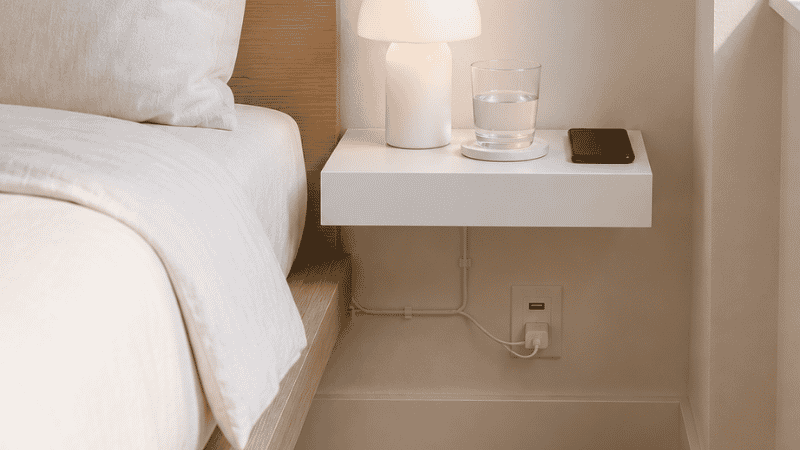
What it holds: A lamp with base under 8 inches in diameter, a phone with charging cable managed below the shelf, a glass of water on a coaster, and a book or e-reader. This is everything most people actually use a nightstand for, delivered from a 6–8-inch-deep shelf.
The lamp issue: A lamp on a floating shelf has no floor or table support — it must be either plugged directly into an outlet behind the shelf (which requires an outlet at the right height) or use a USB-rechargeable or battery-operated lamp. Sconce-style wall lights mounted above the shelf solve this elegantly and free the shelf surface entirely.
Installation: Floating shelves require wall anchors into studs for the weight of a lamp plus items. A 12–18-inch-long, 6–8-inch-deep shelf at correct bedside height, installed with two studs or strong toggle bolts, holds 20–40 lbs — well above the functional load.
Renter option: Command strips rated 7.5 lbs per strip (two per bracket) hold lightweight shelves for lighter-use setups — phone, book, no heavy lamp. For a lamp, wall-anchor installation is necessary.
Option 2: Slim Bedside Table (Best for Gaps of 10–16 Inches)
A slim nightstand — 10–14 inches deep, 16–20 inches wide, 24–28 inches tall — is specifically designed for the small bedroom gap that’s too wide for just a wall shelf but too narrow for a standard nightstand.
What to look for:
- Maximum depth of your gap minus 2 inches (for breathing room)
- Height within 2 inches of mattress top
- Surface area minimum 12 × 12 inches for functional use
- At least one drawer or shelf below the surface (for storing items that accumulate — charging cables, hand cream, sleep aids)
The slim table trade-off: A 12-inch-deep table has a smaller surface area than a standard nightstand. This means fewer items fit on the surface, which is actually a benefit for maintaining an uncluttered bedside — the limited surface enforces the 3-item maximum naturally.
Slim tables that also serve as storage: A slim nightstand with two stacked drawers holds the equivalent of one dresser drawer — socks, accessories, small items that have no other home. In a bedroom without a dresser, this is meaningful supplemental storage from a very small floor footprint.
Option 3: C-Table / Side Table That Slides Under the Bed (Best for No-Gap Situations)
A C-shaped side table (also called a sofa table or laptop table) has an offset base — the tabletop extends to one side while the vertical support and base extend to the other. This allows the tabletop to slide over the edge of the mattress while the base sits on the floor outside the bed’s footprint.
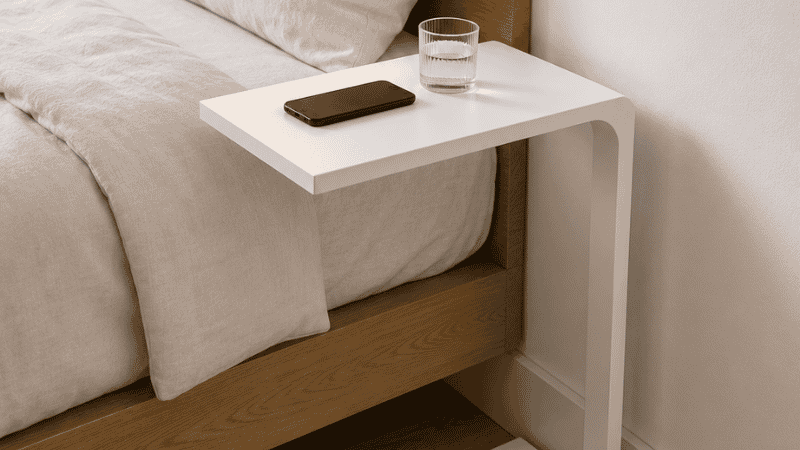
How it works bedside: Position the C-table so the tabletop slides over the edge of the mattress at the correct height, and the base sits on the floor outside the bed frame’s footprint. You now have a bedside surface with no impact on the gap width — the gap remains fully clear. You can have a nightstand surface even when the bed is pushed fully against the wall on that side.
Dimensions to look for: The tabletop should extend 8–12 inches over the mattress edge (enough for a lamp and glass without the items tipping off the mattress). The base should fit in the available floor space on the room side of the bed. Most C-tables are 18–24 inches wide and 24–30 inches tall — verify the height against your mattress top.
The C-table limitation: The tabletop over the mattress is inconvenient for getting into bed — you have to move the table or duck under it. For people who use the bedside table throughout the night (reaching for things without sitting up), a C-table requires more body movement than a standard nightstand. For people who only use the surface for pre-sleep and morning routines, it works fine.
Option 4: Small Stool as Bedside Table (Best for Minimal Aesthetic Rooms)
A small stool — 14–18 inches square, 18–24 inches tall — positioned beside the bed provides a bedside surface without the visual weight of a traditional nightstand. In rooms where the aesthetic priority is openness and minimal furniture, a single stool reads as more intentional and less furniture-heavy than a matched nightstand set.
What works: Solid wood stools or simple upholstered cube stools with flat tops. The flat top surface is essential — an angled or textured top can’t hold a glass of water reliably.
Height consideration: Most stools are 18–24 inches tall — correct for platform beds with 12-inch mattresses (16-inch mattress top) or traditional beds without box spring. Too low for beds with box springs (26-inch mattress top).
The instability consideration: A stool without a second function (seating) tends to migrate around the room. Without a designated bedside placement that’s defined by the stool’s shape or shadow, it drifts. If you choose a stool, place it on a small round rug (12–16 inch diameter) to define its location and prevent migration.
Option 5: Small Dresser as Bedside Table (Best for Maximum Storage)
In a small bedroom where clothing storage is the primary constraint, replacing the traditional nightstand with a small 3-drawer dresser at bedside height (26–30 inches tall, 16–20 inches wide, 14–16 inches deep) provides a nightstand surface while adding meaningful clothing storage.
The math: A small 3-drawer dresser holds underwear, socks, and rolled t-shirts — the equivalent of one full drawer bank — while taking the same floor footprint as a standard nightstand. The top surface functions as the nightstand surface.
Who benefits most: Single-person households where one side of the bed is against a wall (so only one nightstand is needed) and clothing storage is tight. The dresser-as-nightstand approach puts storage exactly where it’s most convenient for the daily getting-dressed routine, which happens beside the bed.
This approach is covered in more detail in our narrow dresser guide — specifically the section on dresser height and nightstand compatibility.
The Floating Shelf Nightstand: A Deeper Look
This option deserves its own section because it’s consistently underused and consistently superior for small bedrooms with constrained gaps.
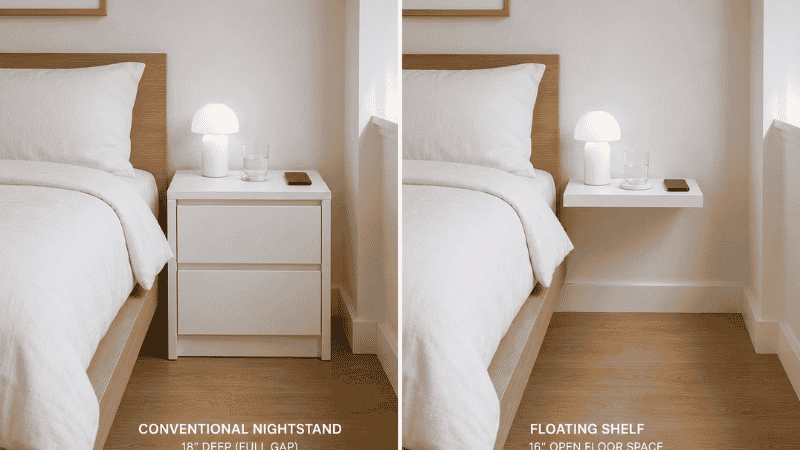
Why the Floating Shelf Works Better Than People Expect
The objection is usually aesthetic: “It looks like a shelf, not a nightstand.” This is true, and it’s actually the point. A floating shelf at nightstand height reads as a design decision — intentional, contemporary, and space-aware — rather than a nightstand that was forced into a space where it barely fits.
The functional comparison:
| Function | Traditional Nightstand | Floating Shelf |
|---|---|---|
| Lamp surface | ✓ | ✓ (with appropriate lamp) |
| Glass of water | ✓ | ✓ |
| Phone charging | ✓ (if outlet nearby) | ✓ (if outlet behind or below) |
| Book storage | ✓ (surface) | ✓ (surface) |
| Drawer storage | ✓ | ✗ (no drawer) |
| Floor footprint | 16–22 sq inches | 0 |
| Gap clearance | Uses full gap width | Uses zero gap width |
The only function a floating shelf doesn’t provide: drawer storage. If you need drawer storage beside the bed — for sleep aids, cables, small accessories — the floating shelf needs to be paired with a small wall-mounted box shelf or a slim nightstand on the other side.
The Correct Height for a Floating Shelf Nightstand
This is the critical installation detail. The shelf surface should be at mattress top height ± 2 inches. For most platform beds (14–16-inch mattress top), this means the shelf is at 14–18 inches from the floor — surprisingly low. Most people install floating shelves at “looks right” heights of 24–30 inches, which is too high for a platform bed. Measure first, mark the wall, install at the correct height.
For a standard bed frame with box spring (26-inch mattress top), the shelf at 24–28 inches feels naturally proportionate and is easier to install at a visually balanced height.
Solving the Lamp Problem on a Floating Shelf
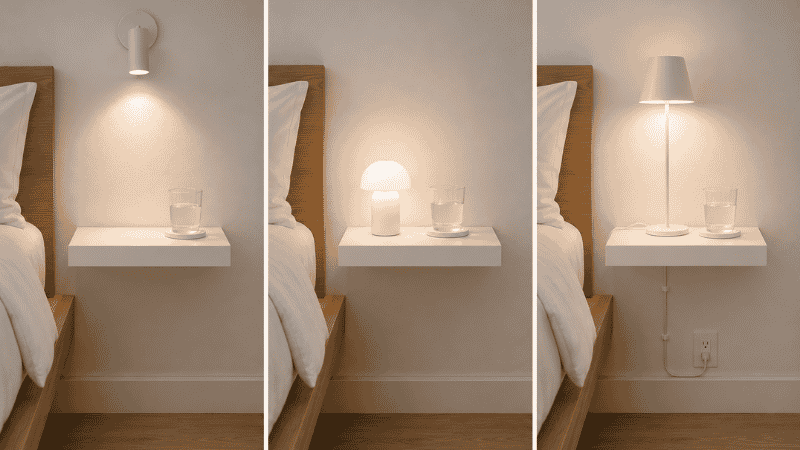
Best solution: A wall-mounted sconce above the shelf, at 48–54 inches from the floor (10–12 inches above a 36–42-inch headboard position). This frees the entire shelf surface and provides directional reading light.
Second best: A USB-rechargeable lamp with its own battery — no cord management required. The lamp charges via USB, runs 8–24 hours per charge depending on brightness. These range from $20–$80 and eliminate the outlet dependency completely.
Workable: A slim plug-in lamp with the cord managed against the wall using a cable clip. The cord runs vertically down the wall from the shelf to the outlet, clipped at 6-inch intervals to keep it flat against the surface.
The Charging Problem: Solving It Before It Ruins the Setup
Every bedside setup fails or succeeds partly on how the phone charging situation is resolved. A phone on the nightstand surface while charging means a cable running from the outlet to the table — either across the floor, dangling from the wall, or tangled in something. All of these create visual chaos that undercuts any carefully chosen bedside furniture.
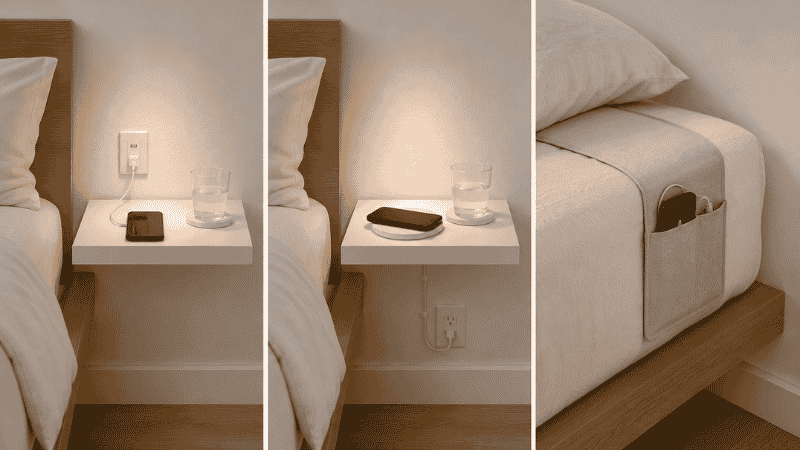
Solution hierarchy by cost:
Wall-mounted USB outlet (behind or near the bedside table): Replace the nearest outlet with a USB-C outlet or add a USB outlet adapter. The phone cable runs a short distance from outlet to table with no cable management needed. Most effective solution, one-time installation.
Power strip on a short cable from the wall outlet, placed on the lower shelf or floor behind the table: The power strip itself is hidden; the phone cable runs from strip to table surface. Creates a clean solution without any installation.
Wireless charging pad on the bedside surface: Phone placed on the pad, one cable runs from the pad to the outlet. One cable instead of multiple is a meaningful visual improvement. Works only for phones with wireless charging capability.
Bedside caddy that clips to the mattress: A fabric organizer clips over the mattress edge and holds the phone, cable, and small items without any table needed. The lowest-cost solution; functional but visible.
When Your Current Bedside Setup Isn’t Working
If the surface is always cluttered: You’re allowing more than 3 categories on the surface. Remove everything, then return only lamp + one drink vessel + one current item (book or phone). Everything else finds another home — drawer, shelf, or another room.
If the table is too tall: The table is more than 3 inches above your mattress top. Options: lower the bed (remove the box spring if present, add a low-profile platform), or replace the table with a lower option, or use a floating shelf at the correct height.
If the table is too deep for the gap: You’re stepping around it every morning. Either replace with a slim option at the correct depth (gap width minus 2 inches), or switch to a floating shelf with zero depth impact.
If the lamp cord is always tangled or in the way: The outlet isn’t in the right position for your setup. Solve it with an outlet replacement, an extension cord managed along the baseboard, or switch to a battery-operated or rechargeable lamp.
FAQ: Small Bedside Table
What size bedside table is best for a small bedroom? The maximum depth should be your side gap (bed edge to wall) minus 2 inches. For most small bedrooms with queen or full beds, this is 10–18 inches. Height should be within 2 inches of your mattress top — measure from floor to mattress surface, not to the top of the fitted sheet. Width (the left-right dimension along the bed) is about proportion: 16–20 inches reads correctly beside most mattresses.
What can I use as a nightstand in a small bedroom? Five options by gap width: (1) floating wall shelf at correct height — works in any gap including zero; (2) slim nightstand 10–14 inches deep — for 12–18-inch gaps; (3) C-shaped slide-under table — for zero-gap situations; (4) small stool — for minimal aesthetic rooms with 18+ inch gaps; (5) small 3-drawer dresser — for maximum storage in 16+ inch gaps. The floating shelf and C-table are the most space-efficient for constrained bedrooms.
What height should a bedside table be? The surface should be at your mattress top height plus or minus 2 inches. Measure from the floor to the top of your mattress (not the headboard or fitted sheet). Platform beds with 10–12-inch mattresses typically have mattress tops at 14–16 inches — far lower than standard nightstands. Standard bed frames with box springs put the mattress top at 25–28 inches, which aligns with most standard nightstands.
How do I style a floating shelf as a nightstand? Install the shelf at mattress top height (not at eye level). Place a slim lamp (rechargeable or plug-in with a managed cord), one glass or cup, and one current book or phone. Use a small tray (8–10-inch diameter) to define the “active zone” and contain items. Keep the shelf clear of accumulated items — the daily 30-second reset is resetting the shelf to lamp + tray + one item only.
Can I have no nightstand in a small bedroom? Yes. If the gap beside your bed is under 6 inches, a wall-mounted sconce above the headboard provides light, and a bedside caddy clipped to the mattress holds the phone and small items. This is a legitimate small bedroom approach rather than a compromise — it’s more honest than cramming a nightstand into an impossible gap.
What is the difference between a nightstand and a bedside table? The terms are used interchangeably. A nightstand typically refers to a small table with a drawer or cabinet specifically designed for bedroom use. A bedside table is a broader category that includes any table used beside a bed — which can be a nightstand, stool, shelf, or any small surface at the right height. In practice, the functional requirements are the same: correct height, stable surface, accessible placement beside the sleeping position.
The Bottom Line
The right small bedside table for a small bedroom isn’t about finding the smallest nightstand available. It’s about matching the solution to your specific gap width, your mattress height, and your actual daily use — the three or four things you reliably reach for in the dark.
For most small bedrooms with gaps under 14 inches, a floating shelf at the correct height solves the problem more elegantly than any floor-standing table. For gaps of 14–20 inches, a slim nightstand with one drawer handles both surface function and small storage. For gaps over 20 inches, the options open up significantly.
Measure the gap. Measure the mattress height. Then choose.
For the full bedroom storage picture — how the bedside table works alongside the bed frame, dresser, and closet — our small bedroom storage guide covers the complete bedroom hierarchy. And for the bed placement that determines which side has the better gap, our small bedroom layout guide has five arrangement formulas with exact clearance measurements.
References
- National Sleep Foundation (2023): Sleep environment recommendations — bedside accessibility guidelines for sleep aids, lighting, and device placement affecting sleep quality and morning routines
- American Academy of Sleep Medicine (AASM): Sleep hygiene behavioral recommendations — bedroom environment optimization including surface organization near the sleep position
- Ergonomics in Design, Human Factors and Ergonomics Society: Reach distance and arm extension guidelines for bedside furniture placement — comfortable reach zone for a supine or semi-reclined adult
Published on Grainv.com | Category: Bedroom · Storage Furniture | Related: Small Bedroom Storage Ideas, Small Bedroom Layout, Narrow Dresser