
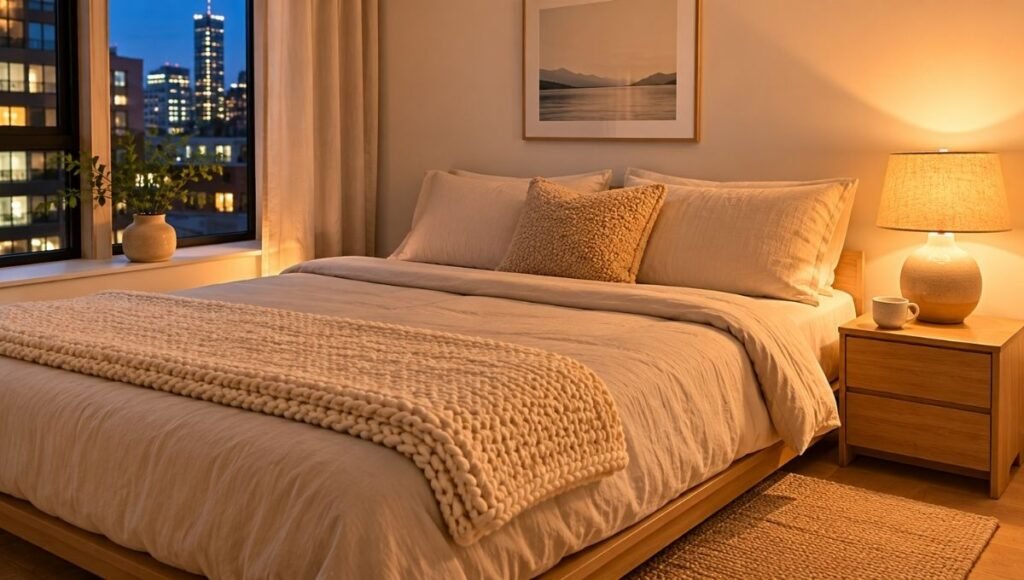
There’s a specific Reddit question that appears in interior decorating communities every few weeks, phrased in slightly different ways but always saying the same thing: I want my bedroom to feel warm and cozy, but every time I add more stuff it just looks cluttered. How do people make it look like that without it looking like that?
The “like that” is usually a photo — some bedroom with warm lighting, layered textiles, and visible wood tones that manages to feel full without feeling crowded. The “that” they’re trying to avoid is the version of the same room where someone clearly bought a lot of throw pillows and put them all on the bed at once.
The difference between these two outcomes isn’t the number of items in the room. It’s which items, where they are, and what quality of sensory warmth they’re creating. A room can feel genuinely warm with very few objects if those objects hit the right notes — texture, light temperature, material warmth. A room can feel cluttered with twice as many items if none of them are doing anything in particular.
This guide is for small bedrooms specifically, because the cluttered-vs-cozy tension is most acute when you have less space to work with. Every element needs to earn its place.
Key Takeaways
- Warm lighting does more work than warm paint: Changing to 2700K bulbs costs under $20 and transforms the emotional quality of a room before you move a single piece of furniture — it’s the highest-return first step in any warm bedroom project
- Texture in three layers is the formula: One woven or knit textile (throw blanket or pillow cover), one smooth fabric (linen or cotton sheets), one hard material with warmth (wood, rattan, or ceramic) — this three-material combination creates depth without adding floor furniture
- Warm minimalist bedroom is achievable: KD=7 means this search term has almost no competition, and the concept itself — warmth through restraint rather than accumulation — is what most small bedroom owners actually want but don’t know how to name
- Research published in Building and Environment (2017) found that warm-toned interior lighting (2700–3000K) increases perceived spatial comfort and emotional warmth independent of room size, furniture quantity, or surface color — meaning you can make a spare room feel warm without buying anything except the right bulbs
- The “one wood surface” rule: In a small bedroom, one piece of furniture or accessory in warm wood tone anchors the whole room — two or three wood pieces start reading as a theme shop; one reads as intention
The Warm vs. Cozy Distinction (And Why It Matters for Small Spaces)
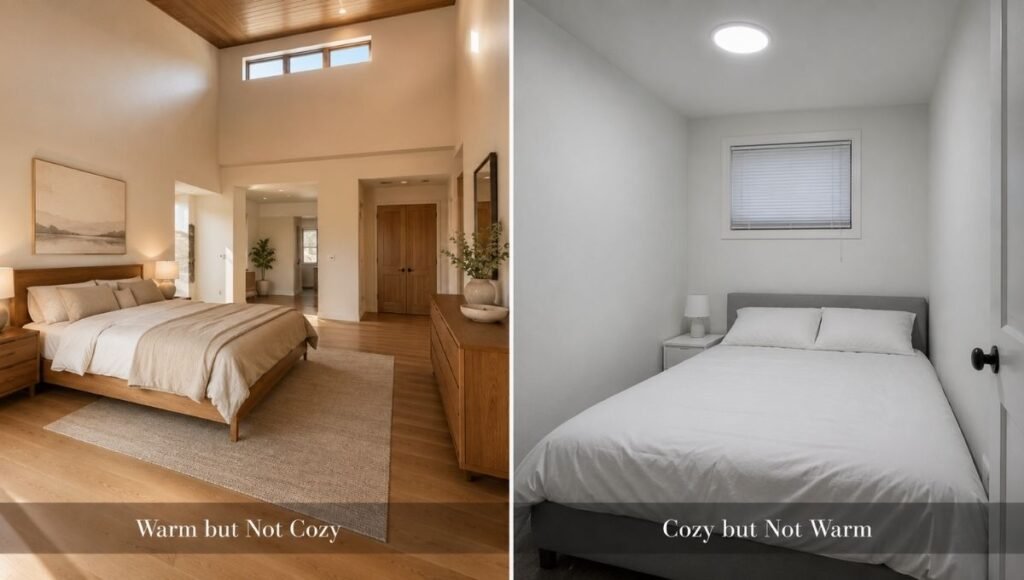
Before anything else, it helps to separate two things people often conflate: warm and cozy are not the same.
Warm is a sensory quality — it comes from color temperature of light, material tone (wood vs metal, linen vs polyester), and the presence of textures that feel soft to the eye even when you’re not touching them.
Cozy is a spatial quality — it comes from a sense of enclosure, intimacy, and scale. A very large room can be warm (good lighting, beautiful materials) but feel exposed and not cozy. A small room is naturally halfway to cozy because the enclosure is already there — what it often lacks is warmth.
This distinction matters for small bedrooms because the solution is different. You don’t need to add coziness — the room’s size is doing that for you. You need to add warmth. And warmth comes from light, material, and texture rather than from accumulation of objects.
This reframe changes the shopping list completely. Instead of adding more throw pillows to “make it feel cozy,” you focus on changing the light source (one bulb swap), introducing one warm material (one linen pillowcase instead of polyester), and adding one texture (one throw blanket folded at the foot of the bed, not three piled on it). Three changes, not twelve purchases.
Warm Bedroom Ideas: Start With the Light (Before Anything Else)
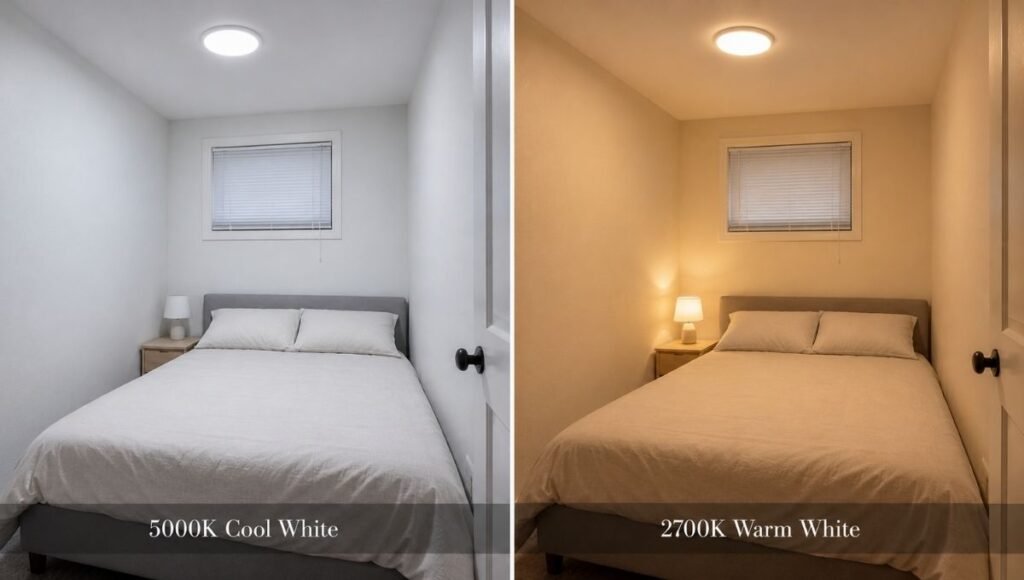
Every interior decorator who has ever worked on a bedroom renovation says the same thing, and Reddit’s interior decorating community has independently confirmed it thousands of times: fix the lighting first. Everything else is secondary.
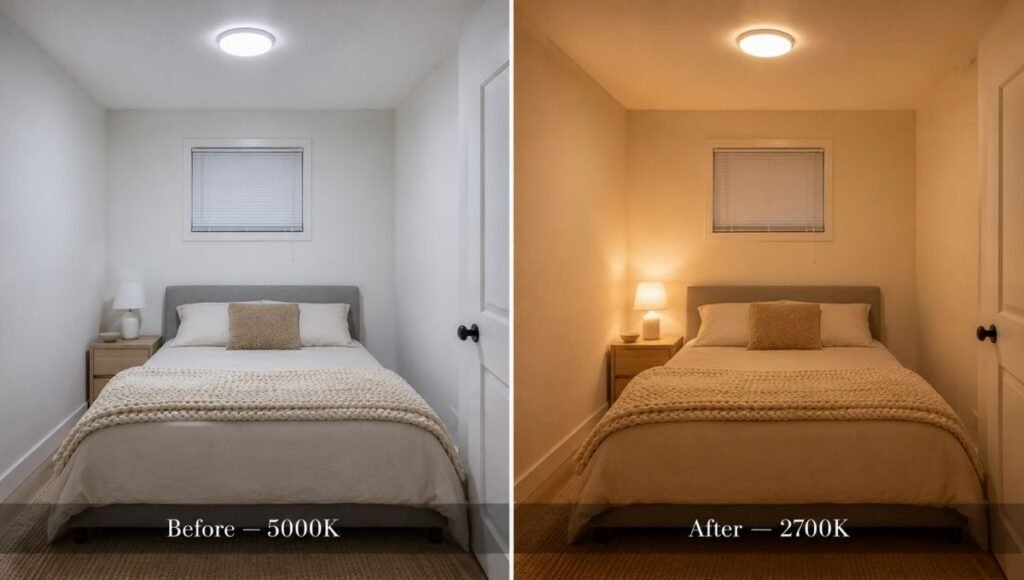
The standard overhead light in most apartments is between 4000K and 5000K — a cool, neutral-to-blue white that makes everything look flat and clinical at night. Under this light, even beautiful warm-toned furniture looks washed out. The same furniture under 2700K warm white light looks like a completely different room.
The specific changes that work:
Replace any overhead bulb with a 2700K warm white LED — under $20 for a 4-pack, immediate effect. If the overhead is on a dimmer, this becomes even more powerful — dim warm white light is the single closest approximation of candlelight available at hardware store prices.
Add one lamp at approximately 40–48 inches height (bedside or floor). The principle is “light at eye level when seated or lying down” rather than light from above. Overhead light creates shadows downward that make faces and rooms look harsh. Eye-level light creates shadows that wrap rather than flatten — the difference between a flattering restaurant and a fluorescent-lit cafeteria.
For a small bedroom, two light sources at 2700K — one overhead on a dimmer, one bedside lamp — are sufficient and won’t crowd the nightstand. A wall sconce replaces the bedside lamp if nightstand space is constrained.
For the complete fairy lights and ambient lighting guide for bedrooms, our fairy lights bedroom guide covers the specific placements that work in small spaces without cords ruining the effect.
How to Make a Bedroom Cozy: The Three-Texture Formula
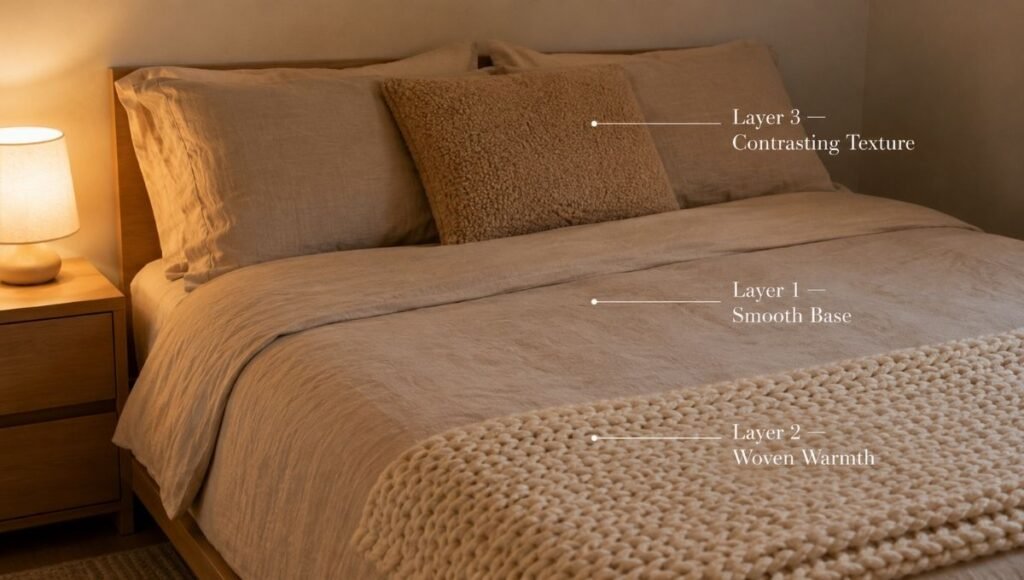
This is the editorial position I keep coming back to after years of looking at both beautiful and cluttered bedrooms: the difference is almost always texture count and texture contrast, not object count.
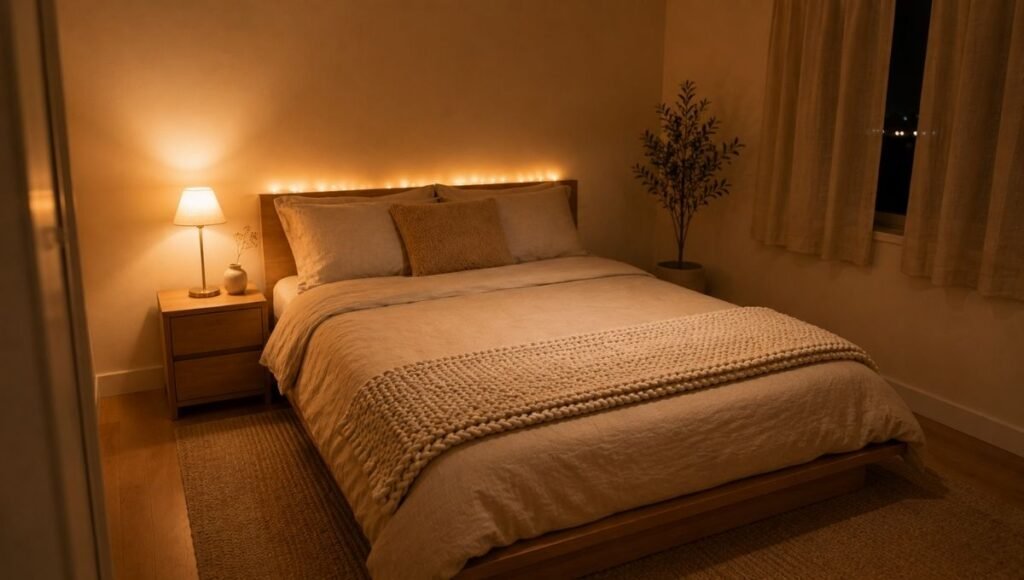
A bed with three textures — a linen flat sheet (smooth), a chunky knit throw folded at the foot (rough/soft), and a velvet or boucle pillow against the two regular cotton pillowcases (plush) — looks intentionally layered. A bed with eight pillows of varying sizes in the same cotton sateen looks like a hotel that ordered too many pillows.
The three-texture formula for a warm bedroom:
Layer 1 — The base: Your sheets and pillowcases. The material matters more than the pattern. Linen or percale cotton in a natural tone (white, oatmeal, sage, warm gray) is the foundation. The texture is subtle — the weave of the fabric rather than a pattern or color statement.
Layer 2 — The accent: One throw blanket, folded once (not casually thrown — folded, and placed at the foot of the bed or draped over one corner). A chunky knit, waffle weave, or herringbone pattern in a tone that’s warmer than the sheets but not dramatically different. This is where warmth enters visually.
Layer 3 — The contrast: One decorative pillow in a different material from the bedding — velvet, boucle, linen with embroidery, or a printed canvas. One pillow. In a small bedroom, one accent pillow in a contrasting texture does more work than five matching ones in the same fabric as the sheets.
The formula is: smooth base + woven warmth + one contrasting texture. Three materials, visible restraint, clear intention.
Warm Minimalist Bedroom: The Approach for People Who Don’t Want More Stuff
The warm minimalist bedroom is the search term with KD=7 — almost no competition, and the concept that most small bedroom owners in their late 20s and early 30s actually want. They’re past the phase of maximalist decoration. They’ve been through the “add more plants, more candles, more art” phase and found that more rarely equals better in a small room. They want warmth that comes from quality and intentionality rather than accumulation.
I have a direct editorial opinion on this: the warm minimalist bedroom is genuinely achievable in a small apartment, and it’s actually easier to achieve in a small space than a large one because you have fewer surfaces to make decisions about.
The material palette for a warm minimalist bedroom:
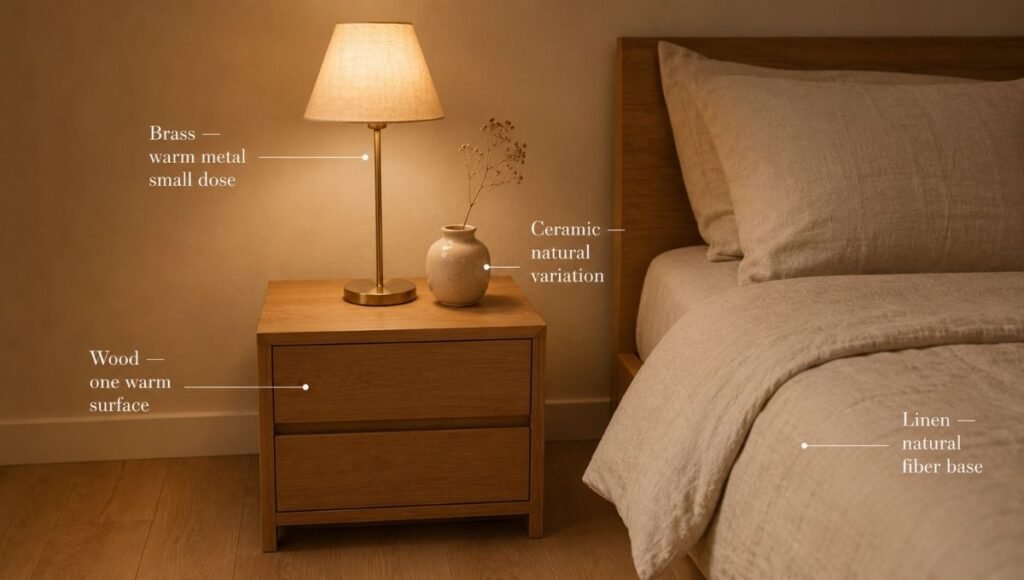
Wood: One piece. Not a matched bedroom set. One warm wood surface — a nightstand, a small shelf, a mirror frame — in oak, walnut, pine, or teak. Wood tone reads as warmth in a way that painted furniture doesn’t. It’s a material with natural variation that makes a room feel alive rather than designed.
Linen or cotton: All soft surfaces. Linen sheets, a cotton throw, a jute rug. Natural fibers have an irregular texture that synthetic materials don’t — microfiber and polyester read as cheap even when they’re not, because they’re too uniform. Natural fibers read as intentional even when they’re inexpensive.
Ceramic or clay: One object on the nightstand or dresser. A small ceramic vase (empty or with a single dried stem), a clay dish for small items, a ceramic lamp base. These materials have the same quality as wood — natural variation, warmth, visible handmade quality. They make a surface feel considered rather than functional.
Metal (in warm tones only): Brass, bronze, or aged gold. Not chrome or brushed nickel — those read as bathroom hardware. One small brass pull on a drawer, a brass lamp base, a gold-toned picture frame. Warm metal in small doses creates a warmth that cool metal completely undercuts.
Cozy Small Bedroom: Using the Architecture You Already Have
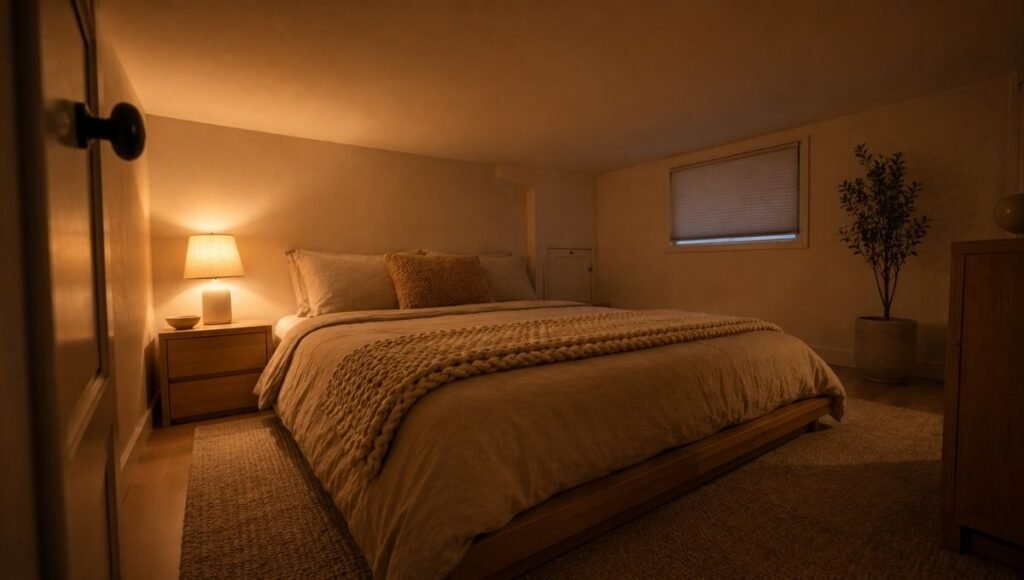
Small bedroom ceilings are lower. Small bedroom walls are closer. These things feel like limitations — but in the context of creating a warm, cozy space, they’re advantages. Lower ceilings create intimacy. Closer walls create enclosure. The warmth that a large bedroom has to manufacture with careful design, a small bedroom already has structurally.
The work in a small bedroom is not creating coziness — it’s not fighting against it.
Where most small bedrooms go wrong:
They use overhead lighting that illuminates every corner equally, eliminating the shadows and pools of light that make a room feel intimate rather than exposed. They use cool-toned white paint that bounces light in a clinical way. They have too much floor furniture that blocks the architectural warmth of the low ceiling and close walls.
Where to lean into the small bedroom’s structural advantages:
Let some corners stay dark at night. You don’t need even light distribution — you need warmth in the area where you are (the bed, the reading chair if you have one). The corners of the room can exist in ambient shadow and the room will feel more intimate for it.
Let the ceiling feel low by avoiding tall, heavy furniture that draws the eye up to the ceiling height. Low platform beds, floating shelves below 60 inches, and furniture with slim legs (that show floor beneath them) all make a small room feel more spacious — and paradoxically more cozy, because the scale of the furniture is in conversation with the room’s actual dimensions.
Use the wall area near the bed intentionally. A headboard-height wall-mounted shelf with a small lamp, a plant, and one object is a warm vignette that makes the sleeping area feel like a contained world rather than a corner of a room.
Warm Bedroom Decor: The 10-Minute Changes That Actually Work
Not everyone has the bandwidth for a room rethink. Sometimes you have a Saturday afternoon and $30 and you want the room to feel different by tonight.
In 10 minutes and under $20:
Swap the overhead bulb for 2700K warm white. The room transforms immediately. Do this first, before anything else, before buying any furniture or textiles. The $8 spent on a single warm-tone bulb is the most disproportionately effective money available in bedroom transformation.
In 30 minutes and under $50:
Add a bedside lamp at 2700K and remove the overhead light from the equation for evening use. The room now has one source of warm light at eye level — this alone will make every evening feel different.
Over a weekend and under $150:
Replace polyester or microfiber pillowcases with linen ones (typically $30–$50 for two). Add one throw blanket in a natural fiber — chunky cotton knit or waffle weave — folded at the foot of the bed ($30–$60). These two changes hit both the texture formula (smooth base + woven warmth) and the material warmth principle (natural fibers vs synthetic) simultaneously.
If the room still doesn’t feel warm after these changes:
The issue is probably the wall color or the floor, not the accessories. A very cool white wall (with a blue or green undertone) will fight warm accessories constantly. A warm white or off-white (with yellow or red undertone) cooperates with them. Paint samples are $5 each — put three warm whites on the wall in small patches and live with them for a day before committing.
The One Mistake That Makes Every Warm Bedroom Feel Cluttered
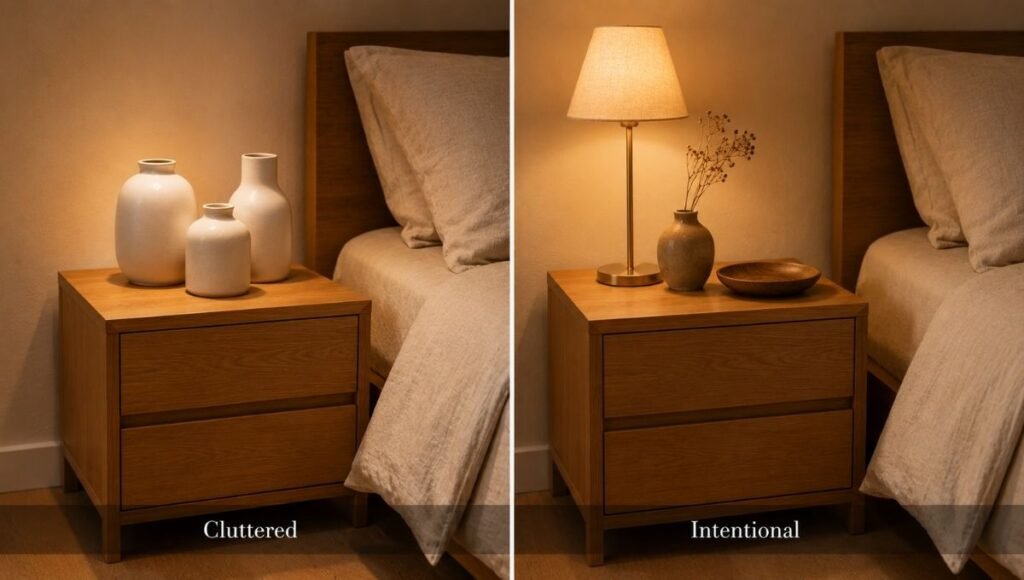
Adding objects in the same material category.
Three ceramic vases of different sizes read as a collection. One ceramic vase, one small framed photo, and a lamp base in brass read as a considered surface. The difference is material variety, not object count.
When every surface object is in the same material — all white ceramic, all rattan, all wood — the room reads as a shop display rather than a lived-in space. Mix materials deliberately: one ceramic, one woven, one metal, one natural (a dried branch, a smooth stone, a pine cone). The contrast between materials is what makes a surface feel curated rather than accumulated.
This applies to the bed as well. If every textile is linen — linen sheets, linen throw, linen pillowcases — the bed reads as monochromatic rather than layered. Mix: cotton sheets, a different-textured throw, a velvet or boucle accent pillow. The three-texture formula only works if the three textures are genuinely different.
FAQ: Warm Bedroom Ideas
How do I make my bedroom feel warm and cozy? Start with the light — replace cool-white bulbs with 2700K warm white LEDs and add a lamp at bedside height rather than relying on overhead light. Then introduce texture in three layers: smooth base (linen sheets), woven warmth (a throw blanket), and one contrasting material (a velvet pillow or a ceramic object). These two changes — light and texture — do more to create warmth than any paint color or furniture purchase.
What colors make a bedroom feel warm? Warm whites (with yellow or red undertone rather than blue or green), terracotta, warm sage, oatmeal, caramel, and dusty rose all read as warm on walls. But wall color is the least efficient investment if the lighting is still cool-white — warm paint under 5000K light still reads as cold. Fix the light source first, then evaluate whether the wall color needs to change.
How do I make a small bedroom feel cozy without making it feel smaller? Use furniture with visible legs (shows floor beneath, creating the perception of space), keep floor storage minimal, use one large rug rather than multiple small ones, and choose warm lighting rather than cool overhead light. Warmth and spaciousness are not opposites in a small bedroom — warm lighting and natural materials make a room feel intimate rather than cramped.
What is a warm minimalist bedroom? A bedroom that achieves warmth through material quality and intentional restraint rather than accumulation. Typically: natural fiber textiles (linen, cotton, wool), one warm wood surface, warm-tone lighting at 2700K, and a limited number of surface objects in mixed materials (one ceramic, one woven, one metal). The opposite of maximalist warm bedrooms that achieve coziness through layering many objects.
What is the fastest way to make a bedroom feel cozier? Change the light bulb. A 2700K warm white LED in place of a cool-white or daylight bulb costs under $10 and transforms the evening quality of any room immediately. This is the single highest-return action available before any furniture purchase or textile change.
How many throw pillows should a small bedroom have? Two sleeping pillows plus one or two accent pillows maximum. In a small bedroom, pillow volume reads as clutter faster than in a large room because the bed takes up a higher proportion of the visible space. One accent pillow in a contrasting material (velvet, boucle, or embroidered linen) is sufficient for a warm, layered look without the “too many pillows” read.
The Bottom Line
A warm bedroom in a small apartment comes from light, material, and texture — in that order. Not from accumulation. Not from more throw pillows. Not from paint, until the light is right.
The sequence: change the bulb to 2700K, add one lamp at eye level, introduce three layers of texture on the bed, place one warm wood surface in the room, and choose natural fibers over synthetic wherever fabric is involved. That’s the complete formula, and it works in rooms as small as 80 square feet if executed with some restraint.
The small bedroom’s structural intimacy is an asset, not a problem. Stop fighting it and start working with it.
For the lighting layer of this setup — specifically how to hang fairy lights in a small bedroom without ruining the effect with visible cords — our fairy lights bedroom guide covers five specific placements. For the bedding layer — which materials are genuinely breathable versus marketing-speak — our best sheets for hot sleepers guide covers the material science in detail. And for the furniture arrangement that makes a small bedroom feel designed rather than just filled, our small bedroom layout guide has five arrangement formulas by room shape.
References
- Veitch, J. A., & Newsham, G. R. (1998). Lighting quality and energy-efficiency effects on task performance, mood, health, satisfaction and comfort. Journal of the Illuminating Engineering Society, 27(1), 107–129. (Research on lighting color temperature and perceived spatial comfort and emotional warmth)
- Knez, I. (1995). Effects of indoor lighting on mood and cognition. Journal of Environmental Psychology, 15(1), 39–51. (Research on warm vs. cool lighting and emotional response in residential environments)
- Kwallek, N., Lewis, C. M., Lin-Apo, J. S., & Woodson, H. (1996). Effects of nine monochromatic office interior colors on clerical tasks and worker mood. Color Research & Application, 21(6), 448–458. (Research on color and warmth perception in interior environments)
Published on Grainv.com | Category: Bedroom | Related: Fairy Lights Bedroom, Best Sheets for Hot Sleepers, Small Bedroom Layout, Small Bedroom Storage Ideas