
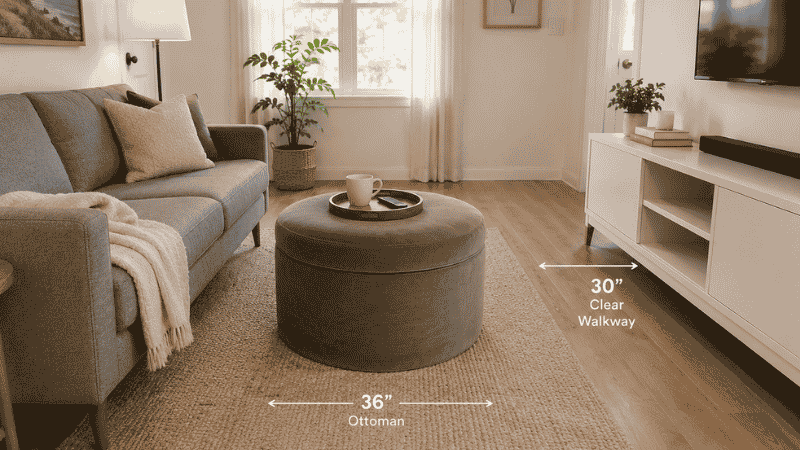
Your living room has a coffee table. It holds a remote control, a coaster, and whatever you set down when you walk in the door. That’s it. It doesn’t seat anyone. It doesn’t store anything. It doesn’t move. And it takes up approximately 8–12 square feet of your living room floor doing all of nothing.
In a small apartment, an ordinary coffee table is one of the least efficient uses of floor space you can make. Every square foot in a room under 150 square feet has to justify its presence — and a table that only holds a remote control fails that test badly.
An ottoman coffee table solves this. It holds drinks and remotes when you need a surface. It stores throws, magazines, and cables inside when you lift the lid. It seats an extra guest when your couch is full. It can be moved in thirty seconds when you need more floor space. It does four jobs from one footprint — and in a small living room, that’s not just convenient, it’s the difference between a room that works and one that doesn’t.
This guide covers what to look for in an ottoman coffee table for a small living room — specific size formulas, shape decisions, materials that hold up, and the tray question that most people get wrong.
Key Takeaways
- An ottoman coffee table replaces four separate items: coffee table, footrest, extra seating, and hidden storage — in a single footprint that’s typically 30–40% smaller than a standard coffee table plus a separate storage bench
- The right height is 16–18 inches: This puts the ottoman surface within 2 inches of standard sofa seat height (17–19 inches), making it comfortable to reach from the sofa and to sit on as extra seating
- Size formula for small living rooms: The ottoman diameter or width should be approximately half the sofa length — for an 80-inch sofa, a 36–40-inch ottoman is proportionally correct
- A tray is not optional: An upholstered ottoman surface is soft and unstable for drinks — a 14–18-inch round tray or 20×20-inch square tray creates a stable coffee table surface and signals “table mode” to guests
- Round ottomans outperform square in most small living rooms: No sharp corners means more usable circulation space, and the circular form softens a room that may be dominated by rectangular furniture
What Is an Ottoman Coffee Table?
The ottoman coffee table is a category, not a specific product type — it refers to any upholstered ottoman designed to function as a coffee table in addition to its seating and storage functions. The key design elements that make an ottoman work as a coffee table are:
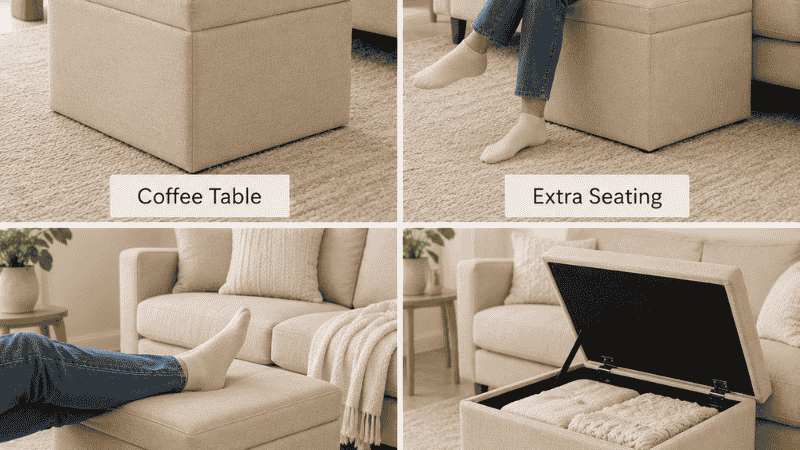
A flat, firm top surface: Not all ottomans have this. Poufs, for example, have a soft rounded top that can’t support a tray or drinks glass without tipping. A true ottoman coffee table has a flat top — either a firm upholstered surface or a removable hard top (wood, acrylic, or tray) that creates a stable platform.
The right height: 16–18 inches from the floor to the top surface. Too low (under 14 inches) and the ottoman doesn’t function as a comfortable coffee table or seat. Too high (over 20 inches) and it feels like a side table rather than a coffee table and looks disproportionate in front of a sofa.
Load-bearing capacity: The top surface needs to hold a tray, drinks, books, and the weight of a sitting adult. Look for a weight rating of at least 200 lbs for a storage ottoman — this covers both surface load and sitting load simultaneously.
A storage interior: This is what separates an ottoman coffee table from a standard upholstered bench. A hinged or removable lid reveals an interior compartment that typically holds 3–5 folded throws, a set of magazines, remote controls, charging cables, and small accessories.
Ottoman Coffee Table Size: The Formula for Small Living Rooms
Getting the size wrong is the most common ottoman coffee table mistake. Too small and the ottoman looks lost in front of the sofa. Too large and it blocks the primary walkway and makes the room feel cramped.
The Proportional Formula
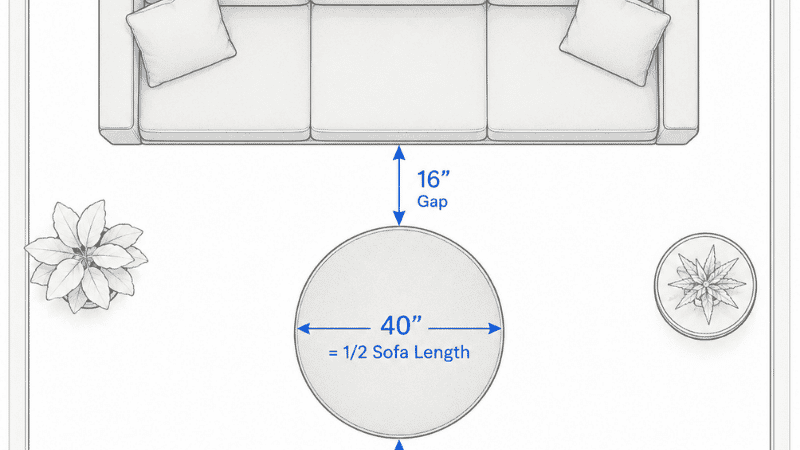
Ottoman diameter or width = approximately 1/2 the sofa length
For an 80-inch sofa: 40-inch ottoman For a 72-inch sofa: 36-inch ottoman For a 60-inch loveseat: 28–30-inch ottoman
This ratio ensures the ottoman reads as a cohesive pairing with the sofa rather than either undersized (visually disconnected) or oversized (dominating the seating zone).
The Distance Formula
Ottoman placement = 14–18 inches from the sofa’s front edge
Less than 14 inches: difficult to stand up from the sofa without hitting the ottoman; also too close for comfortable leg extension as a footrest.
More than 18 inches: the ottoman drifts out of the seating zone and reads as a separate piece rather than part of the sofa grouping. Guests have to lean forward uncomfortably to set drinks on it.
The Walkway Check
Before committing to a size, check this: the distance from the front edge of the ottoman to the nearest wall or piece of furniture should be at least 30 inches — 36 inches is comfortable. In a 10-foot-wide living room (120 inches) with a 34-inch deep sofa against one wall and a 40-inch ottoman placed 16 inches in front:
120 − 34 (sofa) − 16 (gap) − 40 (ottoman) = 30 inches of clearance remaining
That’s exactly the minimum. In rooms under 10 feet wide, a 36-inch ottoman is often the practical maximum. In rooms under 9 feet wide, a 30-inch ottoman may be necessary to preserve a functional walkway.
Round Ottoman Coffee Table vs. Square: Which Works Better in a Small Living Room?
This is the choice most people make by aesthetic preference alone — but in a small living room, shape has real functional consequences.
The Case for Round
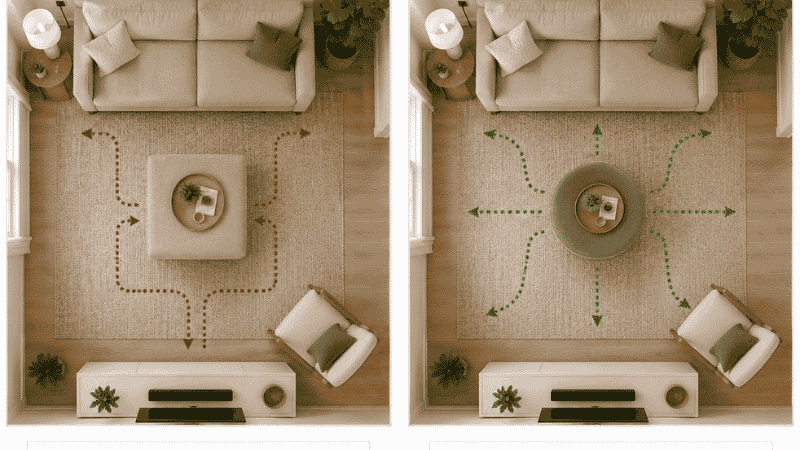
A round storage ottoman has no corners. This sounds minor until you’ve spent a week navigating around the sharp corner of a square coffee table in a tight living room — shins, knees, and corners are incompatible. A round ottoman allows you to walk around it from any angle without the corner-avoidance dance.
Round ottomans also visually soften a room. Small living rooms are often dominated by rectangular furniture — sofa, media console, rug. A round ottoman introduces a different geometry that makes the room feel less rigid and more lived-in.
Best size range for round storage ottomans: 24–36 inches diameter. Under 24 inches looks too small to function as a proper coffee table; over 36 inches starts to feel oversized in rooms under 12 feet wide.
The round ottoman tray requirement: A 14–16-inch round tray placed on top is essential for stability. Without it, the upholstered surface is too soft and round for a drink glass or remote control to sit without sliding. The tray anchors the objects and signals “this is a table surface right now.”
The Case for Square or Rectangle
A square or rectangular ottoman has more flat top surface area for the same footprint size — a 30-inch square top provides 900 square inches versus 707 square inches for a 30-inch round. This matters when the ottoman needs to function as a true work surface or dining surface (eating from the coffee table, laptop use).
Square ottomans also pair more naturally with sectional sofas and rooms with strong rectangular geometry. The 90-degree edges reinforce rather than contrast the room’s existing lines.
The square ottoman corner compromise: If you choose a square or rectangular ottoman, look for rounded corners (a 1–2-inch radius at each corner) rather than sharp 90-degree edges. This reduces the shin-and-knee problem significantly while maintaining the square aesthetic.
Best size range for square storage ottomans: 28–36 inches wide. Matching the sofa’s length at 2:3 ratio works well — for an 80-inch sofa, a 30–36-inch square ottoman reads as proportionally appropriate.
The Storage Ottoman with Tray: Making the Coffee Table Function Work
The tray is the piece that makes an ottoman coffee table actually function as a table — and most people either skip it entirely or use one that’s too small.

Why the Tray Is Non-Negotiable
An upholstered ottoman surface is soft, slightly springy, and often slightly curved. A drink glass on this surface will wobble. A remote control will migrate. The tray solves this: it creates a rigid, flat platform for objects while also visually signaling “this is the table zone” — an important cue in a living room where guests need to understand the ottoman’s current function.
Tray Size and Proportion
For round ottomans: A round tray at 40–50% of the ottoman’s diameter. On a 36-inch ottoman, a 14–16-inch round tray is correct. Too large and the tray dominates the ottoman surface; too small and it looks like an afterthought.
For square ottomans: A square or round tray at approximately 50–60% of the ottoman width. On a 30-inch square ottoman, an 18-inch round tray or 16×16-inch square tray. A tray that spans more than 60% of the ottoman width starts to look like a lid rather than a tray — which is fine functionally but changes the aesthetic.
Tray height: Flat or with low sides (under 1.5 inches). High-sided trays are harder to use for drinks and look more like storage than a surface.
What Goes on the Tray
The tray’s job is to make the ottoman look intentional and function as a coffee table surface, not to be a decorative still life. The effective tray configuration: one functional object (remote control or small book), one drinking vessel (glass, mug, or coaster for the same), and optionally one small organic object (a small plant, a single candle). Three items maximum. More than three and the tray looks cluttered; fewer than three and it reads as empty.
Ottoman Coffee Table Materials: What Holds Up in a Small Apartment
In a small apartment where the ottoman is used daily — sat on, set drinks on, opened and closed for storage — material quality matters more than it might in a larger home where the ottoman is supplemental seating.
Fabric (Most Common)
Standard fabric ottomans range from polyester blends (most affordable, least durable) to performance fabrics (Crypton, Sunbrella, or proprietary equivalents — significantly more durable, stain-resistant, and worth the premium for daily-use ottomans).
Performance fabric: The right choice for any ottoman used daily in a small apartment. Resists stains from drinks, pet hair releases easily, maintains appearance over years of use. Look for the “performance” label or ask specifically about stain resistance before purchasing.
Standard fabric (linen, cotton, chenille): Requires more care. Appropriate for households where drinks are kept on the tray (not directly on the ottoman surface) and the ottoman functions more as seating and storage than as a true work surface.
Velvet Storage Ottoman
Velvet ottomans have a specific advantage in small living rooms: the light-catching pile adds visual richness and warmth that makes a small room feel more furnished and considered. A sage velvet or dusty blue velvet ottoman becomes the room’s aesthetic anchor at a smaller scale than a statement sofa would require.
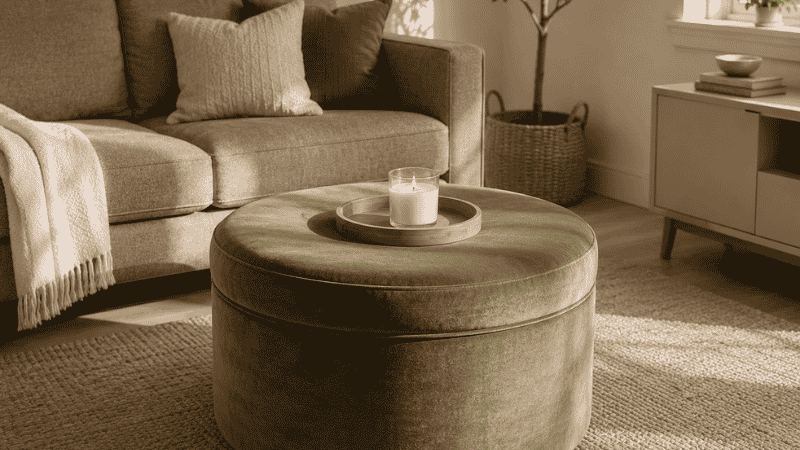
Modern velvet ottomans use synthetic velvet (polyester pile) rather than traditional velvet — significantly more durable, easier to clean, and less prone to crushing over time. Clean with a soft brush to restore crushed pile.
Velvet sizing consideration: Velvet shows footprints and indentations more visibly than other fabrics. In a storage ottoman used as a coffee table, this is generally fine — the visible use marks actually reinforce the “furniture being used” aesthetic. Clean regularly with a lint roller and brush in the direction of the pile.
Leather and Faux Leather
A leather or faux leather storage ottoman has the most durable surface for coffee table use — wipe clean with a damp cloth, no fabric care required, and the surface doesn’t absorb drink spills. The trade-off is that a leather ottoman reads as harder and more formal than fabric, which can work against the cozy-small-room aesthetic that most apartment dwellers are after.
Best use case for leather ottomans: When the ottoman will be used heavily as a work surface (laptop use, eating), when the household has pets or small children who will frequently sit on and eat near the ottoman, or when the room’s aesthetic skews more structured and contemporary.
Faux Leather (Vegan Leather)
More affordable than genuine leather, similar cleanability. The primary limitation is longevity — lower-quality faux leather (bonded leather or PU leather under $150) begins to crack and peel at high-friction points (corners, lid edges) within 2–3 years of daily use. If budget requires faux leather, look for top-grain PU with a thickness specification (over 1.2mm) and avoid bonded leather entirely.
Ottoman Coffee Table Storage Capacity: What Actually Fits Inside
The storage interior is the feature most product pages undersell and most buyers overestimate. Here’s what actually fits in a typical storage ottoman.
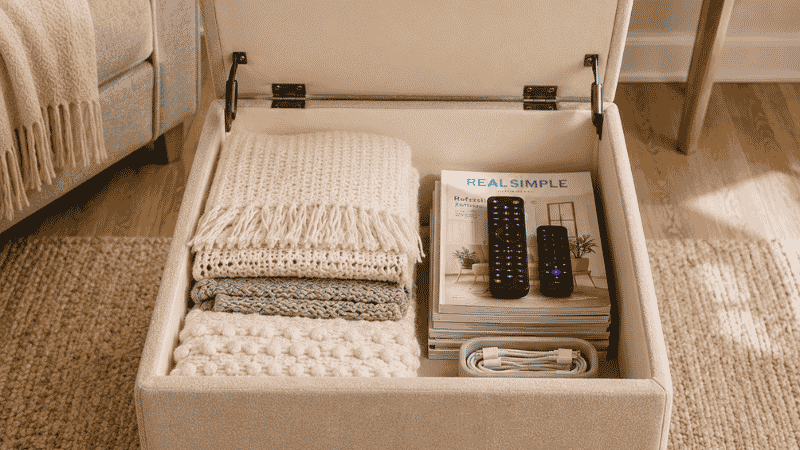
Standard square storage ottoman (30 × 30 × 16 inches):
- 3–4 folded throw blankets
- 8–10 magazines or a small stack of books
- 2 remote controls and associated batteries/accessories
- 1 small games console or equivalent electronics
- Charging cables and small tech accessories
Round storage ottoman (30-inch diameter, 16 inches tall):
- 2–3 folded throw blankets (the round shape wastes some corner volume)
- 6–8 magazines
- Same small items as above
What doesn’t fit: Shoes, large bedding sets, anything with sharp edges that would damage the interior fabric lining, or anything too heavy to be supported by the hinge mechanism on a standard hinged lid.
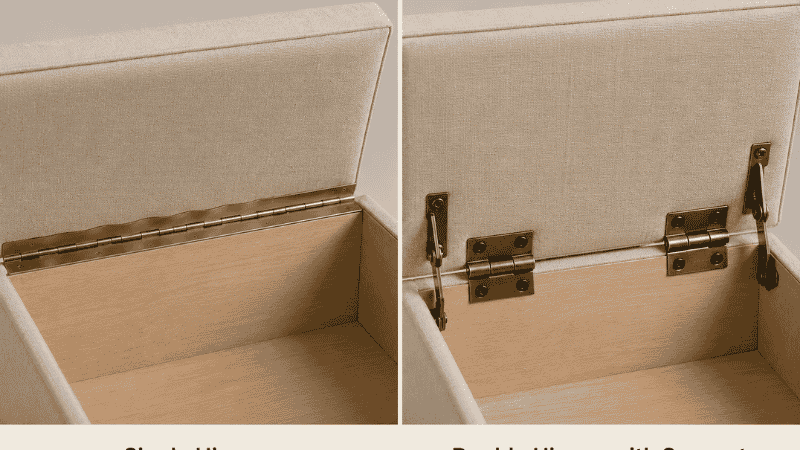
The hinge quality issue: Most storage ottomans open via a hinged lid. Cheaper ottomans have a single continuous hinge that can warp over time; better ottomans have two separate hinges with additional support brackets. Check hinge quality before purchasing — a broken hinge on a storage ottoman is not typically repairable and effectively ends the ottoman’s storage function.
Ottoman vs Coffee Table: When a Traditional Coffee Table Is Still Better
An ottoman coffee table isn’t always the right choice. Here’s when a traditional coffee table outperforms it:
When you need a rigid, stable work surface: Writing, extensive laptop use, or eating meals require a surface that doesn’t shift. An upholstered ottoman with a tray is workable for casual use but not for sustained desk work. A lift-top coffee table (a hinged hard-top coffee table that raises to desk height) is the better solution for apartments where the coffee table doubles as a work surface.
When you rarely need extra seating: If guests are infrequent and storage is handled by other furniture, a standard coffee table with a shelf below provides more surface stability and a better-defined storage zone than an ottoman.
When the room has sharp-cornered furniture on all sides: An ottoman softens the room visually, but if you’re also trying to add warmth through textiles and cushions, the soft ottoman may over-soften a room that would benefit from some structural definition.
If You Only Have 10 Minutes: The Quick Ottoman Assessment
Before buying, run through this checklist:
- Measure 1/2 your sofa length — that’s your ottoman’s maximum width or diameter
- Verify the height is 16–18 inches — this is the functional sweet spot for coffee table and seating use
- Check the weight rating — minimum 200 lbs for safe daily seating use
- Confirm there’s 30+ inches of clearance between the ottoman’s far edge and the nearest obstacle
- Identify your tray size — round: 40–50% of ottoman diameter; square: 50–60% of ottoman width
- Check hinge quality — two hinges minimum, with lid support mechanism to prevent lid from slamming closed
FAQ: Ottoman Coffee Table Questions
Can an ottoman be used as a coffee table? Yes — with a tray. An ottoman’s upholstered top is too soft and slightly unstable for drinks and objects without a flat, rigid tray surface to anchor them. A round tray at 40–50% of the ottoman’s diameter (or a square tray at 50–60% of its width) creates a stable coffee table surface and visually signals “table mode” to anyone in the room.
What size ottoman should I use as a coffee table? The ottoman’s width or diameter should be approximately half the sofa length. For an 80-inch sofa: 36–40 inches. For a 72-inch sofa: 34–36 inches. For a 60-inch loveseat: 28–30 inches. Height should be 16–18 inches — within 2 inches of the sofa’s seat height for comfortable reach and use as extra seating.
Is a round or square ottoman better for a small living room? Round is usually better for small living rooms. No sharp corners means safer circulation around the ottoman and a softer visual profile. The reduced flat surface area compared to a square ottoman is compensated by placing a tray on top. Square or rectangular works better when the room has a sectional sofa or when you need maximum flat surface area for work or dining.
What do you put on top of a storage ottoman to use it as a coffee table? A tray is the essential element — it creates a stable, flat surface for drinks and objects. On the tray: one remote control or small book, one coaster and drink, and optionally one small plant or candle. Keep the tray display to three items maximum to avoid visual clutter. The tray should be round (14–16 inches for a 30–36-inch ottoman) or square (16–18 inches for a 28–32-inch square ottoman).
How much weight can a storage ottoman hold? Quality storage ottomans are rated for 200–300 lbs when used as seating. The hinge mechanism is typically the weakest component — most standard hinges on budget ottomans are rated for the lid weight only and can fail if the lid is used as a load-bearing surface. When using the ottoman as a seat, distribute weight to the frame (edge of the ottoman) rather than the center of the lid.
What is the difference between an ottoman and a storage ottoman? A standard ottoman is a solid upholstered piece — no interior storage. A storage ottoman has a hollow interior accessed through a hinged lid or removable top. For small apartment living rooms where the ottoman functions as a coffee table, storage ottoman is almost always the right choice because the internal storage replaces a separate storage piece — either a media console drawer or a living room basket.
What is a large square storage ottoman good for? A large square storage ottoman (32–36 inches) works best as the primary living room coffee table in a one-bedroom apartment with a sofa of 80+ inches. At this size, it holds meaningful storage (4–5 throws, magazines, and accessories), seats two adults comfortably, and provides enough flat tray surface for two drinks plus a remote. In rooms under 10 feet wide, verify walkway clearance (30 inches minimum) before buying at this size.
The Bottom Line
The ottoman coffee table is the highest-ROI piece of furniture available for a small living room — not because it’s clever or trendy, but because it does four things from one footprint in a space where every footprint has to work. Coffee table function, storage, extra seating, and footrest all resolved by one piece, one purchase, one piece of floor real estate.
Size it correctly (half the sofa length, 16–18 inches tall), add a tray, choose a material that matches your daily use pattern, and the ottoman coffee table will outlast every other furniture decision you make in that room.
For the full picture of how an ottoman fits with everything else in your living room — sofa sizing, rug dimensions, and media console placement — our furniture ideas for small living rooms guide covers the complete sizing formula. And for sofa selection that pairs well with any ottoman coffee table, our sofa for small living room guide has the dimension rules and configuration options by room shape.
References
- American Society of Interior Designers (ASID): Residential space planning guidelines — 30-inch minimum walkway clearance for residential living room furniture arrangements, and recommended coffee table height ranges (16–18 inches) for standard sofa seat heights
- Furniture Industry Research Association (FIRA): Upholstered seating guidelines — weight ratings and structural requirements for dual-function upholstered furniture used as both seating and table surfaces
- Consumer Reports Furniture Testing (2024): Storage ottoman durability testing — hinge mechanism failure rates by price point and construction method in simulated daily-use environments
Published on Grainv.com | Category: Living Room · Multifunctional Furniture | Related: Furniture Ideas for Small Living Rooms, Sofa for Small Living Room, Living Room Storage Ideas