
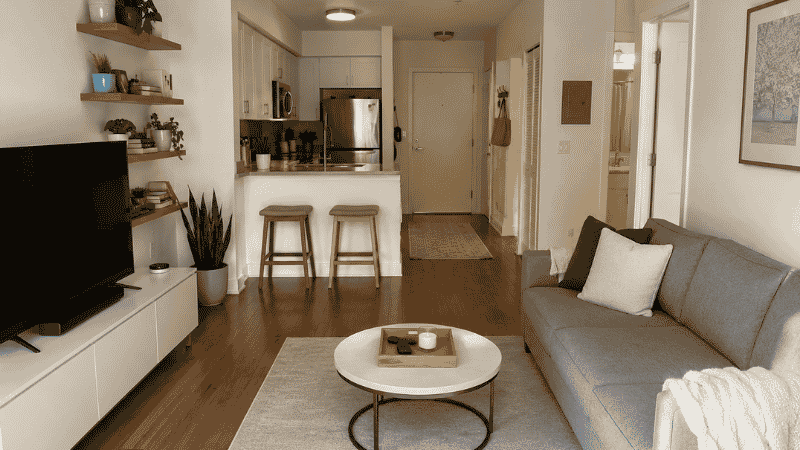
You’ve reorganized your apartment three times in the past year. Each time, it looked great for about two weeks. Then one busy Monday happened, and by Friday the surfaces were back to their default state — a layer of things that don’t have a home, slowly migrating from the bag by the door to the kitchen counter to the coffee table.
This isn’t a willpower problem. It’s a systems problem. Most small apartment organization advice focuses on the cleanup — the one-day purge, the labeled bins, the Instagram-worthy shelves. What it skips is the part that comes after: how do you build a space where things naturally return to their place, without requiring daily effort and sustained motivation?
This guide works differently. We’re going to give you a sequenced approach to organizing a small apartment — starting with what to remove before you buy a single storage product, then moving room by room with specific solutions, and ending with a maintenance system that takes five minutes a day. The goal isn’t a perfect apartment for two weeks. It’s a functional apartment for the next two years.
Key Takeaways
- Declutter before you organize: Buying storage products before reducing your belongings is the most common small apartment mistake — you end up with organized clutter rather than a functional space
- The 30-second proximity rule: Items should be stored within 30 seconds of where you use them — anything further and you won’t return it consistently, regardless of how good your system is
- Vertical space above 60 inches is almost always empty: Most small apartments use only the bottom half of their wall height for storage; the top half is free, requires no floor space, and holds significantly more than most people realize
- Five minutes daily beats one hour weekly: Research on habit formation shows that small daily maintenance behaviors are dramatically more sustainable than periodic deep-cleaning sessions — the goal is a five-minute evening reset, not a monthly overhaul
- Every flat surface is a decision waiting to happen: In a small apartment, any horizontal surface without a defined purpose becomes a clutter magnet within 48 hours — assigning every surface a specific function is the foundation of a working system
Step 1: Declutter Before You Organize Anything
This is the step most people skip, and it’s why their organization systems collapse within weeks. Buying storage bins and rearranging furniture before reducing your belongings is like trying to organize a warehouse that has twice the inventory it has space for. You end up with organized clutter — things in labeled boxes that you still don’t use and don’t need.
The declutter-first principle is simple: you cannot organize your way out of owning too much stuff for your space.
The Four-Box Method for Small Apartments
Rather than trying to declutter your entire apartment in one session (which is overwhelming and rarely completed), work in 30-minute blocks using four designated areas:
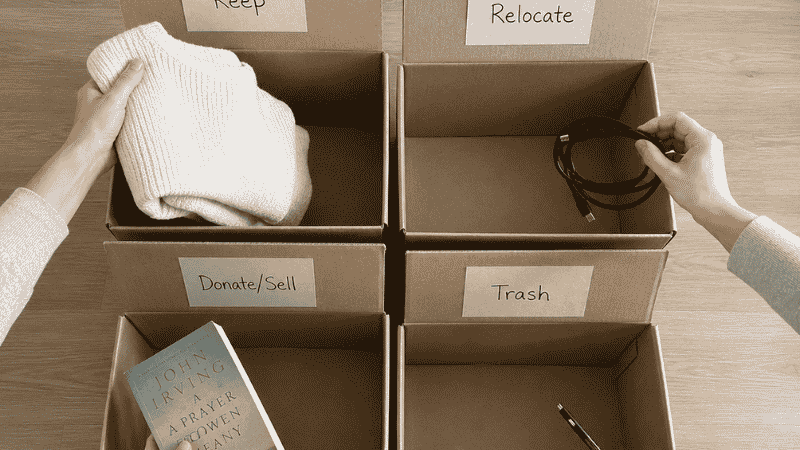
Keep — items you use regularly and that have a specific home in the apartment. If you can’t name where it lives, it doesn’t go in this box yet.
Relocate — items that belong somewhere else in the apartment but ended up here. Don’t put them away mid-session; just pile them in this box and do one relocation round at the end.
Donate/Sell — items in good condition that someone else could use. Be honest: the “I might need this someday” category is where most small apartment clutter lives permanently.
Trash — broken, expired, or genuinely useless items. This box is usually smaller than people expect but takes up proportionally large psychological space.
Work one surface, one drawer, or one shelf at a time. Finish it completely before moving to the next. The momentum of completing small sections is what keeps a declutter session going.
The Inventory Audit: How Much Do You Actually Own?
Most people underestimate how many possessions they have by 30-40%. Before organizing, do a quick count of the categories that typically generate the most small-apartment clutter:
- Clothing items (including items rarely worn in the past six months)
- Shoes
- Kitchen items (including duplicates and specialty tools used less than once per month)
- Books and magazines
- Cables, chargers, and tech accessories
- Cleaning products
- Decorative objects
If any single category exceeds what your designated storage for that category can hold, the answer is reduction — not more storage.
How to Organize a Small Apartment Room by Room
Once you’ve reduced your belongings to what actually fits and functions in your space, organize each zone with a specific strategy. Here’s the order that works best: entry → living room → bedroom → kitchen → bathroom. Starting at the entry and working inward mirrors the natural flow of stuff coming into your home.
The Entryway: Your Apartment’s First Line of Defense
In a small apartment, the entryway is the most strategically important zone because it’s where stuff enters. If you don’t intercept it here — bag, keys, mail, shoes — it migrates inward and colonizes every flat surface in the apartment.
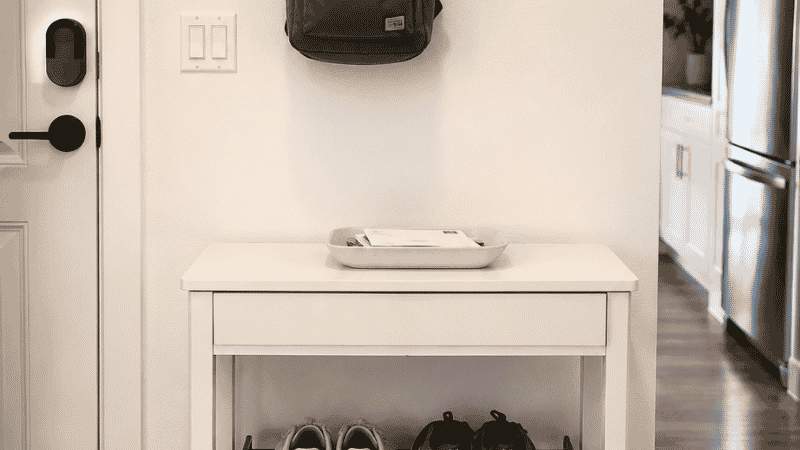
What the entryway needs to handle:
- Keys (one hook, one location, non-negotiable)
- Bags and backpacks (hooks at 60–66 inches height, one per regular bag)
- Outerwear (if no coat closet: a narrow coat rack or 3–4 hooks on a wall panel)
- Mail and delivery items (one small tray or box — when it’s full, deal with it immediately)
- Shoes (a two-tier rack for daily shoes; seasonal shoes go in bedroom storage)
The entryway rule: Anything that comes through the door gets processed here or returns here. If it doesn’t have a hook, shelf, or tray to land on, it will land on the floor.
For apartments with no dedicated entryway — where the front door opens directly into the living room — designate the first 18–24 inches inside the door as the “processing zone” using a small console table (max 12 inches deep) or a wall-mounted hook panel.
The Living Room: Contain the Daily Accumulation
The living room in a small apartment is the zone most likely to accumulate things that belong elsewhere, because it’s where you spend the most time and where you set things down without thinking. The organizational goal here isn’t to make it look like a magazine photo — it’s to make sure everything visible belongs there, and everything that accumulates has somewhere it returns to.
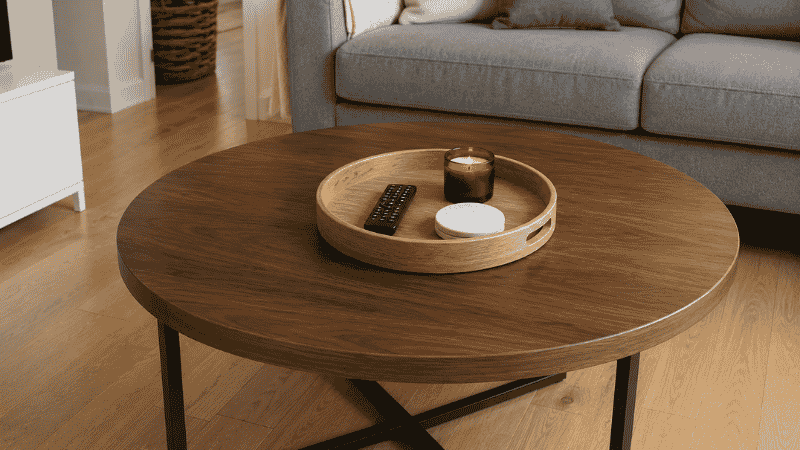
Surfaces need assigned functions:
The coffee table surface: one tray (corrals remotes, a coaster, a candle — nothing else). If something doesn’t fit on the tray, it goes somewhere else.
The console or media unit: electronics and their accessories only. No overflow from other rooms.
The sofa: cushions and one throw. Not the landing zone for bags, clean laundry, or “I’ll put this away later” items.
Storage that works in a small living room:
A storage ottoman replaces the coffee table and holds throws, magazines, and remote controls behind a closed lid. This single swap eliminates three common clutter categories from visible surfaces.
Floating shelves at 48–72 inches handle books and display objects without consuming floor space. Keep display shelves at 70% capacity — full shelves become visual clutter even when organized.
A media console with closed cabinets handles the cable box, router, gaming system, and accessories behind closed doors. Open-shelf media units work in large rooms; in small living rooms, they display cable chaos.
For the full living room storage strategy with specific furniture dimensions, see our living room storage ideas guide.
The Bedroom: Make the Invisible Visible
The bedroom organization challenge in a small apartment is almost always a clothing storage problem. Everything else — books, decor, charging cables — is secondary. Solve the clothing storage first, and the rest follows.
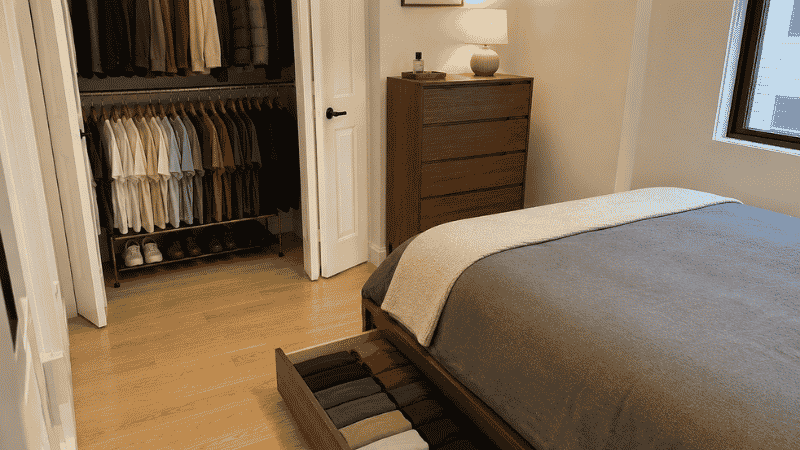
The clothing storage hierarchy for small bedrooms:
First: use your bed. A platform bed with built-in drawers holds roughly the equivalent of a 5-drawer dresser in zero additional floor space. If you have a traditional bed frame with 10+ inches of clearance, rolling under-bed bins or vacuum storage bags for seasonal items use this otherwise dead space.
Second: maximize the closet. Most built-in closets have one rod and one shelf — the least efficient configuration possible. Adding a second hanging rod at 38–42 inches height doubles hanging capacity for short items (shirts, folded trousers). A shoe rack on the closet floor holds 12–16 pairs in the space that 4 pairs occupy when loose.
Third: choose the right dresser. If you need a freestanding dresser, maximum 42 inches wide and 18 inches deep. Deeper dressers create walkway problems in small bedrooms that you’ll feel every single morning.
The nightstand is a clutter magnet. Every item on it should pass the test: “Do I use this at night or first thing in the morning?” Phone charger: yes. Yesterday’s mail: no. A book you’re currently reading: yes. Three books you finished two months ago: no.
For bed placement formulas and clearance measurements, see our small bedroom layout guide.
Maximize Space in a Small Apartment Kitchen
The kitchen is the room where small apartment organization failures are most immediately felt — a disorganized kitchen makes cooking feel impossible and ordering delivery feel inevitable. The good news is that kitchen organization responds quickly to systematic changes; you can usually see dramatic improvement in a single afternoon.
The kitchen edit: what should leave first
Duplicate tools: most people have 3–4 spatulas, 2 sets of measuring cups, and 4 wooden spoons. Keep the best one of each and donate the rest.
Specialty appliances used less than monthly: the waffle iron, the juicer, the pasta maker. In a small apartment kitchen, counter appliances cost as much real estate as a piece of furniture. If it doesn’t earn its counter space through weekly use, it lives in deep storage or leaves entirely.
Expired pantry items: these take up cabinet space you could use for active ingredients.
Vertical storage in the kitchen:
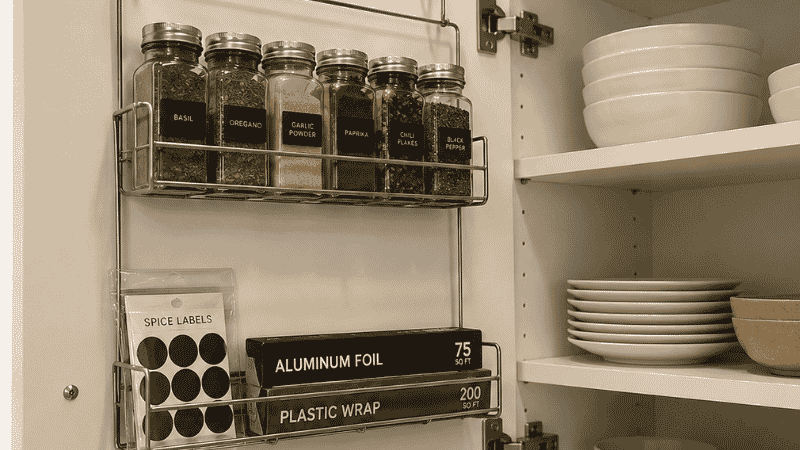
Cabinet doors are the most underused storage surface in most kitchens. An over-door organizer on the inside of a cabinet door holds spices, foil, plastic wrap, and small items without touching any shelf space. Command strips (rated for the weight) mount small hooks and holders without drilling.
The space above the refrigerator: use it for items accessed rarely — a large serving platter, a blender used monthly, seasonal items. A simple shelf placed on top of the refrigerator (if the gap allows) creates useful storage for things that don’t need frequent access.
Counter management:
The counter rule: only items used daily live on the counter. The coffee maker, the knife block, a cutting board — these earn their permanent counter position through daily use. Everything else gets a cabinet.
If your counter is chronically cluttered, the problem is usually insufficient cabinet space rather than a discipline problem. Wall-mounted shelves adjacent to the counter (floating shelves at 18–24 inches above counter height) give you accessible storage for frequently used items without consuming counter space.
How to Declutter a Small Apartment Without the Overwhelm
If your apartment is currently in a state where the organizing steps above feel impossible to even start, you need to declutter first — but in a way that doesn’t require a full weekend or perfect motivation to complete.
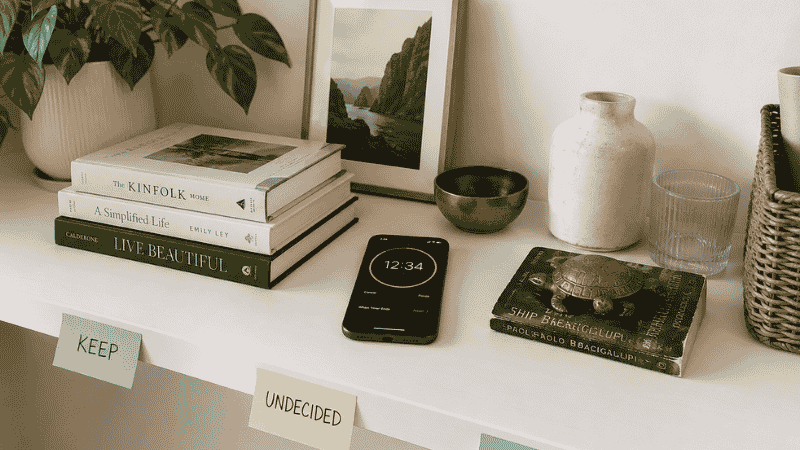
The 15-minute daily declutter:
Set a timer for 15 minutes. Pick one contained zone — one shelf, one drawer, one counter. Work only in that zone. When the timer goes off, stop. Bag anything leaving the apartment and put it by the door immediately. Don’t leave it in a pile to “deal with later.”
At this pace, working five days a week, you process roughly 75 minutes of focused decluttering per week — equivalent to clearing one room’s worth of accumulated items per month. It’s not dramatic. It’s sustainable.
The one-in-one-out rule:
For a small apartment to stay organized long-term, the volume of possessions must remain stable. Every time something new enters the apartment — a purchase, a gift, a package — something of equivalent size leaves. This isn’t minimalism; it’s capacity management.
Seasonal rotation:
Clothing you’re not wearing this season goes into vacuum storage bags under the bed or into labeled boxes in the highest-access storage location. Three seasonal wardrobes’ worth of clothing in a small closet is physically impossible to organize — one season at a time is the only approach that works.
How to Maximize Space in a Small Apartment Without Buying More Storage
Before purchasing any storage product, these zero-cost changes consistently free up the most space:
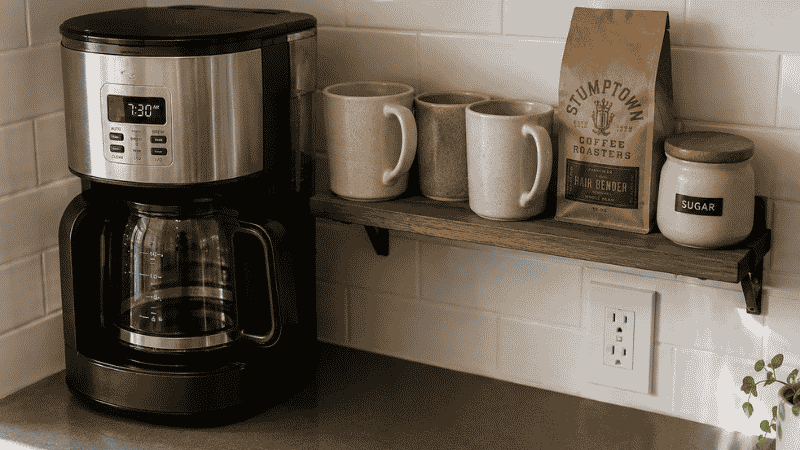
Relocate what’s stored in the wrong place. Most apartments have items stored near where they’re convenient to store rather than near where they’re used. Coffee mugs in a cabinet across the kitchen from the coffee maker. Extension cords in a closet on the opposite end of the apartment from any electronics. Map out where you actually use each category of item and relocate its storage to within 30 seconds of that use point.
Rotate what’s stored at eye level. Prime storage (counter height, eye-level shelves, easiest-to-reach cabinet shelves) should hold items you use daily. Seasonal items, backup supplies, and occasionally-used items belong in the highest and lowest shelves, the back of deep cabinets, and under-bed storage. Most small apartments have this inverted — the most accessible storage is occupied by the least frequently used items.
Use the full height of your walls. Standard apartment walls are 8–9 feet. Most storage furniture tops out at 54–60 inches. That 30–42-inch gap above the furniture line is free wall space that requires no floor footprint to use. A single shelf at 72 inches can hold books, plants, or display objects that currently compete with functional items for surface space.
The 5-Minute Daily Reset: How to Keep a Small Apartment Organized Long-Term
Organization systems fail not because people don’t care, but because maintenance requires consistent small behaviors rather than occasional large ones. Research on habit formation published in the European Journal of Social Psychology (Lally et al., 2010) found that simple daily behaviors become automatic within 66 days on average — meaning a 5-minute daily reset habit, practiced for two months, stops feeling like effort and starts happening automatically.
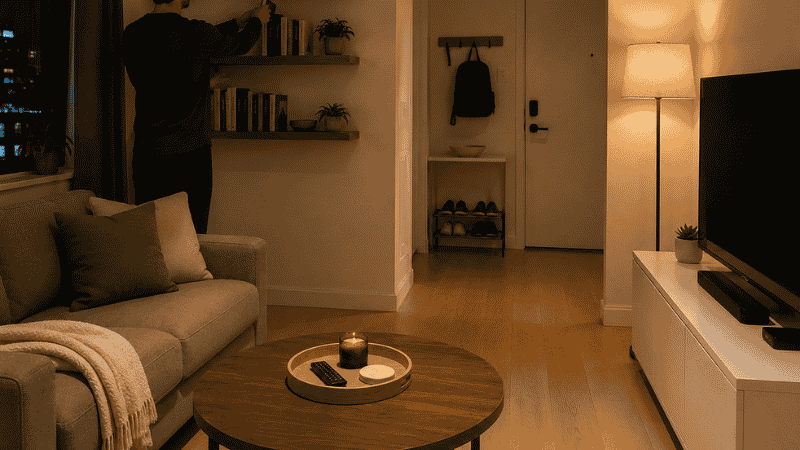
The evening reset routine (5 minutes):
- Walk through every room and return any item that’s not in its designated location to where it belongs (2 minutes)
- Clear every horizontal surface of anything that accumulated during the day — process it (put away, trash, or add to a to-do list) rather than shuffling it to another surface (2 minutes)
- Set up for the morning — bag by the door, keys on the hook, anything needed tomorrow in the entry zone (1 minute)
That’s it. Five minutes. The goal isn’t perfection; it’s preventing the overnight accumulation that compounds into a weekly cleaning problem.
The weekly 20-minute maintenance:
Once per week, do one deeper task that the daily reset doesn’t cover: wipe surfaces, process mail, empty any “staging” areas that accumulated during the week, check under-bed storage and closet floors for item migration.
When to know your system needs an update:
If you find yourself skipping the daily reset three or more times per week, the system has a friction problem — something is taking more than 30 seconds to put away and you’re unconsciously avoiding it. Identify the item or category that’s consistently ending up in the wrong place and redesign its storage location to be closer to where it’s used.
If You Only Have 10 Minutes Right Now
Not ready for a full system overhaul? Do these four things in the next 10 minutes — they have the highest immediate impact:
- Clear every floor surface — anything on the floor that isn’t furniture or a rug goes somewhere else immediately, even if “somewhere else” is a bag you’ll sort later. Visible floor space is the single biggest factor in how large a small apartment feels.
- Put one hook by the front door — a single Command hook (rated 5+ lbs) beside the door for keys and the one bag you use daily takes 60 seconds to install and eliminates one of the most common daily friction points.
- Close all cabinet doors and drawers — every open cabinet door, every drawer left ajar. The room looks immediately more organized.
- Remove one item from every flat surface — not rearrange, not organize. Remove. Put it away, throw it away, or put it in a box to donate. One item per surface, five surfaces, five items gone.
FAQ: How to Organize a Small Apartment
Where do I start when organizing a small apartment? Start with a declutter before touching storage systems. Work the Four-Box method (keep, relocate, donate, trash) one surface at a time in 30-minute sessions. Once you’ve reduced your belongings to what the space can actually hold, organize room by room starting at the entry and working inward. Never buy storage products before completing the declutter — you’ll end up organizing clutter rather than eliminating it.
How do I declutter a small apartment without feeling overwhelmed? Work in 15-minute daily sessions on one contained zone at a time — one shelf, one drawer, one counter. Set a timer and stop when it goes off. At this pace you’ll process roughly one room’s worth of accumulated items per month without requiring a full-weekend commitment or perfect motivation.
How do you maximize space in a small apartment? The highest-impact changes, in order: (1) relocate items to storage within 30 seconds of where you use them — most people store things where they fit, not where they function; (2) use vertical wall space above 60 inches, which is typically empty in most small apartments; (3) replace any single-function furniture piece with a multifunctional equivalent — sofa with storage ottoman, bed with drawer storage, console with closed cabinets; (4) reduce the volume of possessions in each category to match what your storage can actually hold.
How do I keep a small apartment organized long-term? A 5-minute evening reset habit — returning misplaced items, clearing surfaces, setting up for the morning — is more effective than weekly deep-cleaning sessions. Habit research shows that simple daily behaviors become automatic within 66 days. The goal is making the reset take so little effort that it happens without conscious motivation, not building a system that requires sustained discipline to maintain.
How do you organize a small apartment on a budget? The highest-ROI changes cost nothing: relocate items to where they’re used, use door backs and wall space above furniture, remove items that have no permanent home. When budget allows, prioritize in this order: (1) hooks near the front door ($5–15), (2) a second hanging rod in the closet ($20–40), (3) under-bed storage bins if you have clearance ($25–60), (4) floating shelves for wall storage ($30–80). Avoid buying large storage furniture before decluttering — it’s the most common expensive organizational mistake.
What is the best way to organize a small apartment kitchen? Edit first: remove duplicate tools, specialty appliances used less than monthly, and expired pantry items. Then: assign every counter item a test (“do I use this daily?”) and cabinet anything that fails. Use inside cabinet doors for small items. Store items at the height and location that matches how often you use them — daily items at eye level and arm’s reach, occasional items in higher or lower cabinets.
How do you organize a studio apartment where everything is in one room? Zone first, organize second. Define three distinct zones — sleeping, living, working — using rugs, the sofa back as a visual divider, and separate light sources. Each zone needs its own storage solutions for the items used in that zone. Shared storage (a media console or sideboard) goes at the boundary between zones and handles items that cross between them. See our full studio apartment layout guide for zone-definition formulas with specific dimensions.
The Bottom Line
Organizing a small apartment isn’t a one-day project — it’s a sequence of decisions followed by a daily maintenance habit. The sequence: reduce first, then organize, then maintain. Skipping the first step and going straight to organizing is why most small apartment organization attempts fail within weeks.
The maintenance habit is five minutes. It doesn’t require motivation or a perfect system. It requires only that every item has a home it can return to in under 30 seconds.
Get the homes right. The rest follows.
Ready to go deeper on specific rooms? Our small living room layout guide covers furniture arrangement formulas for the living zone. For bedroom-specific storage, our small bedroom storage guide covers the under-bed clearance rules and dresser sizing that make the biggest difference. And if you’re furnishing a studio where everything shares one room, start with our studio apartment layout guide.
References
- Lally, P., van Jaarsveld, C. H. M., Potts, H. W. W., & Wardle, J. (2010). How are habits formed: Modelling habit formation in the real world. European Journal of Social Psychology, 40(6), 998–1009. (Research on habit formation timelines and automaticity)
- Roster, C. A., Ferrari, J. R., & Jurkat, M. P. (2016). The dark side of home: Assessing possession ‘clutter’ on subjective well-being. Journal of Environmental Psychology, 46, 32–41. (Research on clutter’s direct impact on stress and well-being)
- Saxbe, D., & Repetti, R. (2010). No place like home: Home tours correlate with daily patterns of mood and cortisol. Personality and Social Psychology Bulletin, 36(1), 71–81.
Published on Grainv.com | Category: Apartment Layout · Storage Furniture | Related: Small Living Room Layout, Small Bedroom Storage Ideas, Studio Apartment Layout Ideas, Living Room Storage Ideas