
The standard first apartment checklist is 127 items long. Mattress, sofa, dining table, coffee maker, shower curtain, dish rack, toilet brush, mop, step stool, hangers — on and on, organized by room, presented as a shopping list you’re apparently supposed to complete before moving day.
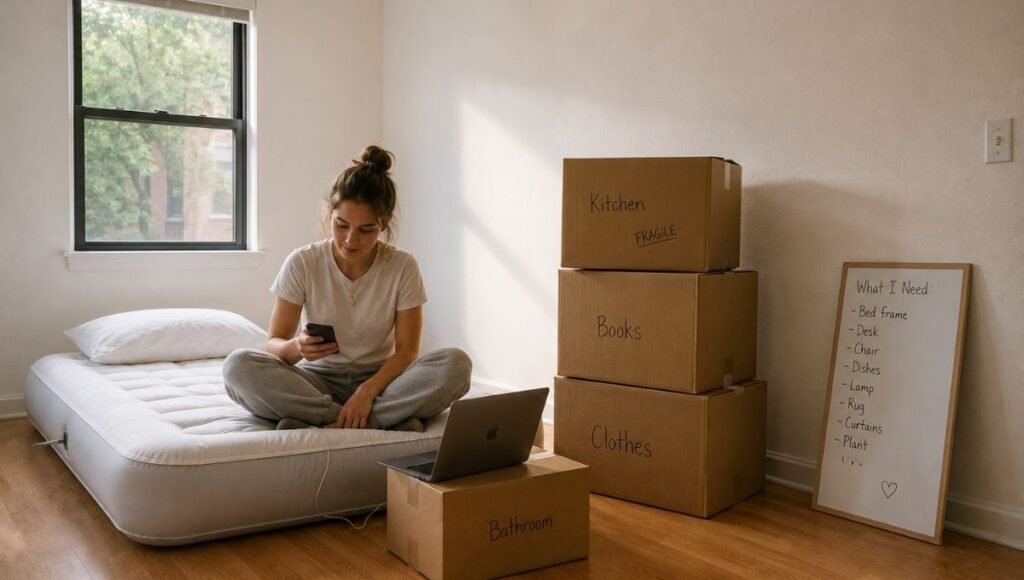
Here’s the problem: nobody moves into a first apartment with the budget and the time to execute a 127-item shopping list simultaneously. You move in with whatever fits in your car or a rented van, you sleep on an air mattress for two weeks while you figure out what you actually need, and then you buy things slowly — sometimes in the wrong order, sometimes the wrong thing entirely. Later, you have a sofa that didn’t fit through the stairwell, a dining table you eat at approximately four times a year, and three different types of mops because you bought one, it didn’t work, and you forgot you owned it when you bought the next one.
The question isn’t “what do you need for a first apartment.” The question is what do you need first, and in what order does the rest follow. That’s what this guide covers.
Key Takeaways
- Day 1 needs are shockingly few: Somewhere to sleep, a way to shower, a method of eating, and toilet paper — these are the actual move-in day requirements; everything else can wait at least 24 hours
- Measure before you buy anything larger than a nightstand: The most common and most expensive first apartment mistake is furniture that doesn’t fit through the door, up the stairs, or in the elevator — get your doorway clearance, stairwell width, and elevator dimensions before browsing sofas
- The “wait a month” rule saves real money: Research consistently shows that people who live in a new space for 30 days before completing their furniture purchases spend significantly less and end up more satisfied — your actual usage patterns are different from what you imagine before you move in
- Small apartments change the priority order: In a 400-square-foot studio, a platform bed with storage drawers eliminates the need for a dresser entirely; an ottoman coffee table eliminates the need for a coffee table and adds storage — two-function furniture decisions made early save significant money and floor space
- The Consumer Financial Protection Bureau recommends budgeting 3–6 months to fully furnish a new apartment: Treating this as a sprint rather than a marathon leads to purchasing the wrong things in the wrong order
The First Apartment Checklist, Organized by When You Actually Need It
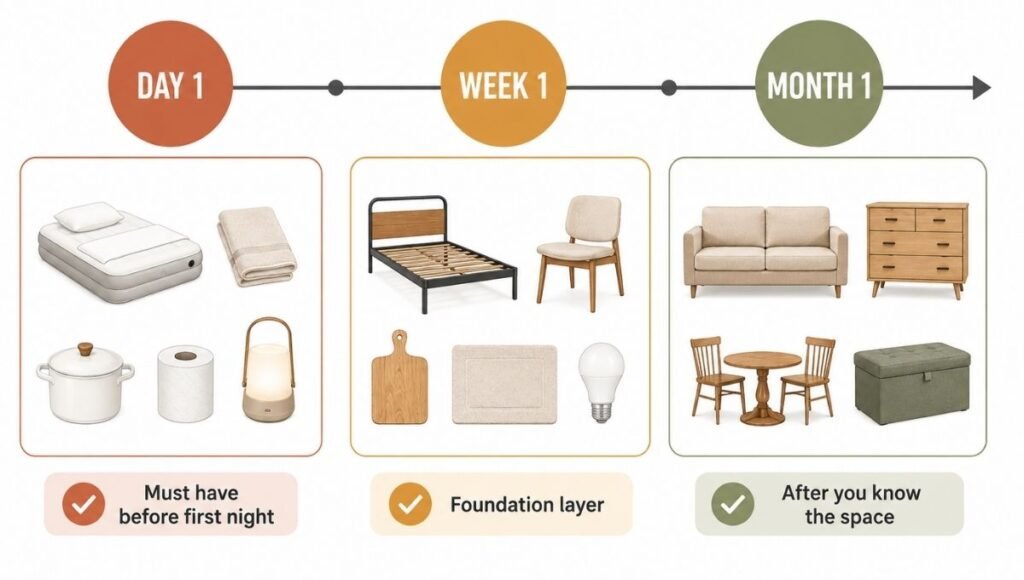
Day 1: What You Need Before You Sleep There the First Night
This is a much shorter list than any checklist website will tell you. You need:
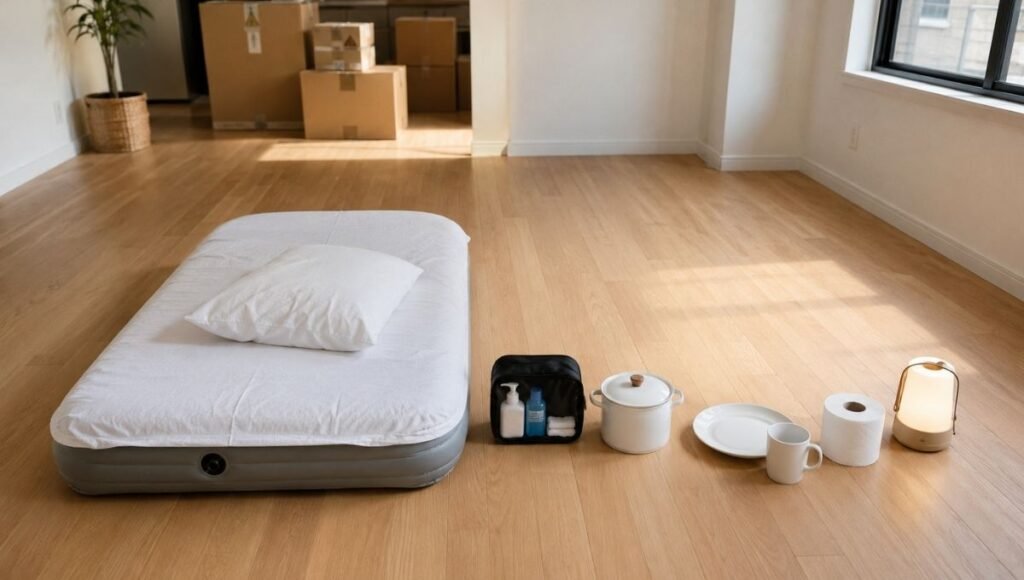
Sleeping: A mattress or air mattress on the floor. Nothing else. A bed frame is week 1 or week 2. Sheets and a pillow. These fit in a garbage bag.
Showering: Soap, shampoo, a towel, a shower curtain and liner if the bathroom doesn’t have one. A tension rod if the curtain needs one. This is everything.
Basic eating: One pot, one pan, one knife, one plate, one cup, fork and spoon. If you’re ordering in for the first few days, you don’t even need this. But if you’re cooking: a pot for boiling water handles pasta, oatmeal, eggs, and more single-handedly.
Toilet paper: This is the one thing people consistently forget to pack in the “open first” box. Don’t be that person.
Lighting: If your apartment doesn’t have overhead lighting in every room — many don’t — you need at least one lamp with a warm-white bulb before the first evening. Standing in a dark apartment with a phone flashlight at 10pm on move-in day is a specific kind of miserable.
Cleaning: One roll of paper towels, one all-purpose cleaner spray. The apartment should be cleaned before your furniture goes in, not after.
That’s it. If you have these things ready before the truck arrives, you can sleep there comfortably the first night. Everything else is a want, not a need, on day 1.
Week 1: The Foundation Layer
By the end of the first week, you want the essential infrastructure in place — the pieces that make daily life function rather than just survivable.
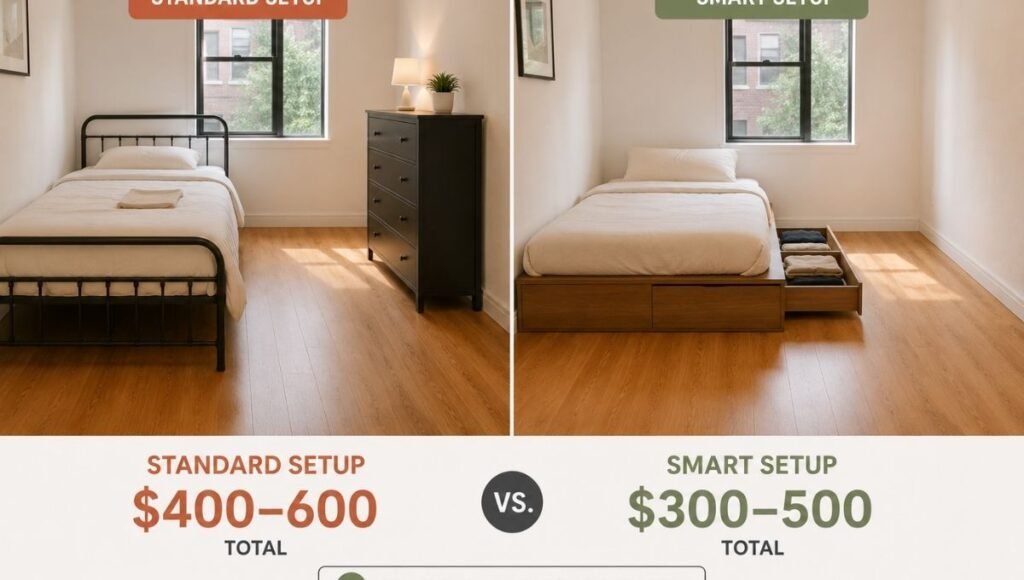
Bedroom: A bed frame (if you want one — many people keep the mattress on the floor for longer than they expected and find they don’t mind). The most important bedroom decision for a small apartment is choosing between a platform bed with storage drawers and a standard bed frame. A platform bed with built-in drawers holds approximately the same clothing as a 4-drawer dresser and costs less than buying both separately — this decision alone saves you from needing a dresser for months or possibly permanently. Our platform bed with drawers guide covers the drawer capacity math and what to look for in slide quality.
Living room: A place to sit. This does not have to be a sofa. Two chairs, a loveseat, a futon — anything you can sit on that isn’t the floor. The full sofa decision should wait until you’ve lived in the space for at least two weeks and know which wall it should go against, how much clearance you need, and whether you actually want a sofa or would be better served by two chairs and a coffee table. We’ve watched too many people order a sofa the week they move in and spend the next three years working around the wrong piece of furniture.
Kitchen: Add to your day-1 basics. A second pot or pan. A cutting board. Dish soap and a sponge. Some food storage containers. A colander if you’re cooking pasta regularly. A dish drying rack or towel. You don’t need a full kitchen set in week 1 — you need enough to cook real meals so you’re not ordering delivery every night.
Bathroom: A bath mat (cold floor, wet feet, slippery — this is a safety item, not a luxury). A second towel. Some basic toiletries organized into the available space.
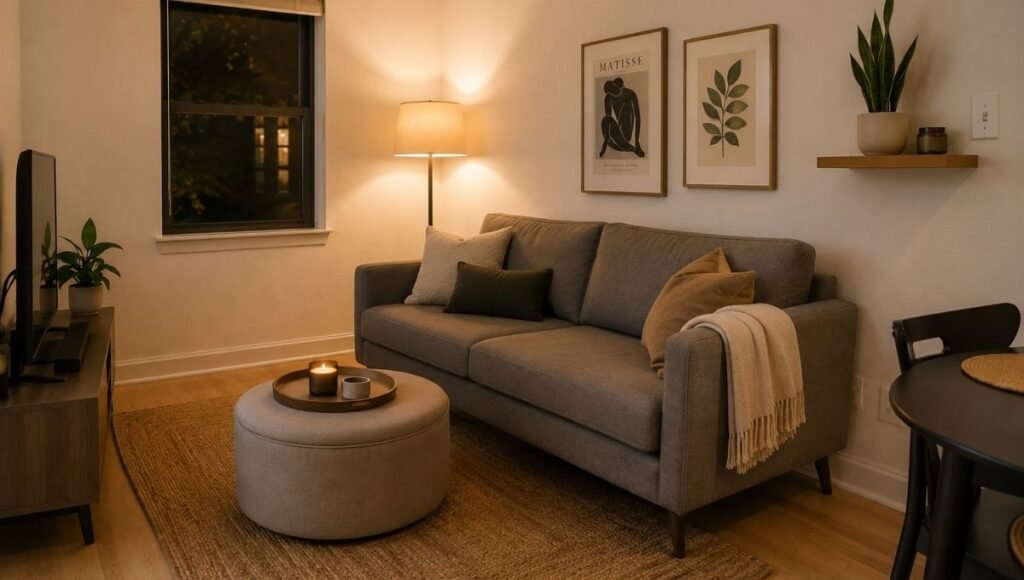
One thing that makes the whole apartment better immediately: A 2700K warm-white bulb in every light fixture. Cool-white or daylight bulbs make apartments feel clinical and temporary. Warm-white bulbs make the same apartment feel like a home. A 4-pack costs $10–15 and this is the best dollar-per-improvement investment available to you in week 1.
Month 1: Building Out the Space
By the end of the first month, you should have your full furniture picture in place. This is also when most people start to understand what they actually need versus what they thought they needed.
The furniture decisions that matter most in a small apartment:
Sofa: Now that you’ve been in the space for a few weeks, you know which wall makes sense, how much of the room you want it to take, and whether you need a sleeper option for guests. Measure the path from the front door to the sofa’s final position — doorway width, hallway width, stairwell width if applicable, elevator dimensions if you’re above ground floor. Our sofa for small living room guide covers the exact dimensions that work and the ones that don’t, with the delivery logistics math.
Storage: The storage problem in a first apartment usually becomes clear by week 2 or 3. Either the closet is insufficient, the kitchen lacks cabinet space, or the bathroom has no storage. Solutions vary by problem — see our small bedroom storage guide and living room storage ideas for specific options.
Dining situation: Genuinely assess how often you eat at a table. If the answer is “rarely,” a dining table takes up floor space you might not be able to spare. A kitchen island with bar stools, a fold-down wall table, or a drop-leaf table that collapses to near-nothing are real options for small apartments. Our space saving dining table guide covers six types and exactly which apartment situations they suit.
Coffee table or ottoman: In a small living room, a storage ottoman replaces the coffee table and adds a footrest, extra seating, and hidden storage from the same footprint. This is one of the highest-value single furniture decisions available in a small apartment. See our ottoman coffee table guide.
The Measurement List: Do This Before Buying Anything Large
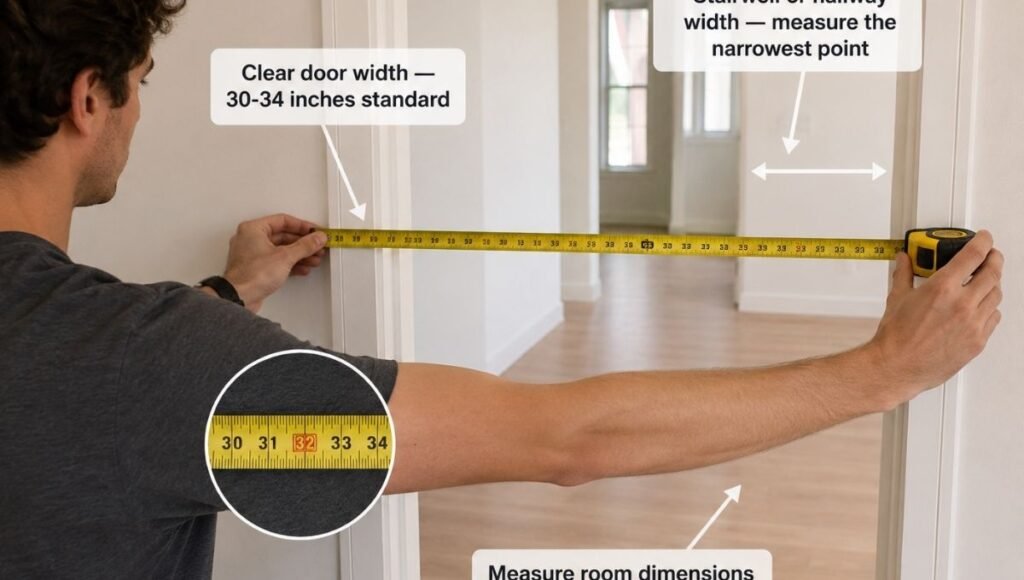
This is the step that separates first-time apartment renters from people who’ve done it before. Measure these things and write them down before browsing any furniture website.
Front door clear width: The inside measurement between door frames, not the door itself. Standard apartment doors: 30–34 inches. Any furniture wider than this in its smallest dimension requires disassembly or won’t enter the apartment.
Elevator interior dimensions (if applicable): Width, depth, and ceiling height. A sofa that fits through the front door may not fit in a small elevator cab.
Stairwell width and turn clearance (if no elevator): The landing between flights is usually the tightest point.
Your bedroom door clear width: Often narrower than the front door. A dresser that fits through the front door may not turn into the bedroom.
The actual room dimensions: Not the listing measurements — measure yourself with a tape measure. Listing measurements are often approximate and almost always exclude closets and architectural features. The dimensions that matter for furniture planning are the clear wall lengths (distance from corner to the first interruption) and the room width at the narrowest walking point.
Keep these measurements in your phone. Every significant furniture purchase should be checked against them before ordering.
First Apartment Essentials: The Complete List by Priority
Must Have Before First Night
- Mattress or air mattress
- Sheets and pillow
- Towel
- Shower curtain and liner (if needed)
- Soap, shampoo, basic toiletries
- One pot, one pan, one plate, one cup, fork/spoon/knife
- Toilet paper
- One lamp with warm-white 2700K bulb
- All-purpose cleaner and paper towels
Week 1 Priorities
- Bed frame or mattress foundation (optional — many people keep floor level temporarily)
- Temporary seating (chairs, loveseat, or futon)
- Additional kitchen basics (cutting board, colander, food storage)
- Bath mat
- Dish soap, sponge, dish rack
- Basic cleaning supplies (mop or Swiffer, vacuum or broom)
- Window coverings (blackout curtains for bedroom — sleep quality is affected immediately)
Month 1 Decisions (after you’ve lived in the space)
- Sofa (sized and placed correctly after you understand the room)
- Dresser or storage solution (only if bed doesn’t have drawers)
- Dining setup (if and as needed — assess before buying)
- Coffee table or storage ottoman
- Full kitchen setup
- Organizational systems for bathroom and closet
Wait Until Month 2+
- Decorative items (art, plants, throw pillows, rugs)
- Accent furniture (side tables, accent chairs)
- Anything “for when guests come” that you can borrow or manage without until needed
What to Buy for a First Apartment on a Tight Budget
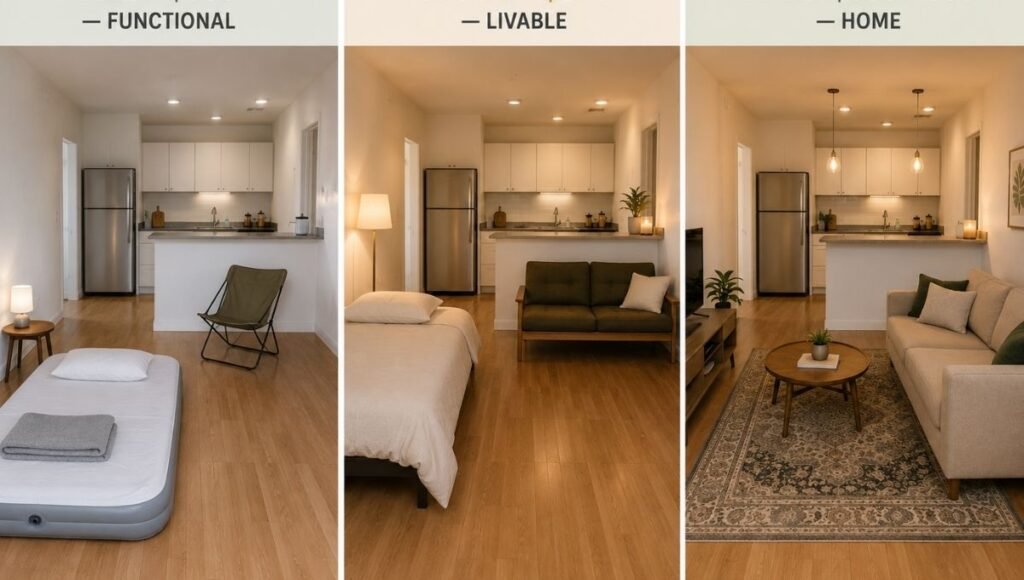
The question isn’t how to do everything at once — it’s how to prioritize so you’re comfortable on $500, then $500 more, then another $500 as budget allows.
$500 first: Mattress (the one thing you can’t compromise on) + sheets + shower curtain + basic kitchen + cleaning supplies. This gets you moved in and functional.
Second $500: Temporary seating + blackout curtains for the bedroom + warm-white bulbs for all fixtures + a lamp + bath mat. This makes the apartment livable rather than just survivable.
Third $500–$1,000: The sofa, sized and chosen after two weeks of knowing the space. This is the highest-leverage single piece of furniture in a small apartment — it’s worth waiting until you can do it right rather than buying quickly and being wrong for years.
After that: Fill in the gaps based on what you’ve actually noticed is missing, not based on a comprehensive checklist. The gaps you notice after living there for a month are real. The gaps the checklist tells you about in advance are often theoretical.
Apartment Must Haves That Most Lists Forget
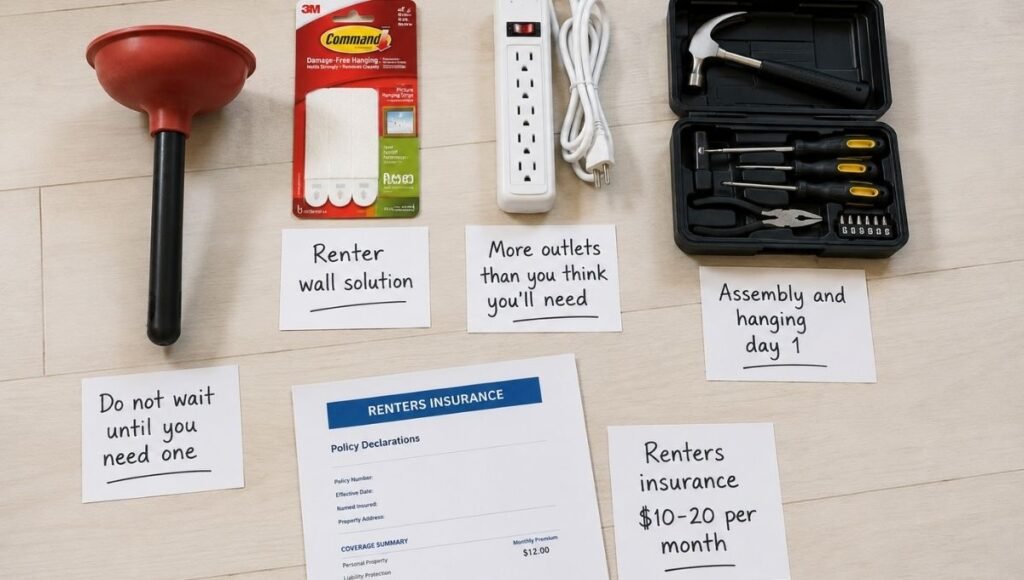
These are the items that don’t appear on standard checklists but appear on the “why didn’t anyone tell me” lists from Reddit threads on moving into first apartments.
A plunger: Do not wait until you need one to own one. Buy it when you buy the toilet paper.
Command strips (large): The renter’s solution for hanging anything on walls without damage. Buy before you need them so you have them when inspiration strikes at 11pm.
A power strip with surge protection: Modern apartments often have fewer outlets than you’d expect, and every outlet needs to be near a device.
Renter’s insurance: Technically not an item but consistently the most “I wish I’d done this from day one” thing in first-apartment retrospectives. Most policies cost $10–$20/month and cover theft, fire, and liability. Some landlords now require it.
A basic tool kit: Hammer, screwdriver set, measuring tape, level. You will need to assemble furniture, hang things, and tighten things that loosen within the first month. Borrowing tools works once; after that, own them.
A door stopper: For propping open the front door during move-in and for any door that swings closed when you’re carrying things. Inexpensive and immediately practical.
Blackout curtains for the bedroom: Not just curtains — blackout curtains. If you’re a renter and your bedroom window faces east, south, or a street lamp, the difference between blackout and non-blackout curtains is the difference between sleeping until your alarm and waking up at 6am every day. This is a first-week purchase, not a decorating decision.
What You Probably Don’t Need (Yet)
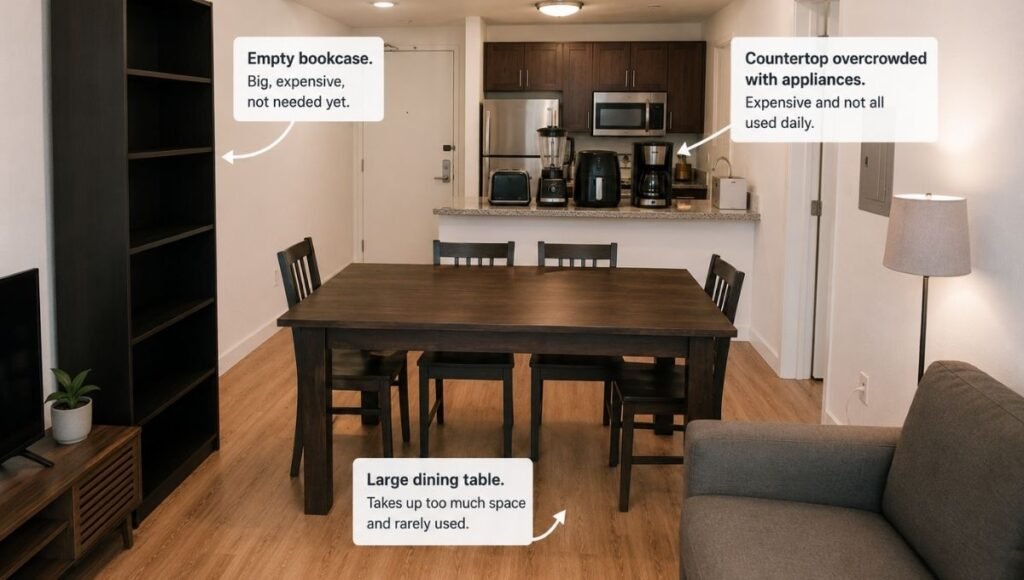
This is the list nobody writes. Everything on most first apartment checklists is technically useful — the question is whether you need it in the first 30 days, or whether you’re buying things in advance of needs you might not actually have.
A dining table (if you’re in a small apartment): Assess this at month 1. Many small apartment dwellers eat at the kitchen counter, the coffee table, or the sofa. A dining table that sees weekly use or less is significant floor space consumed for modest functional return.
A full dresser (if your bed has storage drawers): Platform beds with built-in drawers handle most of a single person’s clothing storage. Buying both is the most common floor space inefficiency in small bedrooms.
A bookcase (before you have books in the apartment): Many people buy bookcases before they unpack and discover their books fit on two floating shelves. See what you actually have before buying furniture to hold it.
A kitchen appliance collection: You probably need a coffee maker (or not — french press takes up less space), a toaster or toaster oven, and a microwave if not provided. You probably don’t need an InstaPot, a blender, an air fryer, and a waffle maker simultaneously in month 1 of a small apartment with minimal counter space.
Decorative items: These should come last. The temptation to buy art, plants, throw pillows, and decorative vases immediately is strong. The problem is you don’t know what your space actually needs to look finished until you’ve lived in it furnished with the essentials for a few weeks. Money spent on decoration in week 1 is often money spent on the wrong things.
Room-by-Room Links: Go Deeper on Each Decision
Once your priority sequence is in place, each room has specific decisions that benefit from more detailed guidance:
Living Room
- Small Living Room Layout: 6 Arrangement Formulas
- Sofa for Small Living Room: Size Rules Before You Shop
- Ottoman Coffee Table: The Four-Job Piece
- Living Room Storage Ideas
Bedroom
- Small Bedroom Layout: 5 Arrangement Formulas
- Platform Bed with Drawers: Does It Replace a Dresser?
- Small Bedroom Storage Ideas
- Small Bedside Table: The Right Option for Every Gap
Full Apartment
- Small Apartment Furniture: The Complete Guide
- How to Organize a Small Apartment
- Studio Apartment Layout Ideas
FAQ: First Apartment Checklist
What should I buy first for my first apartment? In priority order: (1) a mattress or air mattress — sleep is non-negotiable; (2) sheets, pillow, and towel; (3) basic kitchen (one pot, one pan, one plate, one cup); (4) shower curtain and toiletries; (5) toilet paper. Everything else can wait 24–48 hours. The most important first-day purchase many people forget: warm-white light bulbs (2700K). Cool-white apartment lighting makes any space feel like temporary housing.
How much does it cost to furnish a first apartment? The Consumer Financial Protection Bureau notes that fully furnishing an apartment is typically a 3–6 month process, not a single purchase event. A functional-but-minimal setup (mattress, basic kitchen, temporary seating) can be achieved for under $1,000. A complete furnished apartment with sofa, bed frame, dresser, and dining setup typically runs $3,000–$6,000 depending on quality and whether anything is purchased used. The common mistake is trying to do all of this in week 1.
What furniture do you need for a first apartment? The true essentials in priority order: bed (mattress first, frame second), seating (sofa or chairs — one or the other, not both immediately), some form of storage (dresser or platform bed with drawers), and a place to eat if you actually eat at a table. Everything else is supplemental. In a small apartment, every piece should do more than one job — a storage ottoman instead of a coffee table, a platform bed with drawers instead of a separate dresser.
How do I furnish a first apartment on a budget? Buy the mattress new (sleep quality is worth this investment). Buy everything else used if the price difference is significant — Facebook Marketplace, Craigslist, and local consignment shops reliably have functional furniture for 30–60% of retail price. Buy in stages over 3 months rather than all at once. Live in the space for 2 weeks before making major furniture decisions — your actual needs will differ from what you expect before moving in.
What apartment essentials do most people forget? The consistently forgotten items: plunger (needed urgently and immediately when needed), renter’s insurance (the most commonly wished-for item in retrospect), blackout curtains for the bedroom (affects sleep quality from night one), Command strips for renter-friendly wall hanging, and a power strip with surge protection. None of these appear prominently on standard checklists.
The Bottom Line
The first apartment checklist isn’t a shopping list to complete before you move in. It’s a sequence — what you need before the first night, what you need by end of week one, and what deserves the time and thought of living in the space before deciding.
The three decisions that have the most lasting impact in a small apartment: the bed (get storage drawers — this changes your storage equation entirely), the sofa (size it correctly for the room, wait until you know the room), and the lighting (warm-white bulbs, immediately, everywhere).
Everything else follows.
References
- Consumer Financial Protection Bureau (CFPB): Renting Guide — recommended budgeting timeline for furnishing a new apartment (3–6 months); tenant rights and move-in inspection documentation guidelines
- U.S. Department of Housing and Urban Development (HUD): Rental assistance resources and tenant rights overview for first-time renters
- American Academy of Sleep Medicine (AASM): Sleep environment guidelines — bedroom blackout conditions and their effect on sleep quality, including light exposure during sleep onset
Published on Grainv.com | Category: Apartment Layout | Related: Small Apartment Furniture, How to Organize a Small Apartment, Studio Apartment Layout, Small Living Room Layout